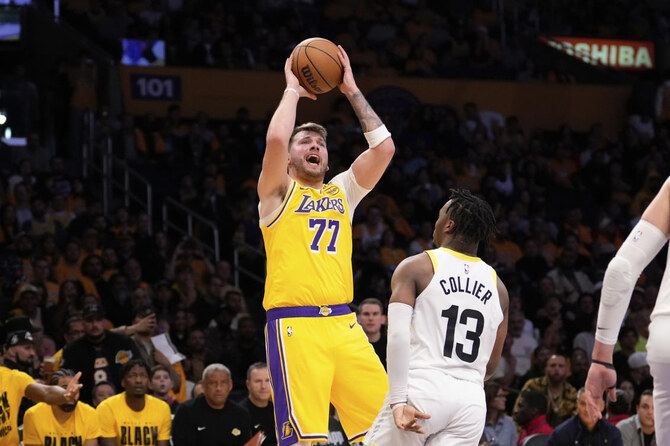
LOS ANGELES: Luka Doncic scored 11 points in the first half of his debut with the Los Angeles Lakers on Monday night, joining their starting lineup alongside LeBron James and immediately getting into the flow.
Doncic got multiple standing ovations from a Los Angeles crowd wearing thousands of gold T-shirts with his name and No. 77 while the Lakers streaked out to a 25-point halftime lead on the Utah Jazz.
The Slovenian superstar’s first bucket was a 3-pointer in the opening minutes on his second shot for the Lakers. Doncic added three rebounds and three assists – none prettier than a three-quarter-court strike to James for a layup late in the first half.
The game was Doncic’s first in nearly seven weeks since he strained his left calf on Christmas with the Mavericks, who shocked the sports world by trading their 25-year-old centerpiece and NBA scoring champion. The grateful Lakers gave up Anthony Davis and Max Christie.
After a full week to settle in and to return to full strength, Doncic joined James, Austin Reaves, Rui Hachimura and Jaxson Hayes as starters for the streaking Lakers, who had won five straight and 11 of 13 even before adding a five-time All-NBA selection to their lineup.
Coach JJ Redick, who played alongside Doncic for 13 games in 2021 with the Dallas Mavericks, was eager to see what Doncic would do in his much-hyped debut with his new team.
“Excitement level is high,” Redick said. “I don’t think anything in our approach or game plan for Utah changes. It is always a challenge in-season to integrate, and we have to be able to give each other patience for that.”
Doncic didn’t disappoint: His first touch was an alley-oop assist to Hayes, and he hit his 3-pointer moments later. He was serenaded with “Luka! Luka!” chants at the first dead ball, and several times thereafter.
That crowd included Dirk Nowitzki, who overlapped with Doncic for one season in Dallas and served as his mentor. Doncic appeared to be the natural heir to the German Hall of Famer’s incredible run in Dallas – until current Mavericks general manager Nico Harrison decided otherwise.
Doncic played the first 6:56 before checking out alongside James – likely a coincidence due to Doncic’s minutes restriction while he returns to full strength. The Lakers are expected to have one of their superstars on the floor at nearly all times when Doncic is up to speed.
“Feel like it’s best right now to ease Luka back in to playing NBA action,” Redick said. “I think if it was up to Luka, he would probably play 48 minutes, but we’re thinking long-term and we want to be safe.”
Doncic returned with about eight minutes left in the first half, and he helped the Lakers on their way to a big lead with several key plays.
Everybody received a Doncic T-shirt to mark the occasion at the Lakers’ downtown arena – including James, who warmed up before the game in the gold No. 77 shirt.
Doncic was followed by dozens of cameras as he warmed up for about 10 minutes before the game, and the Lakers’ arena played the Serbian music he favors for pregame workouts. The Lakers introduced him last before the game, giving him the spot normally reserved for James, which led to another standing ovation.
James returned from a one-game injury absence Monday when the Lakers began a home-and-home set with the Jazz heading into the All-Star break.
“I don’t think any of us know exactly what it’ll look like,” Utah coach Will Hardy said. “I assume it’ll look good. (Doncic and James) are two of the best thinkers, problem-solvers that we’ve ever seen. So yeah, I think preparing for it is a little weird. ... But I don’t see any world where those two playing together isn’t a good thing. Like I said, their processing speed mentally is incredible, and so I’m sure they’ll figure it out.”
Doncic has watched three straight Lakers victories from their bench since arriving in Los Angeles a week ago. Reaves scored a career-high 45 points to lead the Lakers past Indiana 124-117 on Saturday without Doncic or James, who sat out to rest his sore ankle.
Doncic began Monday by donating $500,000 to fire recovery efforts in his new community, making an immediate impression with his pledge to help with the damage caused by the rampant wildfires that devastated parts of Southern California last month – including Pacific Palisades, where Redick’s home was lost.
“It’s been so sad to see and learn more about the damage from the wildfires as I landed in LA,” Doncic wrote on his Luka Doncic Foundation’s social media channels. “I can’t believe it, and I feel for all the kids who lost their homes, schools and the places where they used to play with their friends. Today, my foundation is donating $500,000 to immediate recovery efforts. I am also committed to helping rebuild courts, playgrounds and fields that were destroyed, because every kid needs a safe place to play.
“To everyone affected by these fires: we’re here to help, now and for the long haul.”
Doncic signed his note: “Your new neighbor.”
Doncic’s initial donation is being made to the Community Foundation Wildfire Recovery Fund. He also plans to donate “significant additional funding over the next two years” with a focus on rebuilding children’s play spaces, according to a spokesperson.


![]()

Luka Doncic makes his Lakers debut with win against Jazz
Short Url
https://arab.news/wunxs
Luka Doncic makes his Lakers debut with win against Jazz
- Luka Doncic got multiple standing ovations the from Los Angeles crowd wearing T-shirts with his name and No. 77
- The Slovenian superstar’s first bucket was a 3-pointer in the opening minutes on his second shot for the Lakers

Latest updates


Recommended


© 2026 SAUDI RESEARCH & PUBLISHING COMPANY, All Rights Reserved And subject to Terms of Use Agreement.