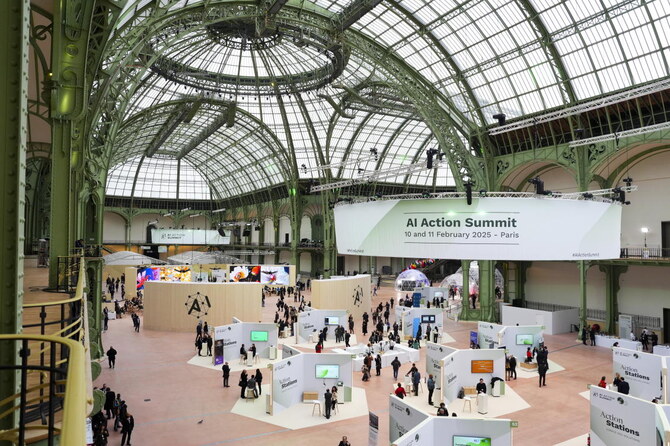
PARIS: France hopes that world leaders and tech executives at an artificial intelligence summit in Paris will agree the AI revolution should be inclusive and sustainable, although it was unclear on Monday whether the United States would be supportive.
Eagerness to rein in AI has waned since previous summits in Britain and South Korea that focused world powers’ attention on the technology’s risks after ChatGPT’s viral launch in 2022.
As US President Donald Trump has torn up his predecessor’s AI guardrails to promote US competitiveness, pressure has built on the European Union to pursue a lighter-touch approach to AI to help keep European companies in the tech race.
A January 30 version of the non-binding draft statement on AI stewardship, a copy of which was seen by Reuters, called for an “inclusive approach” to AI that is multi-stakeholder, human rights-based and bolsters the developing world.
The draft statement laid out priorities that included “avoiding market concentration” and “making AI sustainable for people and the planet.”
US Vice President JD Vance could spell out the United States’ views when he gives a speech at the summit on Tuesday.
Trump’s early moves on AI have underscored how far the strategies to regulate AI in the United States, China and EU have diverged.
And many at the two-day summit that started on Monday pushed the EU to soften its own rulebook.
“If we want growth, jobs and progress, we must allow innovators to innovate, builders to build and developers to develop,” OpenAI CEO Sam Altman said in an op-ed in Le Monde newspaper.
Even the summit’s host, French President Emmanuel Macron said: “There’s a risk some decide to have no rules and that’s dangerous. But there’s also the opposite risk, if Europe gives itself too many rules.”
“We should not be afraid of innovation,” Macron told regional French newspapers.
European lawmakers last year approved the bloc’s AI Act, the world’s first comprehensive set of rules governing the technology.
China’s DeepSeek challenged the United States’ AI leadership last month by freely distributing a human-like reasoning system, galvanizing geopolitical and industry rivals to race faster still.
More investment
Meanwhile, one early outcome from the summit was the launch of Current AI, a partnership of countries such as France and Germany and industry players including Google and Salesforce.
With an initial $400 million in investment, the partnership will spearhead public-interest projects such as making high-quality data for AI available and investing in open-source tools. It is aiming for up to $2.5 billion in capital over five years.
Current AI founder Martin Tisné told Reuters a public-interest focus was necessary to avoid AI having downsides like social media has had. “We have to have learned the lessons,” he said.
Separately, France will announce private sector investments totaling some 109 billion euros ($113 billion) during the summit, Macron said on Sunday.
“The size of this 100 billion euro investment reassured us, in a way, that there’s going to be ambitious enough projects in France,” said Clem Delangue, the CEO of Hugging Face, a US company with French co-founders that is a hub for open-source AI online.
Risks
Not everyone in Paris agreed with taking a lighter-touch approach to AI regulation.
“What I worry about is that... there will be pressures from the US and elsewhere to weaken the EU’s AI Act and weaken those existing protections,” said Brian Chen, policy director at Data & Society, a US-based nonprofit.
Labour leaders expressed concerns on the impact of AI on workers, including what happens to workers whose jobs are taken over by AI and are pushed into new jobs.
“There is a risk of those jobs being much less paid and sometimes with much less protection,” said Gilbert F. Houngbo, director-general of the International Labour Organization.
Top political leaders including China’s Vice Premier Zhang Guoqing are also attending the summit, as well as top executives such as Alphabet CEO Sundar Pichai and OpenAI’s Altman.


![]()

Paris AI summit pits innovation ambitions against job loss fears
Short Url
https://arab.news/4ts27
Paris AI summit pits innovation ambitions against job loss fears
- “We should not be afraid of innovation,” Macron told regional French newspapers
- China’s DeepSeek challenged the United States’ AI leadership last month by freely distributing a human-like reasoning system

Latest updates


Recommended


© 2026 SAUDI RESEARCH & PUBLISHING COMPANY, All Rights Reserved And subject to Terms of Use Agreement.