WASHINGTON: Instances of hate speech against minorities in India such as Muslims increased 74 percent in 2024, a Washington-based research group said on Monday, with incidents ballooning around last year’s national elections.
India Hate Lab documented 1,165 instances of what it considered to be hate speech in 2024, compared with 668 a year earlier, that it observed at events such as political rallies, religious processions, protest marches and cultural gatherings.
“The fact that 2024 was a general election year in India, with polling held in seven phases between April 19 and June 1, played a crucial role in shaping the patterns of hate speech incidents compared to 2023,” the group said in a report.
India’s embassy in Washington had no immediate comment.
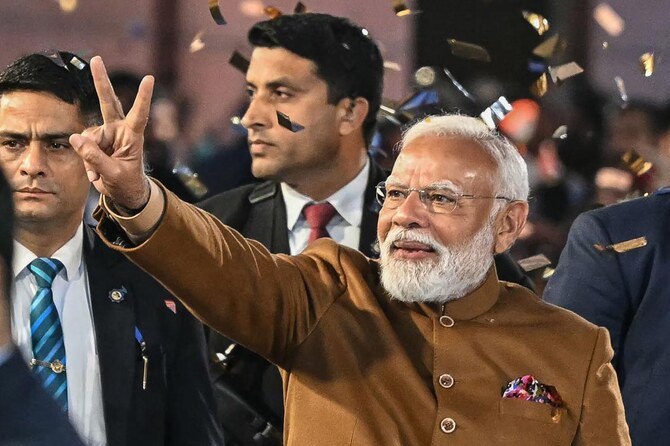
The report comes days before a White House meeting between US President Donald Trump and India’s Hindu nationalist Prime Minister Narendra Modi, whose government is blamed by rights groups including Human Rights Watch and Amnesty International for the mistreatment of minorities in India.
Modi’s government and party have denied being discriminatory and said their policies, such as food subsidy schemes and electrification drives, benefit all Indians.
India Hate Lab said a third of hate speech incidents last year occurred from March 16 through June 1 during the height of election campaigning, with May being a “notable peak.”
The group cited remarks by Modi in April in which he referred to Muslims as “infiltrators” who have “more children.”
Modi won a third successive term and denied stoking divisions. His Bharatiya Janata Party failed to win a majority and relied on coalition allies to form a government.
India Hate Lab said 80 percent of hate speech incidents last year occurred in states governed by the BJP and its allies.
The group, founded by US-based Kashmiri journalist Raqib Hameed Naik, is a project of the Center for the Study of Organized Hate, a nonprofit think tank based in Washington. The BJP has said the group presents a biased picture of India.
Rights advocates, in noting the plight of Indian minorities, point to a 2019 citizenship law the UN called “fundamentally discriminatory,” anti-conversion legislation that challenges the constitutionally protected right to freedom of belief, and the 2019 revoking of Muslim majority Kashmir’s special status.
They also highlight the demolition of properties owned by Muslims that authorities said were illegally constructed, and a ban on the hijab head covering — commonly worn by Muslim girls and women — in classrooms in Karnataka in line with new school uniform rules when the BJP was in power in that state.
India Hate Lab said it used in its report the United Nations’ definition of hate speech: prejudiced or discriminatory language toward an individual or group based on attributes including religion, ethnicity, nationality, race or gender.


Anti-minority hate speech in India rose by 74% in 2024, research group says
https://arab.news/cfrtx
Anti-minority hate speech in India rose by 74% in 2024, research group says

- India Hate Lab said a third of hate speech incidents last year occurred from March 16 through June 1 during the height of election campaigning
- Group cited remarks by Modi in April in which he referred to Muslims as “infiltrators” who have “more children”


Geoeconomic confrontation tops global risks in 2026: WEF report
- Also armed conflict, extreme climate, public polarization, AI
- None ‘a foregone conclusion,’ says WEF’s MD Saadia Zahidi
DUBAI: Geoeconomic confrontation has emerged as the top global risk this year, followed by state-based armed conflict, according to a new World Economic Forum report.
The Global Risks Report 2026, released on Wednesday, found that both risks climbed eight places year-on-year, underscoring a sharp deterioration in the global outlook amid increased international competition.
The top five risks are geoeconomic confrontation (18 percent of respondents), state-based armed conflict (14 percent), extreme weather events (8 percent), societal polarization (7 percent) and misinformation and disinformation (7 percent).
The WEF’s Managing Director Saadia Zahidi said the report “offers an early warning system as the age of competition compounds global risks — from geoeconomic confrontation to unchecked technology to rising debt — and changes our collective capacity to address them.
“But none of these risks are a foregone conclusion.”

The report assesses risks across three timeframes: immediate (2026); short-to-medium term (next two years); and long term (next 10 years).
Economic risks show the largest overall increase in the two-year outlook, with both economic downturn and inflation jumping eight positions.
Misinformation and disinformation rank fifth this year but rise to second place in the two-year outlook and fourth over the 10-year horizon.
The report suggests this reflects growing anxiety around the rapid adoption of artificial intelligence, with adverse outcomes linked to AI surging from 30th place in the two-year timeframe to fifth in the 10-year outlook.
Uncertainty dominates the global risk outlook, according to the report.
Surveyed leaders and experts view both the short- and long-term outlook negatively, with 50 percent expecting a turbulent or stormy global environment over the next two years, rising to 57 percent over the next decade.
A further 40 percent and 32 percent, respectively, describe the outlook as unsettled across the two- and 10-year timeframes, while just 1 percent anticipate a calm global outlook in either period.
Environmental risks ease slightly in the short-term rankings. Extreme weather fell from second to fourth place and pollution from sixth to ninth. Meanwhile, critical changes to Earth systems and biodiversity loss dropped seven and five positions, respectively.
However, over the next decade, environmental threats re-emerge as the most severe, with extreme weather, biodiversity loss, and critical changes to Earth systems topping the global risk rankings.

Looking ahead over the next decade, around 75 percent of respondents anticipate a turbulent or stormy environmental outlook, making it the most pessimistic assessment across all risk categories.
Zahidi said that “the challenges highlighted in the report underscore both the scale of the potential perils we face and our shared responsibility to shape what comes next.”
Despite the gloomy outlook, Zahidi signaled a positive shift in global cooperation.
“It is also clear that new forms of global cooperation are already unfolding even amid competition, and the global economy is demonstrating resilience in the face of uncertainty.”
Now in its 21st year, the Global Risks Report highlights a core message: global risks cannot be managed without cooperation.
As competition intensifies, rebuilding trust and new forms of collaboration will be critical, with the report stressing that today’s decisions will shape future outcomes.
The report was released ahead of WEF’s annual meeting, which will be held in Davos from Jan. 19 to 23.


