ISLAMABAD: The Judicial Commission of Pakistan (JCP), which appoints judges in the superior judiciary, on Monday nominated six high court judges for elevation to the Supreme Court, amid a protest by lawyer bodies in the federal capital of Islamabad.
The announcement of the nomination of judges came from the Supreme Court in a statement, days after four top court judges wrote to Chief Justice Yahya Afridi, who heads the JCP, to postpone Monday’s meeting of the commission and not decide on new judicial appointments until a challenge to the 26th constitutional amendment was decided.
Pakistan’s ruling coalition government passed the contentious amendment in October last year, amid resistance from opposition parties and lawyer bodies. The amendments empowered a parliamentary committee to appoint the Supreme Court’s chief justice for a fixed term of three years, and called for the creation of new group of senior judges to weigh exclusively on constitutional issues.
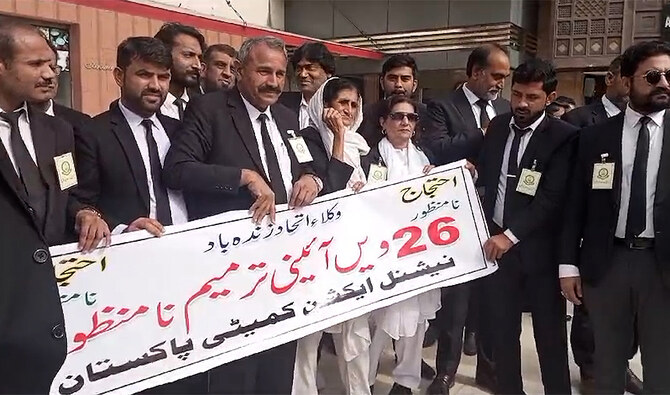
The government says the amendments are aimed at providing speedy justice to citizens and it is parliament’s right to pass laws it deems fit to ensure its sovereignty, but lawyer bodies protesting in Islamabad said the changes are aimed at undermining the judiciary’s independence.
“The commission, by majority of its total membership, nominated the following Hon’ble’ Judges for their appointment as Judges of the Supreme Court of Pakistan,” the top court said in a statement, naming Justice Muhammad Hashim Khan Kakar, Justice Muhammad Shafi Siddiqui, Justice Salahuddin Panhwar, Justice Shakeel Ahmad, Justice Aamer Farooq and Justice Ishtiaq Ibrahim.
“The Commission also by majority of its total membership nominated Mr. Justice Miangul Hassan Aurangzeb Judge, Islamabad High Court for appointment as the Acting Judge of the Supreme Court of Pakistan.”
Meanwhile, lawyers gathered at various locations in Islamabad, leading to the blockade of multiple roads. The also protested President Asif Ali Zardari’s recent move to transfer three judges from the Sindh, Balochistan and Lahore high courts to the Islamabad High Court (IHC), alleging that it was “unconstitutional” as it undermined the seniority of the judges already serving in the IHC.
Footage shared online showed lawyers chanting slogans against the government and demanding independence of the judiciary. Local media reported deployment of heavy police contingent within the Supreme Court’s premises while entry points to the Red Zone, which houses the highest executive, judicial and legislative authority buildings of the country, were sealed to keep the protesters at bay.
“Our job is very clear and it is that we have to participate in this [protest] and present our stance,” Barrister Ali Zafar, a prominent lawyer, told reporters near Islamabad’s Red Zone area.
Zafar acknowledged that some lawyers were in favor of the judicial transfers and the constitutional amendments, acknowledging that a “division” existed among them.
“There is definitely a division among lawyers, some are on this side and some are on that side,” he said. “But you will see that this movement will keep on growing.”
The Islamabad police, however, assured residents it would ensure their safety despite the protests.
“Islamabad Police is actively working to ensure your safety and to ensure the establishment of law and order throughout the district,” they wrote on X.


![]()

Pakistan names six high court judges for elevation to top court amid lawyers’ protest
Short Url
https://arab.news/pwunu
Pakistan names six high court judges for elevation to top court amid lawyers’ protest
- Announcement came days after four top court judges sought to postpone nominations until a challenge to 26th constitutional amendment was decided
- The government says the amendment is aimed at providing speedy justice, but lawyers protesting in Islamabad say it will undermine the judiciary
Latest updates


© 2026 SAUDI RESEARCH & PUBLISHING COMPANY, All Rights Reserved And subject to Terms of Use Agreement.