

Germany’s Scholz describes Trump’s Gaza proposal as a ‘scandal’ in election debate

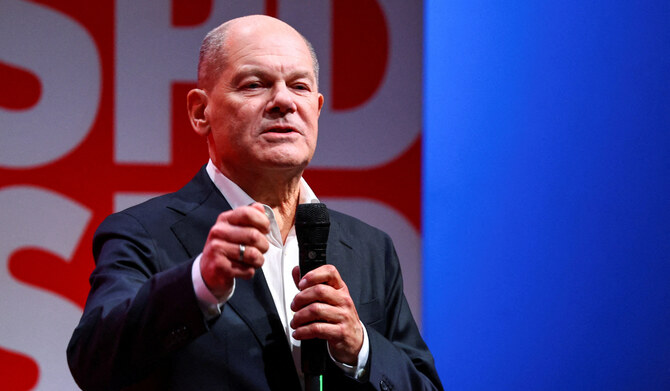
German Chancellor Olaf Scholz speaks as he campaigns for the 2025 general election, in Leipzig, Germany, February 8, 2025. (REUTERS)
Short Url
Updated 10 February 2025
Follow

Germany’s Scholz describes Trump’s Gaza proposal as a ‘scandal’ in election debate

  • “The relocation of populations is unacceptable and against international law,” he added in the debate on ARD and ZDF public television

BERLIN: German Chancellor Olaf Scholz described President Donald Trump’s suggestion that the US could take ownership of the Gaza Strip, relocate its population and redevelop it as a “scandal” in a pre-election debate Sunday. His main challenger also voiced unease but suggested there’s “a lot of rhetoric” coming from Washington.
The center-left Scholz and center-right challenger Friedrich Merz, the front-runner in the Feb. 23 election, discussed top domestic issues such as Germany’s struggling economy and migration, and also addressed foreign policy three weeks into Trump’s new term.
Asked what he made of Trump’s proposal to redevelop Gaza into “the Riviera of the Middle East,” Scholz replied: “A scandal. Besides that, a really terrible expression,” given the extent of the destruction that is now visible there.
“The relocation of populations is unacceptable and against international law,” he added in the debate on ARD and ZDF public television. He pointed to the position of Egypt and Jordan.
“I share this assessment,” Merz said. “But it is one of a whole series of proposals coming from the American administration that are certainly disconcerting, but one has to wait and see what is really meant seriously and how it is implemented — there’s probably a lot of rhetoric in this.”
The two candidates differed in their assessment of a Trump order directing the federal government to recognize only two sexes — male and female. Merz said it “is a decision I can understand.”
“I think it’s inappropriate,” Scholz said. “Every person should be happy the way they want to be happy.”
Merz said the new US president is “predictably unpredictable.” He said that “there are significant concerns on this side of the Atlantic about what else is coming; so it’s all the more important that we on this side of the Atlantic are as united as possible.”
He said that, if elected, he would put a great deal of effort into ensuring such European unity.
Scholz said that his strategy for dealing with Trump is “clear words and friendly conversations.” He pointed to his public statements after Trump said he wouldn’t rule out the use of military force to take control of the Panama Canal and Greenland that all countries must respect existing borders.
He also pointed to the importance of European unity and said he and other countries are working on proposals to increase NATO’s presence in Greenland.
Asked about a response to possible US tariffs against the EU, Scholz said: “We are prepared ... We can act in an hour as the European Union.”


Rubio meets Caribbean leaders as US raises pressure on Cuba

Updated 3 sec ago
Follow

Rubio meets Caribbean leaders as US raises pressure on Cuba

Basseterre: US Secretary of State Marco Rubio will seek to address Caribbean leaders' concerns about Cuba at a summit on Wednesday, as Washington ramps up pressure on the communist island fresh after removing Venezuela's president.
Rubio, a Cuban-American who has spent his political career hoping to topple Havana's government, is also looking for sustained cooperation on Venezuela and troubled Haiti as he takes part in the summit of the Caribbean Community, or CARICOM, which does not include Cuba.
After attending President Donald Trump's State of the Union address to Congress, Rubio flew overnight to join the summit in Saint Kitts and Nevis, a sun-kissed former British colony of fewer than 50,000 people.
Rubio became the highest-ranking US official ever to visit the tiny country, the birthplace of one of the United States' founding fathers, Alexander Hamilton.
Trump has reoriented foreign policy toward the Western Hemisphere through his "Donroe Doctrine" in which he has vowed unrepentant intervention to advance US interests.
After US forces snatched Venezuela's leftist leader Nicolas Maduro in a January 3 raid, the Latin American country has been forced to cut off its crucial oil shipments to Cuba.
This has plunged Cuba into a further economic morass with fuel shortages and rolling blackouts.
Speaking at the opening of the CARICOM summit on Tuesday, Jamaican Prime Minister Andrew Holness warned that a further deterioration in Cuba will impact stability across the Caribbean and trigger migration -- the top political concern for Trump.
"Humanitarian suffering serves no one," Holness said. "A prolonged crisis in Cuba will not remain confined to Cuba."
Plea for 'stability' 
Holness said that Jamaica believed in democracy and free markets -- a rebuke to the communist system in Havana -- but called for "humanitarian relief" for Cubans.
"Jamaica supports constructive dialogue between Cuba and the United States aimed at de-escalation, reform and stability," he said.
"We believe there is space, perhaps more space now than in years past, for pragmatic engagement."
The summit's host, Saint Kitts and Nevis Prime Minister Terrance Drew, also called for humanitarian backing to Cuba, saying: "A destabilized Cuba will destabilize all of us."
A medical doctor, Drew studied for seven years in Cuba and said friends there have told him of food scarcity, power outages and garbage strewn in the streets.
"I can only feel the pain of those who treated me so well when I was a student," he said.
The United States has imposed sanctions on Cuba almost continuously since Fidel Castro's 1959 revolution.
Since becoming the top US diplomat, Rubio has publicly toned down calls for regime change, and Washington has quietly held discussions with Havana.
Trump and Rubio have threatened sanctions against countries that sell oil to Cuba but stopped short of enacting some measures pushed by Cuban-American hardline critics of Havana, such as prohibiting the transfer of remittances.

'Elephant in the room' 
Kamla Persad-Bissessar, the prime minister of Trinidad and Tobago, said she empathized with the Cuban people but took issue with her Jamaican counterpart's remarks.
"We cannot advocate for others to live under communism and dictatorship," she said.
She also criticized CARICOM countries for their reticence, at least publicly, to back what she called the "elephant in the room" -- US intervention in Venezuela.
Trinidad and Tobago, whose coast is visible from Venezuela, gave access to the US military in the run-up to the operation that removed Maduro.
The deposed Venezuelan leader faces US charges of narco-trafficking, which he denies.
Persad-Bissessar thanked Trump, Rubio "and the US military... for standing firm against narco-trafficking, human and arms smuggling."
The Trump administration has been carrying out deadly strikes against alleged drug boats in the Caribbean, drawing criticism by those who say the attacks are legally and ethically dubious.
The Trinidadian prime minister praised the US approach and credited it with bringing down her country's homicide rate by helping cut the flow of firearms from Venezuela.