

Baltic states switch to European power grid, ending Russia ties

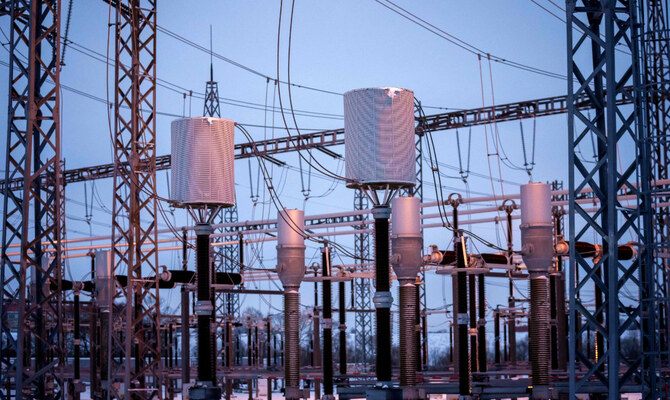
A photo taken on February 8, 2025 shows the power substation in Rezekne, Latvia before the disconnection of the major power line between Latvia and Russia. The three Baltic states on February 8 cut ties with Russia's power grid to join the European Union's network, the culmination of a years-long process that gained urgency with Moscow's invasion of Ukraine. (AFP)
Short Url
Updated 10 February 2025
Follow

Baltic states switch to European power grid, ending Russia ties

  • It is designed to integrate the three Baltic nations more closely with the European Union and to boost the region’s energy security

VILNIUS: The Baltic states of Estonia, Latvia and Lithuania completed a switch from Russia’s electricity grid to the EU’s system on Sunday, severing Soviet-era ties amid heightened security after the suspected sabotage of several subsea cables and pipelines.
European Commission President Ursula von der Leyen hailed the move, years in the planning, as marking a new era of freedom for the region, in a speech at a ceremony in Vilnius alongside the leaders of the three countries and the Polish president.
“These chains of power lines linking you to hostile neighbors will be a thing of the past,” von der Leyen said.
Debated for many years, the complex switch away from the grid of their former Soviet imperial overlord gained momentum following Moscow’s annexation of Crimea in 2014 and its invasion of Ukraine in 2022.
It is designed to integrate the three Baltic nations more closely with the European Union and to boost the region’s energy security.
“This is freedom, freedom from threats, freedom from blackmail,” von der Leyen said, adding that the wider European continent was also liberating itself from the use of Russian natural gas.
Ukrainian President Volodymyr Zelensky said in his nightly video address that Kyiv had taken the same step in 2022 “and the Baltic states are also ridding themselves of this dependence.
“Moscow will no longer be able to use energy as a weapon against the Baltic states.”
After disconnecting on Saturday from the IPS/UPS network, established by the Soviet Union in the 1950s and now run by Russia, the Baltic nations cut cross-border high-voltage transmission lines in eastern Latvia, some 100 meters from the Russian border, handing out pieces of chopped wire to enthusiastic bystanders as keepsakes.

HIGH ALERT
The Baltic Sea region is on high alert following power cable, telecom and gas pipeline outages between the Baltics and Sweden or Finland. All were believed to have been caused by ships dragging anchors along the seabed following Russia’s invasion of Ukraine.
Russia has denied any involvement.
Poland and the Baltics deployed navy assets, elite police units and helicopters to monitor the area after an undersea power link from Finland to Estonia was damaged in December, while Lithuania’s military began drills to protect the overland connection to Poland.
Analysts say any further damage to links could push power prices in the Baltics to levels not seen since the invasion of Ukraine, when energy prices soared.
The IPS/UPS grid was the final remaining link to Russia for the three countries, which re-emerged as independent nations in the early 1990s at the fall of the Soviet Union, and joined the European Union and NATO in 2004.
The three staunch supporters of Kyiv stopped purchases of power from Russia following Moscow’s invasion of Ukraine, but have relied on the Russian grid to control frequencies and stabilize networks to avoid outages.
Analysts say that maintaining a constant power supply requires a stable grid frequency, which can more easily be obtained over time in a large synchronized area such as Russia or continental Europe, compared to what the Baltics can do on their own.
For Russia, the decoupling means its Kaliningrad exclave, located between Lithuania, Poland and the Baltic Sea, is cut off from Russia’s main grid, leaving it to maintain its power system alone.
The Kremlin said it has taken all necessary measures to ensure uninterrupted, reliable operation in its electricity system, including the construction of several gas-fired power plants in Kaliningrad.


Epstein scandal deals new blow to Norway crown princess

Updated 6 sec ago
Follow

Epstein scandal deals new blow to Norway crown princess

  • Her name appears at least 1,000 times in the millions of new Epstein documents
  • Mette-Marit had ceased contact with late US sex offender in 2014

OSLO: Norway’s crown princess, whose son goes on trial Tuesday on rape charges, found herself embroiled in another scandal this weekend after newly unsealed files revealed her unexpected friendship with late US sex offender Jeffrey Epstein.
The latest scandal has even raised questions about whether Mette-Marit, a commoner who married Crown Prince Haakon in 2001, could still become queen one day.
Her name appears at least 1,000 times in the millions of new Epstein documents released by the US Department of Justice on Friday, according to Norwegian daily VG.
Messages between the two published in Norwegian media date from 2011 to 2014.
In one email, Mette-Marit asked Epstein if it was “inappropriate for a mother to suggest two naked women carrying a surfboard for my 15 yr old son’s wallpaper.”
In another, she told him he was “very charming.”
When Epstein told her he was in Paris “on (a) wife hunt” in 2012, she replied saying the French capital is “good for adultery” and “Scandis (are) better wife material.”
Epstein had at that point already pleaded guilty in 2008 to soliciting a minor for prostitution.
The files show she also stayed at his house in Florida for four days in 2013.
On Saturday, Mette-Marit addressed her “embarrassing” friendship with the disgraced financier, who died in 2019 by suicide in jail as he awaited trial for sex crimes against minors.
“I showed poor judgment and I deeply regret having had any contact with Epstein. It is simply embarrassing,” she said in a statement sent to AFP by the royal palace.
The 52-year-old said she was responsible “for not having checked Epstein’s background more closely and not understanding quickly enough what kind of person he was.”
Yet in 2011, Mette-Marit wrote to Epstein that she had “googled” him, adding “it didn’t look too good” and ending the sentence with a smiling emoji.
She did not specify exactly what she was referring to.
According to the palace, Mette-Marit had ceased contact with Epstein in 2014 because she felt he was “trying to use his relationship with the crown princess as leverage with other people.”
- Terrible timing -
“It almost gives the impression that they were close friends,” historian and royal expert Ole-Jorgen Schulsrud-Hansen said.
He noted however the broader context of the messages was unknown.
“A crown princess is never a private person,” he noted.
“This shows in any case a lack of judgment and that all the ‘safety catches’ around her also failed.”
On Sunday, Norwegian Prime Minister Jonas Gahr Store said he “agreed” that Mette-Marit had made an error in judgment.
“Can Mette-Marit become queen after this?” Kjetil Alstadheim, chief political editor of Norway’s paper of reference Aftenposten, asked in an op-ed piece, leaving the question unanswered.
The timing could not be worse for Mette-Marit.
On Tuesday, her 29-year-old son Marius Borg Hoiby, born from a relationship before her marriage to Crown Prince Haakon, goes on trial at Oslo’s district court.
He is accused of allegedly committing 38 crimes, including the rape of four women as well as assault and drug offenses. He could face up to 16 years in jail if found guilty.
Hoiby denies the most serious charges.
The royal couple will not attend the seven-week trial, and Crown Prince Haakon told reporters that Mette-Marit would be away on a private trip during that period.
These woes come on top of her own health issues.
She suffers from an incurable lung illness, a rare form of pulmonary fibrosis that makes it difficult for her to breathe.
In December, the palace announced that she would likely have to undergo a lung transplant, a risky operation generally considered a last resort.
“She is someone who is under much pressure. But that should not stop any criticism, if it is factual,” said Schulsrud-Hansen.