

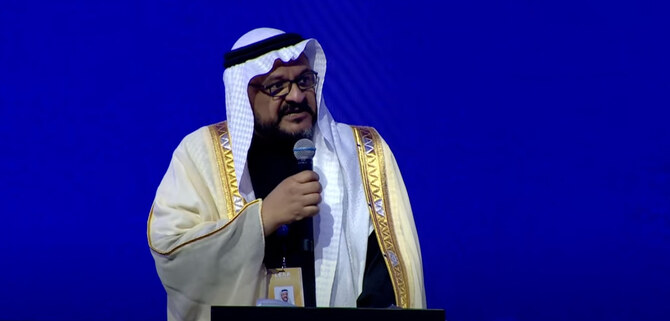
Saudi Aramco executive highlights key factors to unlock AI potential

the executive vice president of technology and innovation at Saudi Aramco, Ahmad Al-Khowaiter.
Short Url
Updated 09 February 2025
Follow

Saudi Aramco executive highlights key factors to unlock AI potential

RIYADH: Real-world data, computing power, and talent are the three key factors required to unlock the full potential of artificial intelligence, according to a Saudi Aramco top official.

On the first day of LEAP in Riyadh from Feb. 9-12, the executive vice president of technology and innovation at Saudi Aramco Ahmad Al-Khowaiter, discussed in his speech “Transforming Industries with Data and AI” these main requirements crucial to Aramco’s success.

This falls in line with the National Strategy for Data and Artificial Intelligence, which aims to train 40 percent of the workforce in essential skills to combat data and AI illiteracy and develop a talent pool of 20,000 data and AI specialists.

It also aligns well with the strategy’s target of attracting SR75 billion ($19.99 billion) in local and foreign investments, as well as supporting over 300 startups to encourage entrepreneurship. 

“Maximizing its (artificial intelligence) potential requires three main elements, three main enablers. One is tremendous amounts of real-world data. You need the data first, then you need to be able to put in place computing power, computing infrastructure to be able to do the models,” Al-Khowaiter said. 

“Finally, and probably the most important element, which I think we tend to forget in our excitement around technology, is you need the talent. You need the subject matter experts who can tell you if the model is telling the truth,” he added. 

The executive highlighted that Aramco has over 90 years of proprietary data from its extensive geological and process surveys. He explained that the company collects about 10 billion data points daily across all its facilities. 

Al-Khowaiter also shed light on how building capable AI models are not limited to global tech companies. 

He said: “It is within the reach of enterprises, even startups, to design AI suited to their own businesses. We have believed this from the beginning, developing our own models with our own data, which is why it gives me great pleasure to introduce our latest innovation Plant Meta Brain, a time series transformer model utilizing large time series data sets.”

He added: “Using these large data sets, we’re able to model the real-time processes that underlie our operations, and we are able to provide actionable insight in real-time to operators, engineers, and scientists. By working in real time with minimal user input, we anticipate demand, optimize operations, predict product qualities, and maximize production.” 

Al-Khowaiter explained that this approach would allow the company’s experts to focus on more value-added tasks instead of troubleshooting or developing models from the ground up.

“We believe our AI is only as good as our HI, our human intelligence, and this is why we are training. More than 6,000 AI developers across the company,” he said. 

“We’re also using the engineers, scientists and operators we already have to work with those AI developers to train new models, making them more robust and more reliable,” he added.

Al-Khowaiter concluded by saying: “Aramco is not only using our unique size and scale to maximize the use of AI on an industrial scale but our decade’s worth of data.” 

Held under the theme “Into New Worlds,” LEAP 2025 aims to expand business networking and investment opportunities in the tech sector. 

The event plays a critical role in Saudi Arabia’s ambition to become a global technology hub, aligning with its Vision 2030 plan to diversify the economy. As part of this initiative, the Kingdom has pledged $100 billion toward advancing its technology sector.


Gulf emerging as beneficiary amid changing global alliances, says TCW executive

Updated 23 January 2026
Follow

Gulf emerging as beneficiary amid changing global alliances, says TCW executive

DAVOS: As artificial intelligence dominated discussions at this year’s World Economic Forum in Davos, asset managers are exploring how the technology can be deployed at scale without losing the human judgement that underpins investment decisions.

For Jennifer Grancio, global head of distribution at asset management firm TCW, Saudi Arabia’s approach to energy and AI makes it a particularly attractive hub for investors.

“Saudi Arabia has been very forward-leaning in traditional energy,” Grancio said.

“They’ve also invested heavily in grid efficiency and electricity, which positions them to serve the wider region. Combined with AI adoption, it makes them a powerhouse for investment opportunities.”

For TCW, the focus is not on replacing human expertise but on expanding capacity.

“We’re using AI to increase capacity, not to replace investment analysts or people who write commentaries or evaluate securities,” Grancio explained.

The firm continues to rely on deep research, deploying AI selectively across functions such as securitized credit, marketing and investment teams.

TCW’s engagement with AI predates the current wave of enthusiasm and adoption.

“We were actually an early AI investor. In the US, we have the oldest AI fund, launched over eight years ago, focused on both enablers and adopters,” Grancio said.

The dual focus on technology and infrastructure increasingly aligns with developments in the Gulf.

“As an investment manager, we look at both the AI systems being developed and how energy and power infrastructure supports them,” she said, highlighting TCW’s global energy and power strategy, which has consistently outperformed its benchmark.

Geopolitical shifts are also reshaping investment flows to the Gulf.

“Concerns around the US, China or Russia have led global investors to rely more on the Gulf,” Grancio said. “It’s a great time for development and trade there.”

Emerging markets are drawing growing attention from investors.

“In the US, there’s a rotation toward global exposure. Elsewhere, there’s renewed focus on emerging markets and managing through volatility,” she said.

TCW has benefited from this trend, particularly in emerging market debt, with sovereign clients increasing allocations by billions of dollars.

Volatility, Grancio added, can create opportunity. “As a value manager, we do deep research and focus on relative valuation. In fixed income and securitized credit, volatility allows us to increase returns for clients.”

In the Middle East, sovereign wealth funds and pension systems are expanding into private credit and alternative income strategies. Education is key, Grancio said.

“Understanding what’s different about private investments is critical. They offer strong compounding and portfolio diversification.”

Private asset-backed finance is a growing trend in the region. “We’re seeing portfolios shift from public fixed income into private securitized credit, a major growth area.” 

Looking ahead to 2026, Grancio said that shifts will vary by region and investor type. “In the US, the wealth market has moved toward ETFs. We’ve rapidly built out a $6 billion ETF platform to meet demand,” she said.