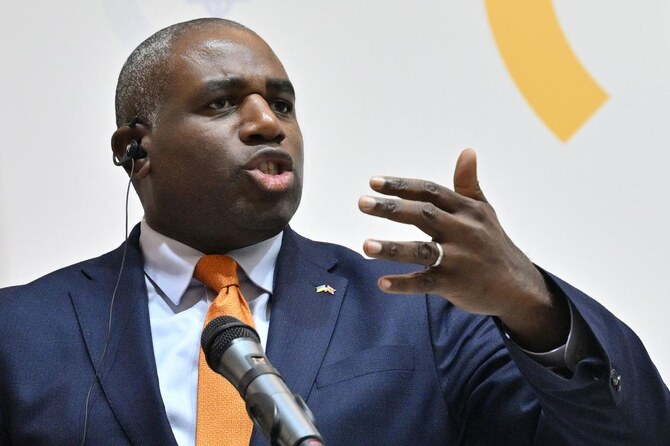
LONDON: British Foreign Secretary David Lammy on Friday warned that US President Donald Trump’s moves to freeze foreign aid and dismantle the USAID agency could see “China and others step into that gap.”
The UK’s top diplomat pointed to reforms by Britain’s previous Conservative government to its foreign aid program as “a big strategic mistake” which the new Trump administration should “look closely at.”
In 2020 the UK government closed down the Department for International Development (DfID) and subsumed it into the Foreign Office, before slashing the aid budget the following year.
The moves earned widespread criticism at the time from aid groups and others in the sector, as well as the countries’ opposition parties.
“What I can say to American friends is it’s widely accepted that the decision by the UK with very little preparation to close down DfID, to suspend funding in the short term or give many global partners little heads up, was a big strategic mistake,” Lammy told the Guardian.
“We have spent years unraveling that strategic mistake. Development remains a very important soft power tool. And in the absence of development... I would be very worried that China and others step into that gap,” he added.
“So I would caution US friends to look closely at what went wrong in the United Kingdom as they navigate this decision.”
Trump on Friday called for the United States Agency for International Development to be shut down, in an escalation of his unprecedented campaign to dismantle the massive government aid agency that has prompted confusion and chaos among its global network.
His administration has already frozen foreign aid and ordered thousands of foreign-based staff to return to the United States, with reported impacts on the ground steadily growing.

UK’s Lammy warns US aid cuts could see China step into ‘gap’
https://arab.news/5yc7x
UK’s Lammy warns US aid cuts could see China step into ‘gap’
Russia says captured Ukraine’s Siversk in key eastern region
- The Russian army in Ukraine is “confidently advancing along the entire front,” Putin said
- He said last month his troops were advancing on Siversk, home to around 11,000 residents
MOSCOW: Russia said Thursday its troops had seized full control of Siversk, a Ukrainian city in the eastern Donetsk region where fighting has intensified in recent weeks, though Ukraine denied the key settlement had been lost.
The Russian army has been slowly but steadily grinding through eastern Ukraine and taking ground from outnumbered and outgunned Ukrainian forces, with some of the fiercest battles taking place in Donetsk.
Russia’s military chief of staff, Valery Gerasimov, said Moscow’s forces had captured Siversk in a report to President Vladimir Putin during a televised meeting with army commanders.
The Russian army in Ukraine is “confidently advancing along the entire front,” Putin said, thanking the commanders and soldiers “for their combat work.”
Putin said last month his troops were advancing on Siversk, home to around 11,000 residents before the war, claiming that the Russian offensive was “practically impossible to hold back.”
The Ukrainian army’s eastern command denied Russian claims it had taken Siversk, saying that it “remains under the control of the Armed Forces of Ukraine.”
“The enemy is trying to infiltrate Siversk in small groups, taking advantage of unfavorable weather conditions but most of these units are being destroyed on the approaches,” it added in a Facebook post.
Siversk is located about 30 kilometers (18 miles) east of Kramatorsk and Sloviansk, the last two major cities still under Ukrainian control in the Donbas — an industrial and mining region in Moscow’s sights.
Moscow earlier this month said it had captured Pokrovsk, a former road and rail hub also in Donetsk, but Kyiv claims fighting in the city is still ongoing.
Putin has said that Moscow is ready to fight on to seize the rest of the land it claims in eastern Ukraine if Kyiv does not give it up as part of a peace deal.
Eastern Ukraine has been ravaged since Russia launched its assault in February 2022, with tens of thousands of people killed and millions forced to flee their homes.


