

Trump administration to keep only 294 USAID staff out of over 10,000 globally, sources say

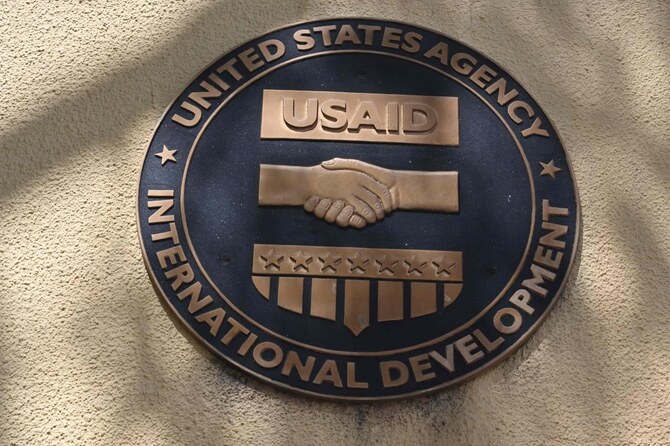
View of the logo of the United States Agency for International Development (USAID). (AFP)
Short Url
Updated 07 February 2025
Follow

Trump administration to keep only 294 USAID staff out of over 10,000 globally, sources say

  • “A lot of people will not survive,” says expert
  • Trump and Musk leveled false accusations that USAID staff were criminals

WASHINGTON: President Donald Trump’s administration plans to keep fewer than 300 staff at the US Agency for International Development out of the agency’s worldwide total of more than 10,000, four sources told Reuters on Thursday.
Washington’s primary humanitarian aid agency has been a target of a government reorganization program spearheaded by businessman Elon Musk, a close Trump ally, since the Republican president took office on January 20.
The four sources familiar with the plan said only 294 staff at the agency would be allowed to keep their jobs, including only 12 in the Africa bureau and eight in the Asia bureau.
“That’s outrageous,” said J. Brian Atwood, who served as head of USAID for more than six years, adding the mass termination of personnel would effectively kill an agency that has helped keep tens of millions of people around the world from dying.
“A lot of people will not survive,” said Atwood, now a senior fellow at Brown University’s Watson Institute.
The US Department of State did not respond to a request for comment.
With Trump and Musk, the world’s wealthiest man, leveling false accusations that its staff were criminals, dozens of USAID staff have been put on leave, hundreds of internal contractors have been laid off and life-saving programs around the globe have been left in limbo.
The administration announced on Tuesday it was going to put on leave all directly hired USAID employees globally, and recall thousands of personnel working overseas.
Secretary of State Marco Rubio had said the administration was identifying and designating programs that would be exempted from the sweeping stop-work orders, which have threatened efforts around the globe to stop the spread of disease, prevent famine and otherwise alleviate poverty.
Implementing partners of USAID are facing financial trouble on the back of stop-work orders from the State Department.

Merging USAID with State Department
The overhaul will upend the lives of thousands of staff and their families.
The administration’s goal is to merge USAID with the State Department led by Rubio, who Trump has made acting USAID administrator. However, it is not clear that he can merge the agencies unless Congress votes to do so, since USAID was created and is funded by laws that remain in place.
USAID employed more than 10,000 people around the world, two-thirds of them outside the United States, according to the Congressional Research Service (CRS). It managed more than $40 billion in fiscal 2023, the most recent year for which there is complete data.
Sources familiar with events at the agency on Thursday said some workers had begun receiving termination notices.
The USAID website said that as of midnight on Friday, February 7, “all USAID direct hire personnel will be placed on administrative leave globally, with the exception of designated personnel responsible for mission-critical functions, core leadership and specially designated programs.”
It said essential personnel expected to continue working would be informed by Thursday at 3 p.m. EST.
The agency provided aid to some 130 countries in 2023, many of them shattered by conflict and deeply impoverished. The top recipients were Ukraine, followed by Ethiopia, Jordan, the Democratic Republic of Congo, Somalia, Yemen and Afghanistan, according to the CRS report.


In Ethiopia, Tigrayans fear return to ‘full-scale war’

Updated 44 min 10 sec ago
Follow

In Ethiopia, Tigrayans fear return to ‘full-scale war’

  • Flights have been suspended into Tigray since Thursday and local authorities reported drone strikes on goods lorries
  • The international community fears the fighting could turn into an international conflict between Ethiopia and Eritrea

ADDIS ABABA: Tigrayans in northern Ethiopia fear a return to all-out war amid reports that clashes were continuing between local and federal forces on Monday, barely three years after the last devastating conflict in the region.
The civil war of 2020-2022 between the Ethiopian government and Tigray forces killed more than 600,000 people and a peace deal known as the Pretoria Agreement has never fully resolved the tensions.
Fighting broke out again last week in a disputed area of western Tigray called Tselemt and the Afar region to the east of Tigray.
Abel, 38, a teacher in Tigray’s second city Adigrat, said he still hadn’t recovered from the trauma of the last war and had now “entered into another round of high anxiety.”
“If war breaks out now... it could lead to an endless conflict that can even be dangerous to the larger east African region,” added Abel, whose name has been changed along with other interviewees to protect their identity.
Flights have been suspended into Tigray since Thursday and local authorities reported drone strikes on goods lorries on Saturday that killed at least one driver.
In Afar, a humanitarian worker, speaking to AFP on condition of anonymity, said there had been air strikes on Tigrayan forces and that clashes were ongoing on Monday, with tens of thousands of people displaced.
AFP could not independently verify the claims and the government has yet to give any comment on the clashes.
In the regional capital Mekele, Nahom, 35, said many people were booking bus tickets this weekend to leave, fearing that land transport would also be restricted soon.
“My greatest fear is the latest clashes turning into full-scale war and complete siege like what happened before,” he told AFP by phone, adding that he, too, would leave if he could afford it.
Gebremedhin, a 40-year-old civil servant in the city of Axum, said banks had stopped distributing cash and there were shortages in grocery stores.
“This isn’t only a problem of lack of supplies but also hoarding by traders who fear return of conflict and siege,” he said.
The region was placed under a strict lockdown during the last war, with flights suspended, and banking and communications cut off.
The international community fears the fighting could turn into an international conflict between Ethiopia and Eritrea, whose relations have been increasingly tense in recent months.
The Ethiopian government accuses the Tigrayan authorities and Eritrea of forging closer ties.
United Nations Secretary-General Antonio Guterres is “deeply concerned about... the risk of a return to a wider conflict in a region still working to rebuild and recover,” his spokesman said.
The EU said that an “immediate de-escalation is imperative to prevent a renewed conflict.”