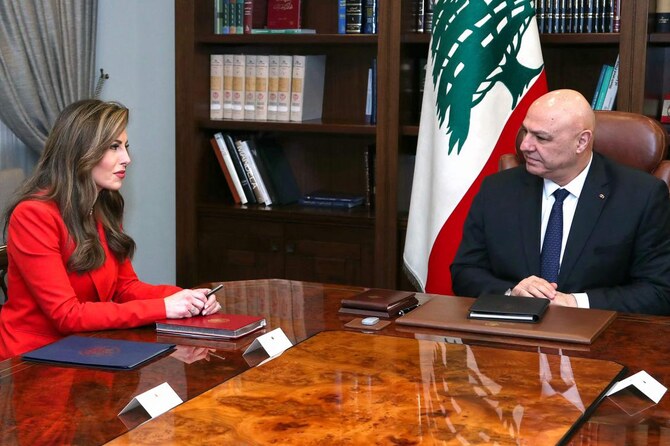
BEIRUT: Morgan Ortagus, US deputy special envoy to the Middle East, caused controversy following her meeting with Lebanese President Joseph Aoun on Friday, after making comments about militant group Hezbollah.
Ortagus, who arrived in Beirut on Thursday evening, emphasized “US commitment to strengthening close relations with Lebanon.”
However, she told reporters that she believes excitement from the Lebanese diaspora about the future of Lebanon “is largely in part, of course, because Hezbollah was defeated by Israel. And we are grateful to our ally, Israel, for defeating Hezbollah.
“But it’s also thanks to you, thanks to the Lebanese people. It is thanks to President Aoun and Prime Minister-designate Nawaf Salam, and everyone in this government who is committed to an end of corruption, who is committed to reforms and who are committed to making sure that Hezbollah is not a part of this government in any form, and that Hezbollah remains disarmed and militarily defeated.”
She continued: “That, of course, starts with the pressure that US President Donald Trump is now placing on the Islamic Republic of Iran so that they can no longer fund their terror proxies through the region.”
Ortagus added: “We will be working again to make sure that the Islamic Republic of Iran doesn’t achieve a nuclear weapon and that they are unable to inflict chaos and harm into this country and to so many other countries around the region, which they were allowed to do for decades. That ends with President Trump.
“We’re incredibly hopeful that hope comes because we know that we have men and women of character, of resilience, of transparency. The men and women of character in this government will ensure that we start to end corruption. That we end influence from Hezbollah and that we embark on the reforms for Lebanon, that all of you, the people of Lebanon, deserve.”
Ortagus said she informed Aoun that “we don’t want to look at Lebanon as a donor country. You’re a beautiful, sophisticated country that deserves to have the most impressive businessmen and women, the most impressive businesses, companies and country from around the world investing in here. We want to get to Lebanon, back to that place where it is, the place and the hope of the Middle East. And I know we’ll get there together.”
Asked about the US stance on Hezbollah’s potential inclusion in the upcoming Lebanese government, Ortagus said: “I am certainly not afraid of Hezbollah. I am not afraid of them because they have been defeated militarily. We have set clear red lines in the US, and they will not be able to terrorize the Lebanese people, and that includes by being part of the government. The end of Hezbollah’s reign of terror in Lebanon and around the world has started, and it is over.”
The US, she said, “is committed to the Feb. 18 deadline for the withdrawal of Israeli forces from southern Lebanon. This date is part of negotiations I had with my partner Eric Trager at the National Security Council, and with the Lebanese government and the Israeli government. Feb. 18 will be the day for redeployment, whenever the IDF troops finish their redeployment and, of course, the Lebanese troops will come in behind them. We are very committed to that firm date.”
Aoun told Ortagus that “the permanent stability in southern Lebanon hinges on Israel’s full withdrawal from the recently occupied territories and the implementation of Resolution 1701 in all its aspects, including the provisions of the ceasefire agreement that took effect on Nov. 27.”
Aoun said: “Israeli attacks must cease. The killing of innocent civilians and soldiers, the destruction of homes, and bulldozing and burning of agricultural lands must stop.” He also pointed out that “the release Lebanese hostages is an integral part of the agreement.”
He added: “The Lebanese Army is prepared to deploy in the evacuated villages and towns, and Israel must adhere to the Feb. 18 deadline for completing its withdrawal.
“Our cooperation with UNIFIL is ongoing and focused on implementing Resolution 1701, aiming to establish stability and gradually restore life to the areas liberated from occupation.
“These areas require a comprehensive reconstruction plan, including essential means of livelihood for returnees, following the extensive damage caused by Israeli aggression to crops and property.”
Aoun’s media office said that he and Ortagus discussed the formation of the Lebanese government. The president emphasized that “the consultations to form the government are nearing completion, with the goal of creating a harmonious and effective government that will meet the hopes and aspirations of the Lebanese people, as outlined in my oath speech.”
Hezbollah supporters expressed their discontent with Ortagus’s statements, gathering outside Beirut’s Rafic Harari International Airport for a sit-in to protest her remarks.
Other Hezbollah activists criticized Ortagus’s ring bearing the star of David, which was visible when she was shaking Aoun’s hand.
The US envoy subsequently headed to southern Lebanon accompanied by a US delegation. Along with a number of Lebanese Army officers, she inspected the area where the Lebanese military has been redeployed.
This is Ortagus’s first visit to Lebanon. It came in parallel with an Israeli raid on Friday afternoon on Baysarieh in the Zahrani region, north of the Litani Line, following a violent day of Israeli strikes on southern Lebanon, Bekaa and the Syrian border, breaching the ceasefire agreement.
Lebanon’s National News Agency said that “the Israeli Army carried out bombings in two stages on Kfarkila.”
An explosion occurred in a house in Tayr Harfa, which witnessed the Israeli army’s withdrawal, killing two adults and several kids. According to the security bodies, it appeared that the house had been previously booby-trapped by the Israeli forces.
The Lebanese Army sent reinforcements to the Kald Al-Sabeh area in the Hermel barrens following tensions in the area, due to confrontation between the Bekaa tribes and Syrian Arab Republic forces.
Syrian personnel pushed into the villages of Al-Fadiliya, Blouza, Jermash and Hawik, to reinforce their presence in the Lebanese-inhabited Assi basin villages inside the Syrian territory.


![]()

US envoy’s anti-Hezbollah stance causes controversy in Lebanon
Short Url
https://arab.news/ce4v2
US envoy’s anti-Hezbollah stance causes controversy in Lebanon
- Ortagus told reporters that she believes excitement from the Lebanese diaspora about the future of Lebanon “is largely in part, of course, because Hezbollah was defeated by Israel”
- Ortagus said she informed Aoun that “we don’t want to look at Lebanon as a donor country”


Latest updates


© 2026 SAUDI RESEARCH & PUBLISHING COMPANY, All Rights Reserved And subject to Terms of Use Agreement.