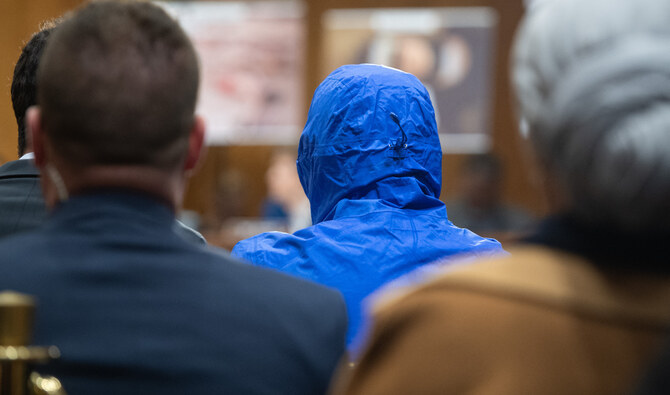
BEIRUT: A Syrian whistleblower, who smuggled tens of thousands of pictures depicting torture under Bashar Assad, on Thursday revealed his identity for the first time, two months after the longtime ruler was toppled.
“I am First Lt. Farid Al-Madhan, the (former) head of the forensic evidence department at the military police in Damascus, known as Caesar,” he said in a televised interview with Qatari broadcaster Al Jazeera.
Identified at the time only as a Syrian military photographer under the pseudonym Caesar, he had fled the country in 2013, taking with him some 55,000 graphic images taken between 2011 and 2013.
Describing himself during the interview as a “son of a free Syria,” he said he was from the city of Daraa, “the cradle of the Syrian revolution.”
Following the outbreak of Syria’s civil war in 2011 with the brutal repression of anti-government protests, he said he was tasked with “taking pictures of victims of detention.”
These included “old men, women and children, who were detained at security checkpoints in Damascus, and from protest squares that called for freedom and dignity,” said Madhan, who added that he currently resides in France.
“They were detained, tortured and killed in bloody, systematic ways and their bodies were transferred to military morgues to be photographed and taken to mass graves,” he continued.
He said he postponed his defection from the government forces and fleeing the country in order to be able to “collect the largest number of pictures documenting and incriminating the Syrian regime apparatuses of committing crimes against humanity.”
He said the pictures were smuggled in a flash drive that he sometimes hid in his socks or a bundle of bread to escape government security checkpoints or those of the opposition.
The photos, authenticated by experts, show corpses tortured and starved to death in Syrian prisons.
Some people had their eyes gouged out. The photos showed emaciated bodies, people with wounds on the back or stomach, and also a picture of hundreds of corpses in a shed surrounded by plastic bags used for burials.
Assad’s government said only that the pictures were “political.”
But Caesar testified to a US Congress committee and his photographs inspired a 2020 US law which imposed economic sanctions on Syria and judicial proceedings in Europe against Assad’s entourage.
Germany, the Netherlands and France have since 2022 convicted several top officials from the Syrian intelligence service and militias.


Syria’s ‘Caesar’ whistleblower unveils identity
https://arab.news/rfp5p
Syria’s ‘Caesar’ whistleblower unveils identity

- First Lt. Farid Al-Madhan was the former head of the forensic evidence department at the military police in Damascus


German parliament speaker visits Gaza
BERLIN: The speaker of Germany’s lower house of parliament briefly visited the Israeli-controlled part of the Gaza Strip on Thursday, the body said.
Julia Kloeckner spent “about an hour in the part of Gaza controlled by Israeli army forces,” parliament said, becoming the first German official to visit the territory since Hamas’s attack on Israel in October 2023 that sparked the devastating war.
Since the start of the conflict, Israel has drastically restricted access to the densely populated coastal strip.
In a statement shared by her office, Kloeckner said it was essential for politicians to have access to “reliable assessments of the situation” in Gaza.
“I expressly welcome the fact that Israel has now, for the first time, granted me, a parliamentary observer, access to the Gaza Strip,” she said.
However, she was only able to gain a “limited insight” into the situation on the ground during her trip, she said.
Kloeckner appealed to Israel to “continue on this path of openness” and emphasized that the so-called yellow line, which designates Israeli military zones inside the Gaza Strip, must “not become a permanent barrier.”
The German Foreign Ministry did not immediately respond to AFP’s request for comment.
Germany has been one of Israel’s staunchest supporters as the European power seeks to atone for the legacy of the Holocaust.
But in recent months, Chancellor Friedrich Merz has occasionally delivered sharp critiques of Israeli policy as German public opinion turns against Israel’s actions in Gaza.
In August, Germany imposed a partial arms embargo on Israel, which was lifted in November after the announcement of what has proved to be a fragile ceasefire for Gaza.
Merz visited Israel in December and reaffirmed Germany’s support.
But in a sign of lingering tension, Germany’s Foreign Ministry on Wednesday criticized Israeli plans to tighten control over the occupied West Bank as a step toward “de facto annexation.”


