

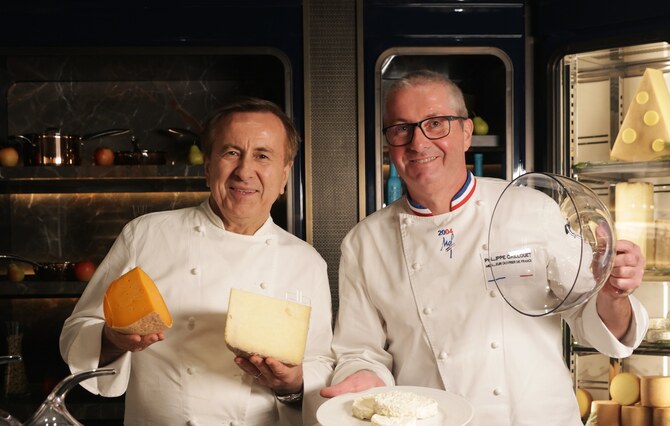

RIYADH: When Philippe Caillouet imagines Riyadh’s future, he doesn’t see glittering skyscrapers or the construction cranes carving out Vision 2030. He sees cheese.
Not the rubbery processed slices found in diners across the city. No, Philippe’s vision is one of hand-pressed wheels of camembert, buttery brie layered with the sharpness of Madinah mint, and alpine tommes with histories as rich as their rinds.
At the Four Seasons Hotel Riyadh, where he oversees Café Boulud’s cheese cave and non-alcoholic wine library, Caillouet curates dozens of artisanal varieties to introduce Riyadh’s diners to the nuanced flavors of European cheesemaking.

Philippe Caillouet. (Supplied)
“Cheese isn’t a commodity,” he says, standing in the cave’s hushed cool. “It’s a living product. It has terroir, history, personality. You can’t treat it like a block of butter.”
Caillouet is Riyadh’s first French cheesemonger and he carries the title with pride. He also sports a tri-colored collar that marks him as a Meilleur Ouvrier de France, a national accolade given to his country’s finest craftsmen.
The meticulously climate-controlled cave housing some 60 varieties of handpicked cheese. There’s gruyère, manchego, comté, and the indulgent vacherin Mont d’Or, which Caillouet serves baked and oozing, accompanied by non-alcoholic wine pairings from the library he also oversees.
“It’s not only about having the best cheese,” he says. “It’s about knowing how to serve it — the right temperature, the right accompaniments, the right story. If a cheese doesn’t have a story, it’s just food. When it has one, it becomes an experience.”
Born in Poitiers, the 56-year-old started his career in hospitality school, where an inspiring teacher instilled in him a passion for the “art of service.” From there, he worked his way up through the French hospitality circuit, running dining rooms at Michelin-starred institutions including La Palme d’Or in Cannes. But it wasn’t the gleaming service stations or polished silverware that captivated him — it was the cheese.

Caption
“It’s similar to wine,” he says. “Cheese is tied to the land, the season, the hands that make it. No two wheels are ever the same.”
By the time he opened his own fromagerie in the south of France, his reputation was firmly established. Yacht owners from Monaco, Cannes Film Festival organizers, and French Riviera gourmands made pilgrimages to his shop for perfectly aged Roqueforts and custom-made cheese boards, long before grazing platters became a trend.
So what brought Caillouet to Saudi Arabia last year? Opportunity.
“Cheese, as a concept, is still in its infancy in Saudi, but the people are curious, sophisticated, and hungry for new experiences,” he says.
Nowhere is Caillouet’s panache more evident than in his handmade Paris-Madinah cheese — a creamy brie infused with the sharp, herbaceous mint of Madinah.
“I was amazed by the mint here,” he says. “It smells like mint, tastes like mint — it’s alive. You don’t get that everywhere.”
At first, it was offered discreetly to adventurous diners, but within weeks, word spread. Now, guests arrive asking for “the one with the mint,” often bringing friends or returning with family to try it again. “That’s how cheese becomes culture,” he says. “It spreads, person to person.”
Riyadh’s diners, while adventurous, do arrive with preconceptions. Blue cheese, for example, can be met with hesitation, due to associations with overpowering flavors.
“If you’ve only had mass-produced blue cheese with a year-long shelf life, of course you won’t like it,” Caillouet says. So, he introduces them to artisanal blues — creamy, subtle, with just the right tang. “When you explain why it’s different, people trust you. And then they fall in love with it.”
Riyadh is rapidly becoming a global dining destination. “It’s alive, growing, full of potential. You just have to nurture it,” Caillouet says.
Like the Kingdom, Caillouet is dreaming big. “Why shouldn’t Saudis have the same level of cheese as they do in Europe?” he asks. “They’re already flying to Paris for Chanel and Hermès — why not stay here and enjoy the best Gruyère or Camembert? The country deserves it.”
At 56, he shows no signs of slowing down. “I don’t believe in retirement,” he says. “If you love what you do, why would you stop?”
For Caillouet, cheese is more than his livelihood — it’s a purpose. “A good cheese doesn’t just feed your body, it feeds your soul,” he says, recalling a spring day in France when a bite of fresh chèvre stopped him in his tracks.
“It tasted like sunshine, like the season itself. That’s what I want to bring to Saudi Arabia — cheese that makes you pause, think, feel,” he says. “That’s the future I imagine.”


