

UAE’s non-oil sector continues ‘robust’ growth in January: S&P Global

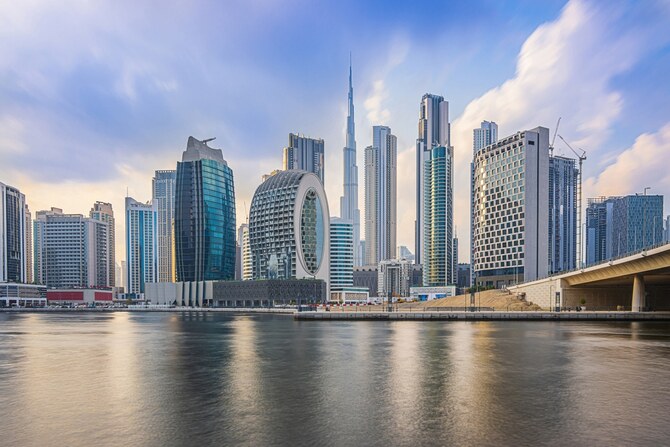
S&P Global said non-oil businesses in the UAE experienced a sharp rise in sales volume, primarily driven by strong domestic demand. Shutterstock
Short Url
Updated 05 February 2025
Follow

UAE’s non-oil sector continues ‘robust’ growth in January: S&P Global

  • Price pressures eased, with input costs rising at their slowest rate in 13 months
  • Non-oil companies raised their selling prices for the first time in four months

RIYADH: The UAE’s non-oil economy maintained steady growth in January, driven by a rise in new orders, ‘favorable market conditions,’ and easing cost pressures, according to S&P Global. 

The Emirates’ Purchasing Managers’ Index stood at 55, slightly down from December’s nine-month high of 55.4. 

A PMI reading above 50 indicates growth in the non-oil sector, while a below 50 signals contraction. 

The sustained expansion of non-oil business activity across the Middle East, including the UAE, highlights the region’s economic diversification efforts. Saudi Arabia posted a PMI of 60.5 in January, its highest level in a decade. Kuwait recorded a PMI of 53.4, followed by Egypt at 50.7, and Qatar at 50.2. 

“The UAE PMI signalled another good month for the non-oil private sector in January, with the headline figure falling only slightly from December’s nine-month high,” said David Owen, senior economist at S&P Global Market Intelligence. 

He added: “Robust expansions in activity and new business, as well as lower input cost inflation, suggest the economy is in a healthy position.” 

S&P Global said non-oil businesses in the UAE experienced a sharp rise in sales volume, primarily driven by strong domestic demand. 

Price pressures also eased, with input costs rising at their slowest rate in 13 months. The slowdown in inflation enabled firms to increase their purchases of inputs at the start of the year. 

The PMI survey said favorable market conditions and strong client relationships led to faster delivery times among UAE non-oil businesses in January. 

However, companies only recorded a modest increase in staff numbers, though the pace of hiring was the fastest since August. 

“A persistently low rate of employment growth suggests that firms are lacking the ability to hire in order to tackle backlog issues,” said Owen. “Input resources similarly remain weak, which seems to be aggravating capacity pressures as work-in-hand rose at the quickest pace in eight months in January.” 

Despite the positive trends, surveyed firms were less optimistic about their future outlook, with only 9 percent expecting growth over the next 12 months. 

According to these firms, intense competition in the UAE’s non-oil sector was a key factor in dampening confidence. 

“The broad decline in business confidence over the past few months will therefore be a surprise to some. Notably, total confidence was at its lowest level since December 2022,” said Owen. 

He added: “Strong competition and cash flow concerns arising from heavy backlogs have appeared to sow doubt among firms that they can continue to boost their revenues, underlining efforts to reduce the gap between output and input prices.” 

The survey said continued capacity strain was due to heightened demand and administrative challenges, such as slow client payments. 

The rate of backlog accumulation accelerated to its fastest pace in eight months, it added.

Due to strong demand pressures, non-oil companies in the UAE raised their selling prices for the first time in four months. 

S&P Global said business conditions in Dubai’s non-hydrocarbon sector remained promising, with the emirate’s PMI reaching 55.3 — slightly below December’s nine-month high of 55.5. 

Non-oil firms in Dubai saw robust activity expansion in response to greater new business inflows. 

Cost pressures also eased, with input price inflation slipping to a three-month low. 

Employment and inventory levels saw fractional increases, reflecting a subdued outlook for future business activity. 

Regarding future expectations, business confidence in Dubai’s non-oil sector dropped to its lowest level in over four years. 


Middle East conflict driving jet fuel surge, pushing airlines to raise fares 

Updated 16 sec ago
Follow

Middle East conflict driving jet fuel surge, pushing airlines to raise fares 

JEDDAH: Military operations involving the US and Israel against Iran have roiled global energy markets, sending jet fuel prices sharply higher and prompting a wave of fare increases and fuel surcharges from airlines worldwide. 

Jet fuel, which traded at roughly $85 to $90 per barrel before recent strikes, has surged to $150 to $200 per barrel in recent days, underscoring the scale of the cost shock. 

Several major carriers, including Australia’s Qantas Airways, Scandinavia’s Scandinavian Airlines and Air New Zealand, announced airfare hikes on March 10, attributing the moves to a steep rise in fuel costs linked to the Middle East conflict, according to Reuters. These were joined by Air India and Air Chathams. 

Speaking to Arab News, Khaled Ramadan, economist and head of the International Center for Strategic Studies in Cairo, said the developments have prompted some airlines to hike fares and suspend financial outlooks, as fuel constitutes 20 to 30 percent of operating costs. 

“Over the coming months, airline fares could rise 15 to 20 percent on international routes, exacerbated by airspace closures forcing detours that add hours to flights and burn extra fuel,” he said, adding that low-cost carriers in Asia and unhedged US airlines face the sharpest margin pressure. 

The conflict has not only disrupted shipping along key oil export routes — including the critical Strait of Hormuz — but also upended flight operations and pricing on some of the busiest global air links. 

That has contributed to higher ticket prices on certain long-haul routes and sparked concerns across the travel sector about a broader slump in demand that could leave planes parked if pressures persist. 

Regional carriers respond 

The trend is spreading beyond Europe and the Asia-Pacific region, with Air India Group announcing a phased expansion of fuel surcharges across its domestic and international network. The airline said the move was necessitated by a sharp escalation in aviation turbine fuel, or ATF, prices linked to supply disruptions associated with the geopolitical situation in the Gulf region. 

“Since early March 2026, ATF, which accounts for nearly 40 percent of an airline’s operating costs, has seen significant price escalation due to supply interruptions,” the airline said in a statement. 

In India, the pressure is amplified by high excise duty and value added tax on ATF in major metro cities such as Delhi and Mumbai, magnifying the impact and placing additional strain on airline economics. 

The levy will take effect in phases from March 12, with initial charges of 399 Indian rupees ($4.4) per domestic and SAARC flight and incremental surcharges of up to $200 on long-haul routes in later stages. 

In its announcement, Air India acknowledged the hardship for travelers but described the measure as necessary due to factors beyond its control. 

“Absent such fuel surcharges, it is likely that some flights would be unable to cover operating cost and would have to be canceled,” the airline said, highlighting the risk to route viability if jet fuel costs remain elevated. 

Wider industry responses 

Beyond fare and surcharge adjustments, carriers are adapting operationally to the challenging environment.

Airspace closures and security concerns in the Middle East have forced some airlines to reroute flights, contributing to higher fuel burn and operational costs.

At the same time, airline shares have shown signs of stabilizing after sharp market sell-offs, as oil prices eased slightly following indications that tensions could de-escalate.

While some airlines, such as Germany’s largest airline Lufthansa and Ireland-based low-cost airline Ryanair, benefit from fuel hedging that limits exposure to price swings, others without extensive hedges are increasingly passing costs on to travelers or warning of future adjustments if jet fuel remains elevated. 

The ripple effects of rising jet fuel costs are also being felt in New Zealand, where Air Chathams has introduced a $20 fuel surcharge on all new bookings. 

The airline cited shipping concerns through the Strait of Hormuz and the Middle East conflict as key drivers behind the sharp jump in fuel prices, which have risen by more than 120 percent in recent weeks. 

This surcharge will be reviewed regularly and removed once fuel prices return to more normal levels, the airline said. 

Ramadan said that the global travel industry risks a slowdown, with aircraft potentially grounded if demand dips due to higher costs and safety concerns. 

He added that tourism-dependent economies like Thailand, with 12 percent of gross domestic product derived from tourism, and Africa could see growth stall, with bookings down 25 to 60 percent from Europe and the Middle East. 

“If the conflict persists beyond weeks, as projected by some analysts, it may usher in a ‘new era’ of elevated fares and rerouted global aviation, shifting hubs away from the Gulf and costing billions in lost revenue,” Ramadan warned. 

He added that resilient demand for post-pandemic travel offers hope for recovery if tensions ease, and airlines must hedge fuel risks while governments could subsidize routes to mitigate broader economic fallout.