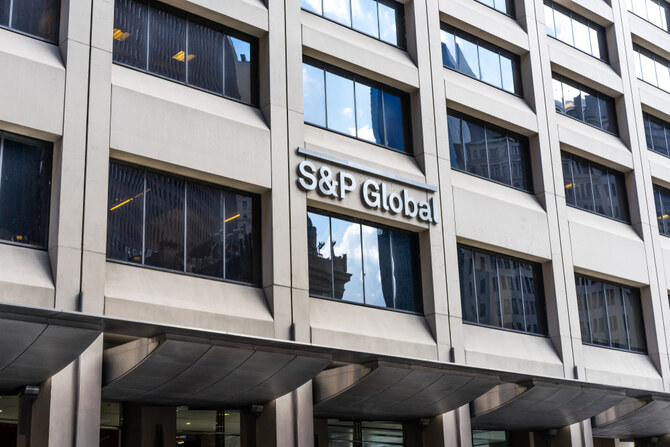

RIYADH: Non-oil private sectors in Kuwait and Qatar continued their growth momentum in January, while business conditions in Egypt saw a strong rebound after more than four years of slowdown, according to S&P Global.
In a new report, the financial services firm revealed that Kuwait’s purchasing managers’ index reached 53.4 in January, marginally down from 54.1 in December but still comfortably above the 50 neutral mark.
According to S&P Global, any PMI reading above 50 signifies the expansion of the private business conditions, while below 50 indicates contraction.
The steady momentum of non-oil business activities across Middle Eastern countries highlights the progress of their economic diversification efforts. Notably, the Kingdom recorded a PMI of 60.5 in January, the highest level in 10 years.
“It was pleasing to see Kuwait’s non-oil private sector pick up in 2025 where it left off in 2024, posting strong increases in output and new orders,” said Andrew Harker, economics director at S&P Global Market Intelligence.
The study revealed that business activities in Kuwait continued to rise in January despite the rate of growth falling to a three-month low.
“Encouragingly, the pace of job creation picked up and was the joint-fastest on record equal with June and November 2024,” added Harker.
However, S&P Global underlined that despite this there is still set to be a rise in work backlogs driven by the influx of new businesses.
Respondents who participated in the PMI survey also revealed that some of their businesses benefited from Kuwait’s hosting of the Arabian Gulf Cup at the start of the month.
New export orders also increased in January due to new deals received by Kuwaiti businesses from neighboring Arab nations.
According to the study, business confidence regarding the future outlook remained strongly positive despite easing to a four-month low.
“Firms are also optimistic that growth will continue over the course of the year, and so they will need to keep raising capacity in the months ahead if they are to keep up with demand,” added Harker.
Qatar maintains growth momentum
In a separate report, S&P Global said that Qatar’s PMI fell from 52.9 in December to 50.2 in January, signaling a slower overall improvement in business conditions in the non-energy private sector economy.
The US-based agency added that the rate of employment growth in Qatar’s non-energy sector eased in January. Still, over the past five months, jobs have increased faster than in any previous period in the survey history.
“The headline PMI fell for the first time in four months at the start of 2025, but managed to remain just above 50.0 thanks to a further marked increase in employment. In each of the past five months, the non-energy economy has added more jobs than in any previous period since the survey began in 2017,” said Trevor Balchin, economics director at S&P Global Market Intelligence.
He added: “This has been accompanied by strong wage increases, with labor costs increasing at a fresh record pace in January.”
Qatar’s PMI decline in January was mainly due to a fall in new businesses, especially in the construction sector.
S&P Global added that total outstanding business in the non-energy private sector economy continued to rise in January, albeit at a slower rate.
“The drop in the PMI mainly reflected a decline in new business, only the second of the past two years. But this was heavily driven by the construction sector, with manufacturing and wholesale & retail recording further robust increases in new orders,” said Balchin.
He added: “Overall, the level of work in hand but not completed continued to rise, and the 12-month outlook remains strongly positive.”
Egypt’s non-energy economy rebounds in January
In a report focusing on Egypt, S&P Global said the north African country’s PMI stood at 50.7 in January, up from 48.1 in December, signaling positive growth in the nation’s non-energy sector.
Egypt’s PMI in January was at its highest level since November 2020, having risen above the 50 neutral mark only twice in this period, the other being in August.
According to the survey, this growth in the non-oil private sector was driven by a softening of cost pressures as some material prices fell.
“Growth at the start of 2025 was welcome news for Egypt’s non-oil private sector, which has struggled in recent times amid rampant inflation and the wider effects of regional instability. A reduction in some input prices helped to soften cost pressures and fuel a pick-up in sales for only the second time in over three years,” said David Owen, senior economist at S&P Global Market Intelligence.
This growth in Egypt’s non-oil economy happened just a month after the International Monetary Fund reached an agreement with Egyptian authorities, allowing the North African nation to access about $1.2 billion to strengthen its troubled finances.
Survey respondents said that business activity and new orders rose modestly in January, adding that an improvement in economic conditions and falling inflationary pressures gave clients greater confidence to place new orders.
The report added that manufacturing, construction, and wholesale and retail sectors witnessed positive growth in January, while Egypt’s services sector posted a decline in expansion.
After a two-month streak of job cuts, total employment also stabilized across the non-oil economy in January.
“The ceasefire deal between Israel and Hamas likely added confidence to markets in January,” said Owen.
Despite improvement in overall business conditions, firms were restrained in their outlook of future activity in January, with expectations slipping from December to a historically low level.
“Business expectations for the next 12 months remain subdued, showing that firms are still uncertain about economic stability over the longer term,” said Owen.
He added: “The survey’s price metrics gave some hopeful signs for inflation. The official CPI rate dropped to a two-year low of 24.1 percent in December, and our findings suggest that this should continue to fall in the months to come.”