

Government says Pakistan preparing Cyber Security Act as digital expansion raises risks

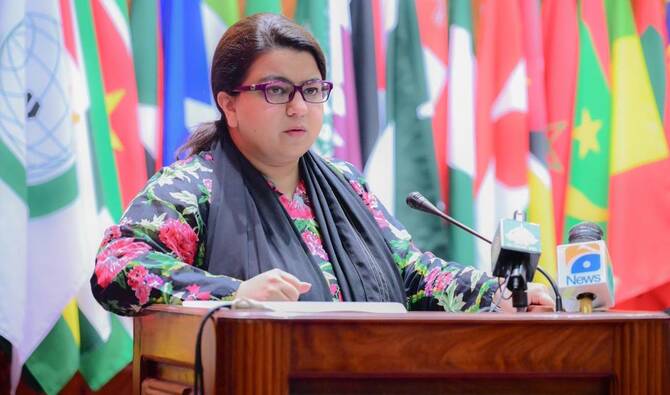
Pakistan IT Minister Shaza Fatima addresses a ceremony in Islamabad, on March 11, 2026. (@MoitOfficial/X)
Short Url
Updated 11 March 2026
Follow

Government says Pakistan preparing Cyber Security Act as digital expansion raises risks

  • The proposed legislation will create Cyber Security Authority to oversee the country's cyber defenses
  • IT minister warns misuse of genetic and digital data could enable targeted cyber and biological threats

ISLAMABAD: Pakistan is preparing a Cyber Security Act and a dedicated regulatory authority to strengthen defenses against rising digital threats as the country rapidly digitizes government services and economic systems, IT Minister Shaza Fatima said while addressing a ceremony in the federal capital on Wednesday.

The planned legislation is part of Islamabad’s broader “Digital Nation Pakistan” initiative, which aims to expand e-governance, a cashless economy and online public services while safeguarding national cyber infrastructure.

“The more we move toward digitization, with the kind of opportunities that are opening up for us, it is also bringing an equal, or even greater, set of challenges,” the minister said. “This does not mean that we stop digitization. It means that we must make our cybersecurity systems robust.”

She said Pakistan had already activated its National Computer Emergency Response Team (CERT) and provincial CERTs to detect and respond to cyber incidents, while a multi-agency digital monitoring framework known as the National Threat Intelligence System (NTIS) operates around the clock.

“We have a Cyber Security Act coming up, under which a Cyber Security Authority will be established.”

The minister said cybersecurity was not a “generic” concept and required multiple technical specializations as well as comprehensive monitoring and regulation. She warned that the rapid expansion of data-driven technologies was creating new risks even as it opened opportunities in areas such as health and biotechnology.

Referring to advances in genomics and precision medicine, she said the same technologies that help treat diseases could also pose security risks if sensitive biological data were misused. She warned that access to large-scale genetic data could potentially allow hostile actors to develop targeted viruses or other biological threats against populations.

The minister also highlighted Pakistan’s cyber defense capabilities, saying government and military systems remained secure during last year's war with India despite sustained cyber warfare attempts.

She said multiple institutions, including the IT ministry, the National Telecommunication Corporation (NTC), national cybersecurity teams and the armed forces’ cyber command structures, worked together to defend critical systems.

“Despite that massive war ... we did not face a single communication breakdown and we did not allow any penetration into our government systems,” she said, adding that the experience demonstrated the need to further strengthen cybersecurity coordination across institutions.


Pakistan reviews austerity measures amid Middle East crisis, urges strict nationwide implementation

Updated 5 sec ago
Follow

Pakistan reviews austerity measures amid Middle East crisis, urges strict nationwide implementation

  • Deputy Prime Minister Ishaq Dar chairs review meeting of austerity steps
  • Officials briefed on salary cuts, school closures, four‑day week, petrol conservation

ISLAMABAD: Pakistan’s government on Wednesday assessed progress on a sweeping set of austerity measures introduced to mitigate the country’s economic strain from sharply rising global oil prices and supply disruptions linked to the ongoing war in the Middle East.

Prime Minister Shehbaz Sharif this week announced a series of austerity steps, including a four‑day work week for government offices, requiring 50  percent of staff to work from home, cutting fuel allowances for official vehicles by half, grounding up to 60  percent of the government fleet and closing all schools for two weeks to conserve fuel amid the global oil crisis.

The measures were unveiled in response to global oil market volatility triggered by the conflict involving the United States, Israel and Iran, which has disrupted supply routes such as the Strait of Hormuz and pushed crude prices sharply higher, straining Pakistan’s heavily import‑dependent energy sector.

“The meeting stressed the importance of strict and transparent adherence to the austerity measures, promoting fiscal responsibility and prudent use of public resources,” Deputy Prime Minister and Foreign Minister Senator Mohammad Ishaq Dar said in a statement.

He was chairing a meeting of the Committee for Monitoring and Implementation of Conservation and Additional Austerity Measures, constituted under the directions of the PM, bringing together federal and provincial officials to review execution of the broad cost‑cutting plan. 

Dar emphasized the government’s commitment to enforcing the PM’s austerity steps nationwide. The committee’s review also covered reductions in departmental expenditure, deductions from salaries of senior officials earning over Rs. 300,000 ($1,120), and coordination with provincial administrations to ensure uniform implementation of the plan.

Participants at the meeting reiterated that all ministries and divisions must continue strict monitoring and reporting, with transparent oversight mechanisms, as Pakistan navigates the economic pressures from the prolonged Middle East crisis and its fallout on global energy and trade markets.