SAN SALVADOR: US Secretary of State Marco Rubio left El Salvador on Tuesday with an agreement from that country’s president to accept deportees from the US of any nationality, including violent American criminals now imprisoned in the United States.
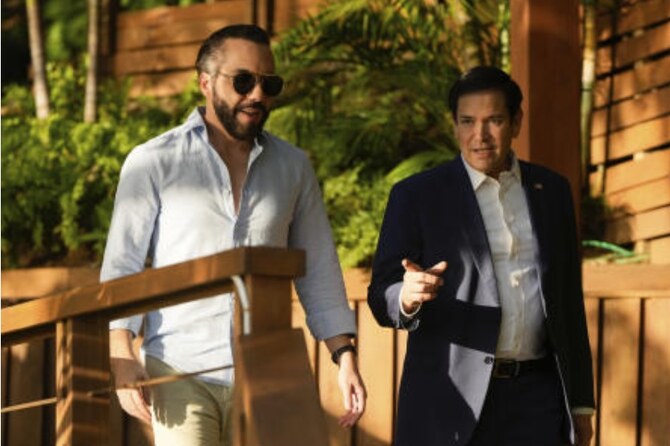
President Nayib Bukele “has agreed to the most unprecedented, extraordinary, extraordinary migratory agreement anywhere in the world,” Rubio said after meeting with Bukele at his lakeside country house outside San Salvador for several hours late Monday.
“We can send them, and he will put them in his jails,” Rubio said of migrants of all nationalities detained in the United States. “And, he’s also offered to do the same for dangerous criminals currently in custody and serving their sentences in the United States even though they’re US citizens or legal residents.”
Rubio was visiting El Salvador to press a friendly government to do more to meet President Donald Trump’s demands for a major crackdown on immigration.
Bukele confirmed the offer in a post on X, saying El Salvador has “offered the United States of America the opportunity to outsource part of its prison system.” He said his country would accept only “convicted criminals” and would charge a fee that “would be relatively low for the US but significant for us, making our entire prison system sustainable.”
Elon Musk, the billionaire working with Trump to remake the federal government, responded on his X platform, “Great idea!!”
After Rubio spoke, a US official said Trump’s Republican administration had no current plans to try to deport American citizens but called Bukele’s offer significant. The US government cannot deport American citizens, and such a move would be met with significant legal challenges.
The State Department describes El Salvador’s overcrowded prisons as “harsh and dangerous.” On its current country information webpage it says, “In many facilities, provisions for sanitation, potable water, ventilation, temperature control, and lighting are inadequate or nonexistent.”
El Salvador has lived under a state of emergency since March 2022, when the country’s powerful street gangs went on a killing rampage. Bukele responded by suspending fundamental rights like access to lawyers, and authorities have arrested more than 83,000 people with little to no due process.
In 2023, Bukele opened a massive new prison with capacity for 40,000 gang members and boasted about serving only one meal per day. Prisoners there do not receive visits, and there are no programs preparing them for reinsertion into society after their sentences and no workshops or educational programs.
El Salvador, once one of the most dangerous countries in the world, closed last year with a record low 114 homicides, a newfound security that has propelled Bukele’s soaring popularity in the country of about 6 million residents.
Rubio arrived in San Salvador shortly after watching a US-funded deportation flight with 43 migrants leave from Panama for Colombia. That came a day after Rubio delivered a warning to Panama that unless the government moved immediately to eliminate China’s presence at the Panama Canal, the US would act to do so.
Migration, though, was the main issue of the day, as it will be for the next stops on Rubio’s five-nation Central American tour of Costa Rica, Guatemala and the Dominican Republic after Panama and El Salvador.
His tour is taking place at a time of turmoil in Washington over the status of the government’s main foreign development agency.
Trump’s administration prioritizes stopping people from making the journey to the United States and has worked with regional countries to boost immigration enforcement on their borders as well as to accept deportees from the United States.
The agreement Rubio described for El Salvador to accept foreign nationals arrested in the United States for violating US immigration laws is known as a “safe third country” agreement. Officials have suggested this might be an option for Venezuelan gang members convicted of crimes in the United States should Venezuela refuse to accept them, but Rubio said Bukele’s offer was for detainees of any nationality.
Rubio said Bukele then went further and said his country was willing to accept and to jail US citizens or legal residents convicted of and imprisoned for violent crimes.
Human rights activists have warned that El Salvador lacks a consistent policy for the treatment of asylum seekers and refugees and that such an agreement might not be limited to violent criminals.
Manuel Flores, the secretary general of the leftist opposition party Farabundo Martí National Liberation Front, criticized the “safe third country” plan, saying it would signal that the region is Washington’s “backyard to dump the garbage.”
After meeting with Bukele, Rubio signed a memorandum of understanding with his Salvadoran counterpart to advance US-El Salvador civil nuclear cooperation. The document could lead to a more formal deal on cooperation in nuclear power and medicine that the US has with numerous countries.
While Rubio was out of the US, staffers of the US Agency for International Development were instructed Monday to stay out of the agency’s Washington headquarters after Musk announced Trump had agreed with him to shut the agency.
Thousands of USAID employees already had been laid off and programs shut down. Rubio told reporters in San Salvador that he was now the acting administrator of USAID but had delegated that authority so he would not be running its day-to-day operations.
The change means that USAID is no longer an independent government agency as it had been for decades — although its new status will likely be challenged in court — and will be run out of the State Department by department officials.
In his remarks, Rubio stressed that some and perhaps many USAID programs would continue in the new configuration but that the switch was necessary because the agency had become unaccountable to the executive branch and Congress.


![]()

Rubio says El Salvador offers to accept deportees from US of any nationality, including Americans
Short Url
https://arab.news/c3j3m
Rubio says El Salvador offers to accept deportees from US of any nationality, including Americans
- President Nayib Bukele “has agreed to the most unprecedented, extraordinary, extraordinary migratory agreement anywhere in the world,” Rubio said
- Rubio was visiting El Salvador to press a friendly government to do more to meet President Donald Trump’s demands for a major crackdown on immigration


Latest updates


© 2026 SAUDI RESEARCH & PUBLISHING COMPANY, All Rights Reserved And subject to Terms of Use Agreement.