Rubio says Panama must reduce Chinese influence around the canal or face possible US action

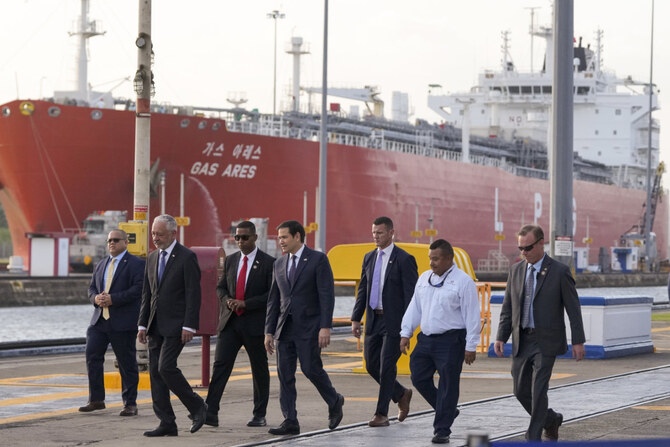
US Secretary of State Marco Rubio, 4th from left, tours the Miraflores locks at the Panama Canal in Panama City on Feb. 2, 2025. (AP Photo/Pool)
Short Url
Updated 03 February 2025
Follow

Rubio says Panama must reduce Chinese influence around the canal or face possible US action

  • China’s presence in the canal area may violate a treaty that led the US to turn the waterway over to Panama in 1999, Rubio tells Panama President Mulino
  • After his meeting with Rubio, Mulino said Panama would not be renewing its agreement with China’s Belt and Road Initiative when it expires

PANAMA CITY: US Secretary of State Marco Rubio brought a warning to Panamanian leader José Raúl Mulino on Sunday: Immediately reduce what President Donald Trump says is Chinese influence over the Panama Canal area or face potential retaliation from the United States.
Rubio, traveling to the Central American country and touring the Panama Canal on his first foreign trip as top US diplomat, held face-to-face talks with Mulino, who has resisted pressure from the new US government over management of a waterway that is vital to global trade.
Mulino told reporters after the meeting that Rubio made “no real threat of retaking the canal or the use of force.”
Speaking on behalf of Trump, who has demanded that the canal be returned to US control, Rubio told Mulino that Trump believed that China’s presence in the canal area may violate a treaty that led the United States to turn the waterway over to Panama in 1999. That treaty calls for the permanent neutrality of the American-built canal.
“Secretary Rubio made clear that this status quo is unacceptable and that absent immediate changes, it would require the United States to take measures necessary to protect its rights under the treaty,” the State Department said in a summary of the meeting.
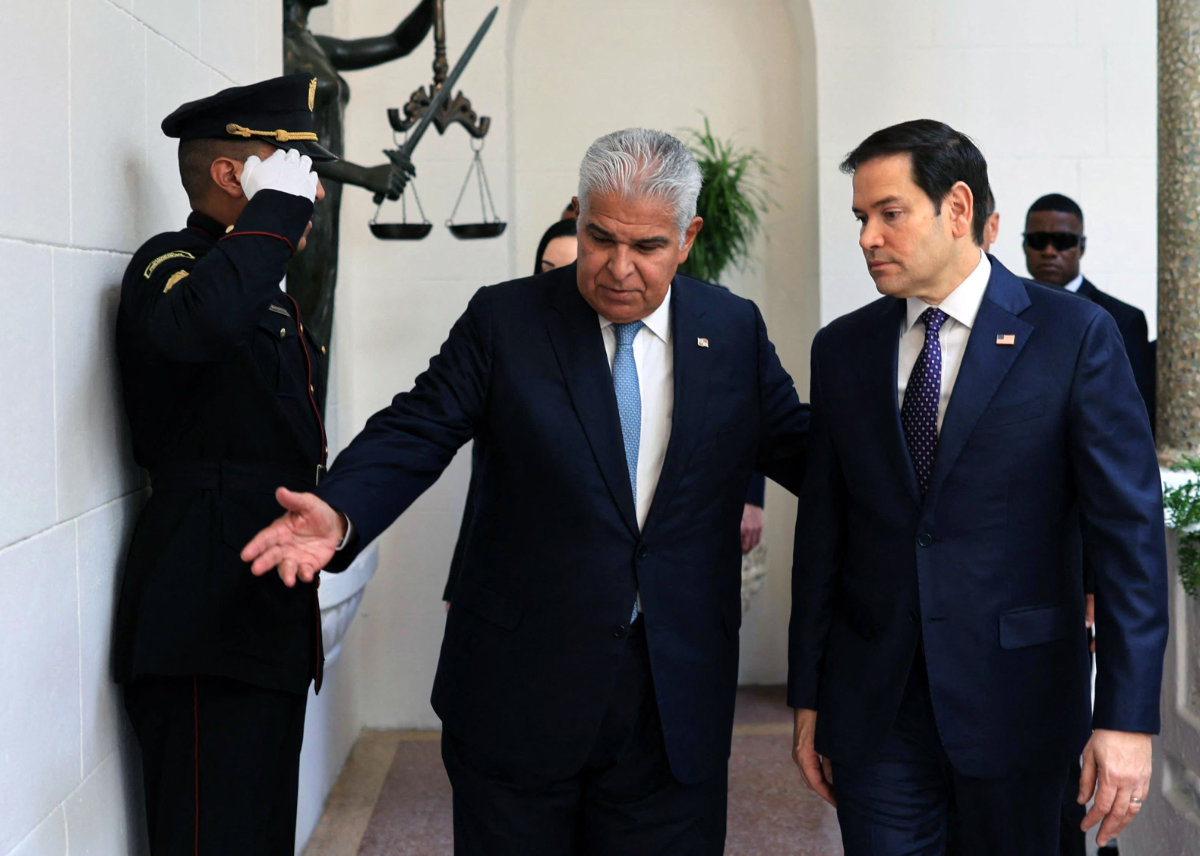


Panama's President Jose Raul Mulino (L) greeting US Secretary of State Marco Rubio on arrival at the presidential palace in Panama City on February 2, 2025. (AFP)

The statement was unusually blunt in diplomatic terms, but in keeping with the tenor and tone Trump has set for foreign policy. Trump has been increasing pressure on Washington’s neighbors and allies, including the canal demand and announcing Saturday that he was imposing major tariffs on Canada and Mexico. That launched a trade war by prompting retaliation from those close allies.
Mulino, meanwhile, called his talks with Rubio “respectful” and “positive” and said he did not “feel like there’s a real threat against the treaty and its validity.”
The president did say Panama would not be renewing its agreement with China’s Belt and Road Initiative when it expires. Panama joined the initiative, which promotes and funds infrastructure and development projects that critics say leave poor member countries heavily indebted to China, after dropping diplomatic recognition of Taiwan and recognizing Beijing.
Rubio later toured the canal at sunset with its administrator, Ricaurte Vásquez, who has said the waterway will remain in Panama’s hands and open to all countries. Rubio crossed the lock and visited the control tower, looking down over the water below, where a red tanker was passing through.
Earlier, about 200 people marched in the capital, carrying Panamanian flags and shouting “Marco Rubio out of Panama,” “Long live national sovereignty” and “One territory, one flag” while the meeting was going on. Some burned a banner with images of Trump and Rubio after being stopped short of the presidential palace by riot police.
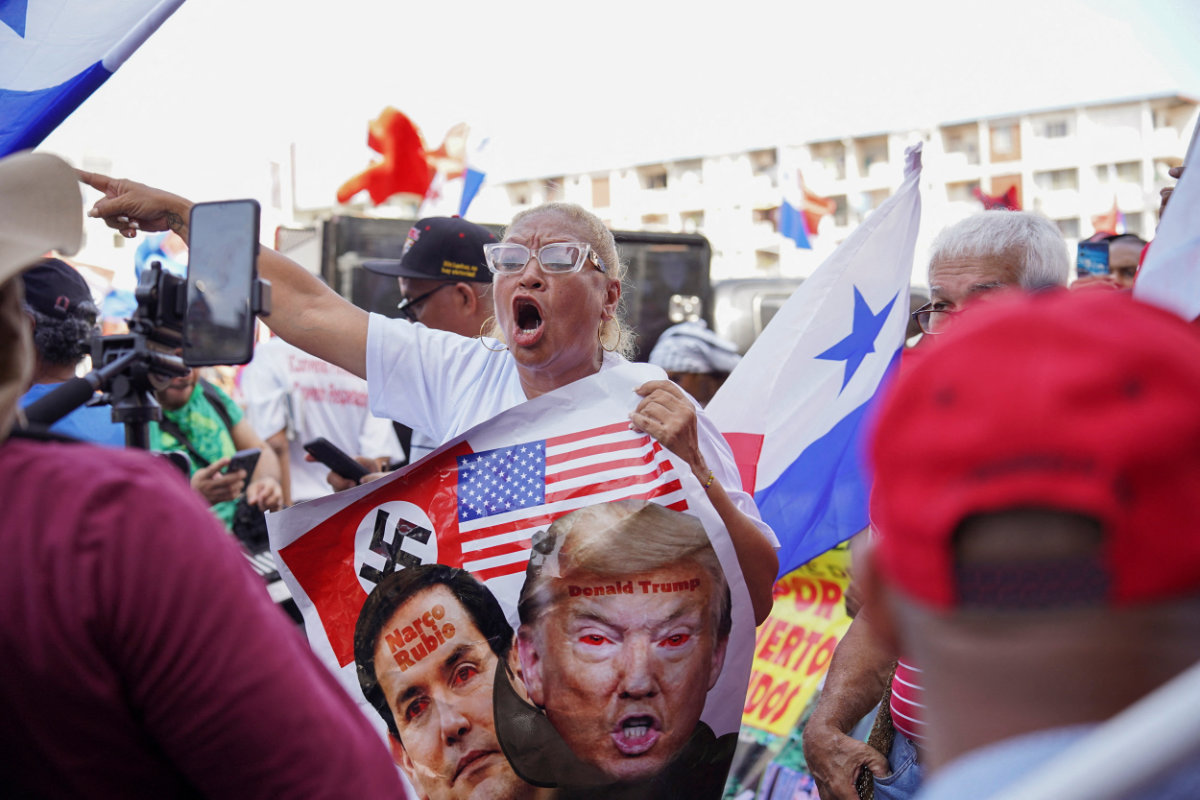


Panama activists take to the streets in Panama City to protest US Secretary of State Marco Rubio's diplomatic visit to discuss the Panama Canal and immigration with President Jose Raul Mulino on February 2, 2025. (REUTERS)

Rubio also pressed Trump’s top focus — curbing illegal immigration — telling Panama’s president that it was important to collaborate on the work and thanked him for taking back migrants. Rubio’s trip, however, comes as a US foreign aid funding freeze and stop-work orders have shut down US-funded programs targeting illegal migration and crime in Central American countries.
In a Wall Street Journal opinion piece on Friday, Rubio said mass migration, drugs and hostile policies pursued by Cuba, Nicaragua and Venezuela have wreaked havoc, and port facilities at either end of the canal are run by a China-based company, leaving the waterway vulnerable to pressure from the Beijing government.
“The president’s been pretty clear he wants to administer the canal again,” Rubio said Thursday. “Obviously, the Panamanians are not big fans of that idea. That message has been brought very clear.”
Despite Mulino’s rejection of any negotiation over ownership, some believe Panama may be open to a compromise under which canal operations on both sides are taken away from the Hong Kong-based Hutchison Ports company, which was given a 25-year no-bid extension to run them. An audit into the suitability of that extension is already underway and could lead to a rebidding process.
What is unclear is whether Trump would accept the transfer of the concession to an American or European company as meeting his demands, which appear to cover more than just operations.
Rubio’s trip, which will also take him to El Salvador, Costa Rica, Guatemala and the Dominican Republic, comes amid a freeze in US foreign assistance. The State Department said Sunday that Rubio had approved waivers for certain critical programs in countries he is visiting but details of those were not immediately available.


Teenage preacher to alleged mass killer: Bondi attack suspect’s background emerges

Updated 5 sec ago
Follow

Teenage preacher to alleged mass killer: Bondi attack suspect’s background emerges

SYDNEY/MANILA: Standing in the rain outside a suburban Sydney train station, seventeen-year-old Naveed Akram stares into the camera and urges those watching to spread the word of Islam.
“Spread the message that Allah is One wherever you can ... whether it be raining, hailing or clear sky,” he said.
Another since-deleted video posted in 2019 by Street Dawah Movement, a Sydney-based Islamic community group, shows him urging two young boys to pray more frequently.
Authorities are now trying to piece together what happened in the intervening six years that led a teenager volunteering to hand out pamphlets for a non-violent community group to allegedly carry out Australia’s worst mass shooting in decades.
Akram, who remains under heavy guard in hospital after being shot by police, was briefly investigated by Australia’s domestic intelligence agency in 2019 for links to individuals connected to Islamic State, but authorities found he did not have extremist tendencies at the time.
“In the years that followed, that changed,” Home Affairs Minister Tony Burke said on Tuesday.
Police have not formally identified Naveed Akram, 24, as one of the alleged gunmen who killed 15 people at a Jewish event on a Sydney beach on Sunday. His father Sajid Akram, 50, is the other gunman who was shot and killed by police, local media reported.
Officials have said the second gunman is the deceased man’s son and is in a critical condition in hospital.

MOTIVATED BY DAESH
Prime Minister Anthony Albanese said on Tuesday the attack was likely motivated by the ideology of Daesh, but that the two men appeared to have acted alone.
Homemade Daesh flags were found in the suspects’ car after Sunday’s attack, and police said on Tuesday the pair had last month visited the Philippines, where offshoots of the militant group have a presence.
A spokesperson for the Philippines Bureau of Immigration said Akram, an Australian national, arrived in the country on November 1 with his father, who was traveling on an Indian passport.
Both reported Davao as their final destination, the main city on Mindanao island, which has a history of Islamist insurgency. A months-long conflict on the island in 2017 between armed forces and two militant groups linked to IS left over a thousand dead and a million displaced, though the country’s military says these groups are now fragmented and weakened.
The pair left the Philippines on November 28, two weeks before Sunday’s attack using high-powered shotguns and rifles.

’NEVER DID ANYTHING UNUSUAL’
Local media reported that Akram, an unemployed bricklayer, attended high school in Cabramatta, a suburb around 30 kilometers by road from Sydney’s central business district and close to the family’s current home in Bonnyrigg, which was raided by police after the attacks.
“I could have never imagined in 100 years that this could be his doing,” former classmate Steven Luong told The Daily Mail.
“He was a very nice person. He never did anything unusual. He never even interrupted in class.”
After leaving school, Akram showed a keen interest in Islam, seeking tutoring and attending several Street Dawah Movement events. The group confirmed he appeared in the videos.
“We at Street Dawah Movement are horrified by his actions and we are appalled by his criminal behavior,” the group said in a statement, adding Akram had attended several events in 2019 but was not a member of the organization.
Months after the videos were posted, Akram approached tutor Adam Ismail seeking tuition in Arabic and the Qur'an, studying with him for a combined period of one year.
Ismail’s language institute posted a photo in 2022, since deleted, showing Akram smiling while holding a certificate in Qur'anic recitation.
“Not everyone who recites the Qur'an understands it or lives by its teachings, and sadly, this appears to be the case here,” Ismail said in a video statement late on Monday.
“I condemn this act of violence without hesitation.”

EARLIER TIES TO DAESH NOT PROVEN
Two of the people he was associated with in 2019 were charged and went to jail but Akram was not seen at that time to be a person of interest, Albanese said.
However he was radicalized, Akram’s journey from a teenager interested in Islam to one of Australia’s worst alleged killers has taken not just the public, but also law enforcement by surprise.
“We are very much working through the background of both persons,” New South Wales Police Commissioner Mal Lanyon told reporters on Monday.
“At this stage, we know very little about them.”