

Pakistan army chief vows retaliation after militant attack kills 18 troops in Balochistan

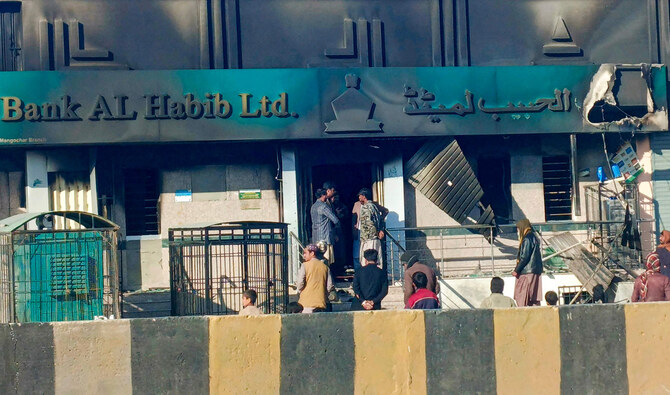
Onlookers gather near a bank set ablaze by militants at Kalat district, in Pakistan's Balochistan province on February 1, 2025. (AFP)
Short Url
Updated 01 February 2025
Follow

Pakistan army chief vows retaliation after militant attack kills 18 troops in Balochistan

  • Pakistani forces suffered casualties when they engaged militants who had erected barricades on a key highway in Kalat district late Friday
  • Balochistan has for years been the scene of an insurgency, with several separatist groups staging attacks and targeting mainly security forces

ISLAMABAD: Pakistan’s army chief, General Asim Munir, on Saturday visited the southwestern Balochistan province after militants killed 18 Pakistani soldiers in the restive region, promising to hunt down the perpetrators of attacks on Pakistani security forces.
General Munir was given a comprehensive brief on the prevailing security situation in Balochistan during his visit, according to the Inter-Services Public Relations (ISPR), the Pakistani military’s media wing.
He offered funeral prayers for the deceased soldiers and later inquired after the injured ones at the Combined Military Hospital in Balochistan’s provincial capital of Quetta.
“Those who are acting as terrorist proxies of their foreign masters who have mastered the art of manifesting double standards of hunting with the hound and running with the hare are well known to us. No matter what these so called ‘frenemies’ may do, you will surely be defeated by the resilience of our proud nation and its Armed Forces,” the army chief was quoted as saying by the ISPR.
“For the defense of our motherland and its people, we will definitely retaliate and ‘hunt you down,’ whenever required and wherever you may be.”
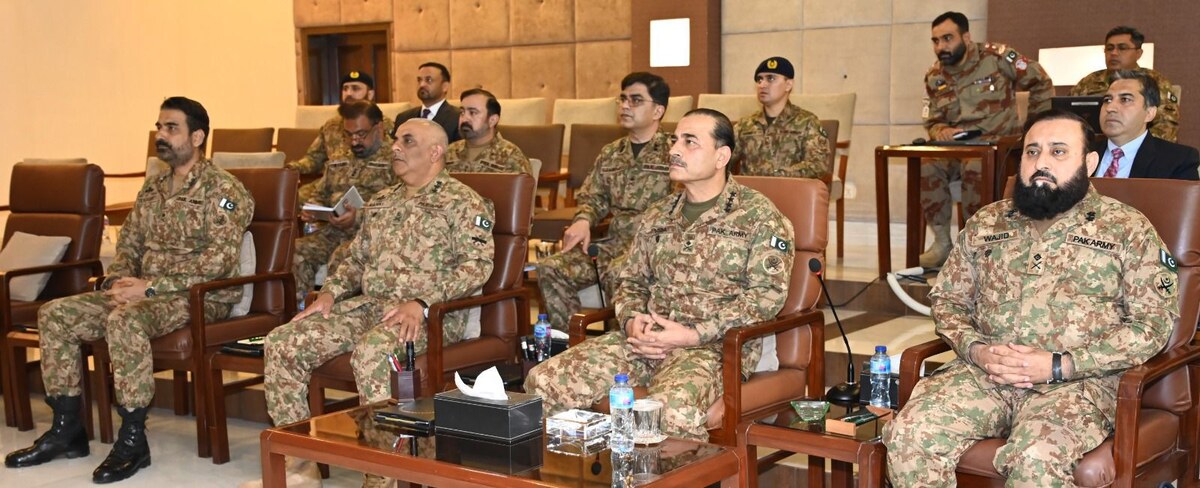


In this handout photo, released by Pakistan’s Inter-Services Public Relations (ISPR), Pakistan Army Chief General Syed Asim Munir (2R) gestures during a briefing on a security briefing in Quetta on February 1, 2025. (Photo courtesy: ISPR)

Pakistani forces suffered the casualties when they engaged militants who had erected barricades on a key highway in Balochistan’s Kalat district late on Friday night. The banned Baloch Liberation Army (BLA), one of the most prominent separatist groups operating in the southwestern province, claimed responsibility for the incident.
The fighting continued overnight into Saturday morning and the military said it had killed at least 23 militants in subsequent clearance operations.
Balochistan has for years been the scene of an insurgency, with several separatist groups staging attacks and targeting mainly security forces in their quest for independence. The separatists accuse Islamabad of exploiting the province’s natural resources. Successive Pakistani governments deny the allegations and say they have prioritized Balochistan’s development through investments in health, education and infrastructure projects.
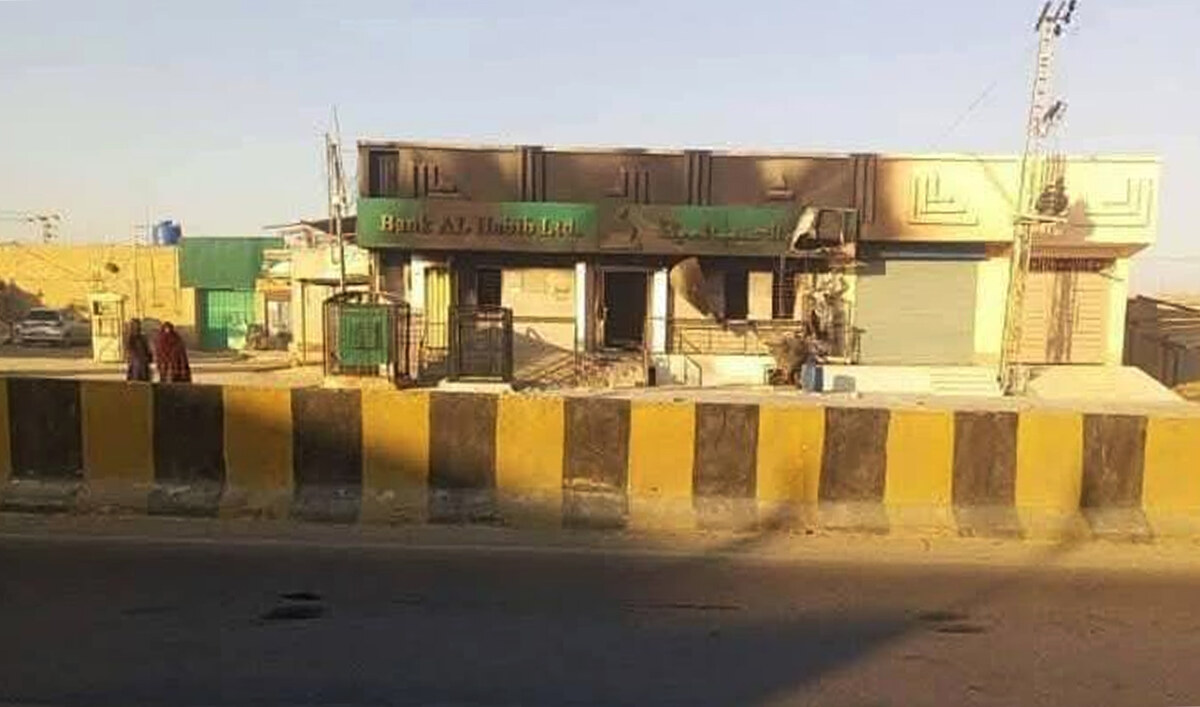


A handout image released by Balochistan Levies on February 1, 2025, shows a bank damaged in an overnight attack by separatist militants in the town of Mangochar, located in Balochistan’s Kalat district. (Photo courtesy: Balochistan Levies)

In the past, the BLA has carried out major attacks in Balochistan and other parts of Pakistan, targeting security forces, ethnic Punjabis whom it considers “outsiders” in Balochistan, and Chinese interests and nationals.
More than 50 people, including security forces, were killed in August last year in a string of assaults in Balochistan that were claimed by the BLA. Last month, dozens of fighters of the separatist outfit wrested control of a small town in Khuzdar from the Levies paramilitary forces. Pakistani authorities had regained the town after hours of efforts.


Pakistan, China to sign multiple MoUs at major agriculture investment conference today

Updated 18 January 2026
Follow

Pakistan, China to sign multiple MoUs at major agriculture investment conference today

  • Hundreds of Chinese and Pakistani firms to attend Islamabad event
  • Conference seen as part of expanding CPEC ties into agriculture, trade

KARACHI: Islamabad and Beijing are set to sign multiple memorandums of understanding (MoUs) to boost agricultural investment and cooperation at a major conference taking place in the capital today, Monday, with hundreds of Chinese and Pakistani companies expected to participate.

The conference is being billed by Pakistan’s Ministry of National Food Security and Research as a platform for deepening bilateral agricultural ties and supporting broader economic engagement between the two countries.

“Multiple memorandums of understanding will be signed at the Pakistan–China Agricultural Conference,” the Ministry of National Food Security said in a statement. “115 Chinese and 165 Pakistani companies will participate.”

The conference reflects a growing emphasis on expanding Pakistan-China economic cooperation beyond the transport and energy foundations of the flagship China-Pakistan Economic Corridor (CPEC) into agriculture, industry and technology.

Under its first phase launched in 2015, CPEC, a core component of China’s Belt and Road Initiative, focused primarily on transportation infrastructure, energy generation and connectivity projects linking western China to the Arabian Sea via Pakistan. That phase included motorways, power plants and the development of the Gwadar Port in the country's southwest, aimed at helping Pakistan address chronic power shortages and enhance transport connectivity.

In recent years, both governments have formally moved toward a “CPEC 2.0” phase aimed at diversifying the corridor’s impact into areas such as special economic zones, innovation, digital cooperation and agriculture. Second-phase discussions have highlighted Pakistan’s goal of modernizing its agricultural sector, attracting Chinese technology and investment, and boosting export potential, with high-level talks taking place between planning officials and investors in Beijing.

Agri-sector cooperation has also seen practical collaboration, with joint initiatives examining technology transfer, export protocols and value-chain development, including partnerships in livestock, mechanization and horticulture.

Organizers say the Islamabad conference will bring together government policymakers, private sector investors, industry associations and multinational agribusiness firms from both nations. Discussions will center on investment opportunities, technology adoption, export expansion and building linkages with global buyers within the framework of Pakistan-China economic cooperation.