Supporters of Istanbul mayor clash with police

1 / 2
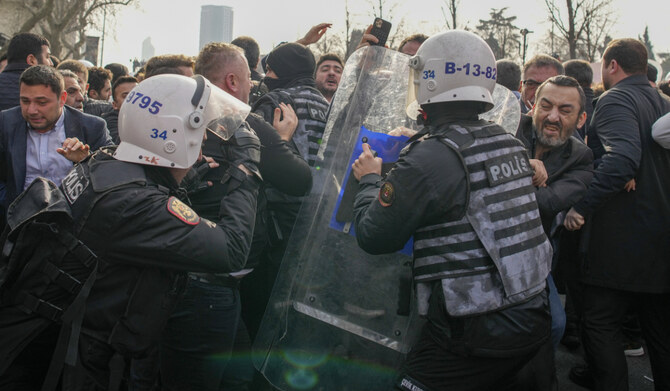
Turkish police officers clash with Istanbul's Mayor Ekrem Imamoglu supporters as they gather in front of the Istanbul courthouse, in Istanbul, Turkey, Friday, Jan. 31, 2025. (AP)
2 / 2
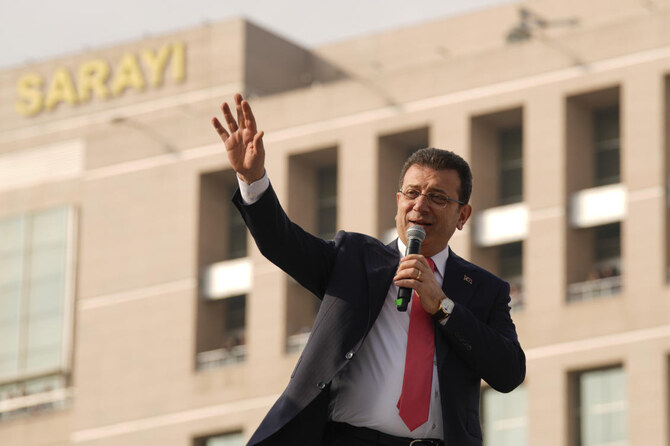
Istanbul’s mayor, Ekrem Imamoglu said there was a ‘conspiracy’ against him. (AP)
Short Url
Updated 31 January 2025
Follow

Supporters of Istanbul mayor clash with police

  • Imamoglu, 53, was first elected to lead Istanbul in March 2019
  • Critics argue that the probes were part of an effort to remove Imamoglu from the political scene

ISTANBUL: Police in Turkiye fired tear gas to disperse a group of protesters who clashed with officers on Friday outside an Istanbul courthouse while rallying in support of the city’s mayor, who was called to give testimony in two new legal probes against him.
Thousands of supporters gathered outside the Caglayan courthouse to protest the legal actions against Ekrem Imamoglu, a potential future leader of Turkiye’s main opposition, the Republican People’s Party, or CHP.
Imamoglu testified on Friday before prosecutors for two hours in connection with comments he made about a chief prosecutor and a court expert.
Critics argue that the probes were part of an effort to remove Imamoglu from the political scene.

FASTFACT

Thousands of supporters gathered outside the Caglayan courthouse to protest the legal actions against Ekrem Imamoglu.

The politician has already been convicted of charges of insulting members of Turkiye’s Supreme Electoral Council and faces a political ban if a high court upholds his conviction in 2022.
He is also on trial on charges involving the alleged rigging of bids in a tender dating back to 2015.
Tensions escalated on Friday when riot police blocked a CHP bus from approaching the courthouse.
The move led to clashes between the protesters and the police, who responded with tear gas.
It was not clear if any arrests were made. Imamoglu later addressed the crowds from the top of the bus at another location.
“Today’s issue is ... an issue of seeking rights and justice,” the mayor said.
“Unfortunately, today’s issue stems from a conspiracy against Istanbul.”
Imamoglu, 53, was first elected to lead Istanbul in March 2019.
His win was a historic blow to Justice and Development Party, which had controlled Istanbul for a quarter-century.
The party pushed to void the municipal election results, alleging irregularities in the city of 16 million.
The challenge resulted in a repeat of the election a few months later, which Imamoglu also won.
Imamoglu was reelected mayor of Turkiye’s largest city last year.


How Lebanon’s health system is coping as renewed war drives mass displacement

Updated 6 sec ago
Follow

How Lebanon’s health system is coping as renewed war drives mass displacement

  • Hospitals and aid groups race to meet surging healthcare needs as Israeli operation displaces hundreds of thousands
  • Aid groups deploy mobile clinics and scramble for chronic-disease medications amid dwindling supplies and funding

LONDON: As Israeli airstrikes and ground operations drive hundreds of thousands of civilians from their homes in southern Lebanon and the Bekaa Valley, hospitals and aid groups say they are racing to set up clinics and supply chains to help displaced families.
The strain is already visible on the frontlines of care. “It is a hard day,” Dr. Mohamad Abdallah, CEO of Rayak Hospital in Bekaa, told Arab News on March 6. “All the surrounding (areas) were warned to leave their houses, which caused shortage of staff and panic in the hospital.”
Given the scale and short notice of Israeli evacuation orders, issued on March 2, Abdallah said some communities could not make it out before the bombing began. “We are dealing with many injuries and death unfortunately,” he said.
“There is a village where people could not evacuate, and it was hit by Israeli airstrikes, and casualties, including martyrs and injuries, started pouring into the hospital.” After midnight, in the early hours of March 7, the hospital received the bodies of 19 civilians.
Israel has ordered civilians to evacuate Beirut’s southern suburbs, Bekaa, and the entire area south of the Litani River — directives that Ravina Shamdasani, spokesperson for the UN High Commissioner for Human Rights, called “blanket displacement orders.”
“In all, hundreds of thousands have now been affected by these Israeli displacement orders,” Shamdasani said in a March 6 statement.
“Their breadth makes them very difficult for the population to comply with and therefore brings into question their effectiveness, a requirement under international humanitarian law, and risks amounting to prohibited forced displacement.”
At the Rayak Hospital, the evacuation order caused chaos. On March 3, while some staff were working their regular shifts, others were forced from their homes by nearby strikes and are now sleeping at the facility.
Despite the upheaval, Abdallah said the medical sector had not yet been overwhelmed, in part because of swift government action.
“The Ministry of Public Health issued a directive requiring hospitals to accept all injured patients at the ministry’s expense, including people displaced to Beirut and other parts of the country,” he said. “A hotline has also been set up to connect displaced residents with care.”
The crisis, which escalated following joint US-Israeli strikes on Iran on Feb. 28, caps months of simmering violence, which has shattered the fragile ceasefire of November 2024 between Israel and the Iran-backed Hezbollah.
The conflict escalated sharply after Iran confirmed the killing of Supreme Leader Ali Khamenei in an Israeli strike on Feb. 28. Hezbollah launched a barrage of missiles and drones at an Israeli military site in Haifa, northwestern Israel, displacing thousands of Israeli civilians from the north.
Israel swiftly retaliated with airstrikes across more than 50 villages in southern and eastern Lebanon and hammered the southern outskirts of Beirut.
According to Lebanon’s Health Ministry and the World Health Organization, Israeli strikes have killed roughly 400 people in Lebanon in about a week of fighting since early March, including dozens of children.
In a March 7 statement, Prime Minister Benjamin Netanyahu said Israel would “do everything necessary to protect our communities and our citizens,” casting Hezbollah’s actions as acts of aggression that forced Israel to act to defend its population.
“I say again to the Lebanese government: It is your responsibility to enforce the ceasefire agreement and it is your responsibility to disarm Hezbollah. If you do not do so, Hezbollah’s aggression will bring catastrophic consequences upon Lebanon.”
Prime Minister Nawaf Salam warned of a “looming humanitarian disaster.” The sustained bombardment has compounded the suffering of a civilian population already exhausted by years of war and financial collapse — and the humanitarian response is struggling to keep pace.
“The situation is bad,” Dr. Tania Baban, Lebanon country director for the US-headquartered NGO MedGlobal, told Arab News on March 6. “Funding is very minimal, aid is very minimal, people are in the streets or in school shelters.
“In just the last 48 hours, more than 100,000 people have been forced to flee their homes. The scale and speed of this displacement is pushing humanitarian resources to the brink.
“Schools don’t have showers, soap or towels. It’s cold. There are no mattresses. People are sleeping on cardboards on the streets. There are no blankets, let alone medications.
“Many people are arriving at shelters without basic supplies like food, medications, infant formula, diapers, or warm clothing.
“Every hour, more families are leaving their homes. And right now, humanitarian resources are struggling to keep up with the scale of displacement.”
Echoing Baban’s concerns, Valerie Rowles, director of program implementation at Relief International, said in a statement that schools converted into shelters “are already overwhelmed and under-resourced.”
“Families are arriving traumatized and fearful, only to find overcrowded shelters with very few provisions,” she said, highlighting that medical treatment, medicine, and mental health support are among the most pressing needs.
As of March 6, some 110,162 people had been registered at 512 shelters nationwide, said Baban.
“That is a massive displacement. Shelters are filling so quickly that authorities are now preparing to open the main sports stadium in Beirut to accommodate additional displaced families.
“We’re only a team of five, but from day one (of the Israeli assault), three people had to move and evacuate somewhere else. We have no time to think about our own safety.”
On March 5, Medecins Sans Frontieres said it was “alarmed by the dramatic escalation in conflict across the Middle East.” Program Manager Francesca Quinto said “there is nowhere safe to go” for thousands of civilians.
Thousands have fled with nothing, many on foot, leaving essential medication behind. Many are fasting as they observe the holy month of Ramadan.
Elderly residents are stranded, sleeping on sidewalks in the cold. Pregnant women face uncertainty, and many are unsure where their next meal will come from. Children are sleeping in cars or in the open.
Amid the chaos, aid groups are racing to fill the gaps. Hassan El-Rashidi, president of the Sidon-based Education Planet Association, said his organization operates three mobile clinics and a public health dispensary.
“We’re working in the shelters around Sidon because people are in need of medications for chronic conditions, like asthma,” El-Rashidi told Arab News on March 3.
“We’re two associations working on the ground together — the Development and Cooperation Association and the Education Planet Association.”
On March 6, the association’s offices in Sidon were bombed. El-Rashidi said no staff were injured, but the damage poses a serious setback to their work.
Displacement in the south began even before the Israeli military’s latest evacuation orders. Within two days, about 9,000 people had fled to Sidon. The municipality, in coordination with NGOs, opened 13 shelters, said El-Rashidi.
“The needs are immense, especially for medication,” he said.
“Many people are sleeping on beaches and in open areas, I swear, because there is simply nowhere else to go. Shelters are full. Sidon is the main city in the south, and funding is scarce.
“Many people are stuck in cars on the Sidon-Beirut highway, so the numbers will only increase here.”
To support affected communities, Health Minister Rakan Nasreddine directed hospitals to provide medical services, including treatment for trauma injuries, dialysis and cancer care, free of charge.
The minister has also called on all NGOs with mobile clinics to assist displaced populations, according to El-Rashidi.
Relief International is providing critical healthcare through emergency medical units deployed to shelters in Beirut, Bekaa, West Bekaa, and Baalbek.
“We are doing everything within our power to provide the care and emergency aid that people need, but the situation is only getting worse with thousands more being forced to flee,” Rowles said, stressing the urgent need for increased funding.
MSF teams, meanwhile, are running clinics across the country — in Bourj Hammoud serving migrant workers, in Baalbek-Hermel providing primary healthcare to host and refugee communities, in the south, and in Tripoli and Akkar reaching Syrians who lack access to care.
MedGlobal is prioritizing support for mothers and infants. “We are preparing to receive funds to support a mobile unit in Sidon to try to reach displaced communities with no access to healthcare,” Baban said. “But funding is limited.”
Before the recent escalation, the organization had planned a maternity program set to launch in April.
It included providing its partner in Sidon, Education Planet Association, with a “full-size ultrasound machine for the fixed clinic and a portable point-of-care ultrasound device for the mobile unit,” Baban said.
“The POCUS device is roughly the size of a mobile phone and connects wirelessly to a tablet, allowing the family physician to perform ultrasound scans in the field.”
The goal is to identify complicated pregnancies so that expecting mothers can be properly referred to hospitals.
During the 2024 war, MedGlobal provided medical support through Primary Satellite Units, which refer patients to permanent healthcare centers for ongoing care.
These units have not yet been activated for the current escalation because “this crisis is moving extremely fast,” Baban said.
But even as aid groups expand their reach, a critical funding gap threatens to undermine the response.
Since late 2025, the UN refugee agency, UNHCR, has ceased healthcare coverage for about 1.5 million Syrian refugees in Lebanon due to funding cuts.
While some 50,000 Syrians have crossed from Lebanon into Syria over the past week, according to the International Organization for Migration, many more remain trapped or stranded — or even denied shelter.
Beyond the funding shortfall, other pressing challenges persist, including insufficient shelters and medication shortages, El-Rashidi said.
With resources dwindling and displacement growing, the hospitals and aid groups scrambling to respond face a stark question: how long can they keep up with the scale of need?