ISTANBUL: Turkey’s main opposition scored a major blow against President Recep Tayyip Erdogan last month when it won control of Istanbul, but now faces a wounded government reluctant to relinquish power.
With Erdogan expected to stay in office until at least 2023, the new mayor of Istanbul, Ekrem Imamoglu of the secular Republican People’s Party (CHP), knows he must find a way to work with the president.
But the signs are mixed.
After Erdogan’s ruling AKP party lost Turkey’s largest city in a rerun vote on June 23, the president congratulated Imamoglu and described the vote as the “will of the people.”
But just days later his government moved to strip Imamoglu of key mayoral powers of patronage.
The show of strength raises strategic questions for Imamoglu, who has vowed to work “in harmony” with Erdogan but is also talked about as a future presidential challenger.
Having called for a meeting with Erdogan to address the urgent problems of the 15-million-strong metropolis, the new mayor has so far remained fairly vague about his plans.
He has promised to crack down on alleged lavish spending at the municipality and bring in international-standard auditors to assure transparency, warning that the city faces bankruptcy if urgent action is not taken.
Imamoglu also said he would create green belts in Istanbul, and return trees and grass to Taksim square in the heart of the city — echoing the demands of protesters who triggered a mass anti-government movement over the redevelopment of neighboring Gezi park in 2013.
Urban planners remain skeptical about his promises.
“Istanbul’s green space problem is not only about hostility to nature — it’s also a question of the economy,” said Sedat Durel, environment engineer at the Chamber of Environmental Engineers.
Durel said nothing will change without a fundamental change in the current governing mentality, which favors mass commercial development over natural spaces.
Imamoglu, who started out in his family’s lucrative real estate and restaurant business in western Istanbul, does not appear to have an obvious background to shift that mindset.
“Although there is hope it will not continue this way, we have yet to hear anything concrete,” said Durel.
After failing to mount serious challenges in elections for decades, Turkey’s main opposition has been revitalized by Imamoglu’s win.
Aside from the sky-high expectations, his biggest challenge may be overcoming a municipal council dominated by AKP members and its right-wing ally, the MHP, which together control 25 of 39 city districts.
Ege Seckin, an analyst at IHS Markit, said Imamoglu’s new job would be an “uphill struggle.”
“The government will go to great lengths to impede his work, seeking to validate their long-standing claim that the AKP is the only game in town when it comes to delivering basic services, and that all alternatives, including the CHP, are incompetent,” Seckin told AFP.
The first sign of trouble came immediately after the June 23 election, when Erdogan’s government issued a circular shifting the power to assign managers of municipal companies from the mayor to the council.
“We were informed of a change in legislation,” Imamoglu told reporters this month, warning against “political maneuvering” to limit his power.
The first municipal council meeting chaired by Imamoglu on July 8 — which was aired live, as part of his efforts at greater transparency — nonetheless saw positive messages from the AKP rank and file.
One AKP councilor, Tevfik Goksu, assured that the party would avoid “negative” attitudes and support any project that serves Istanbul.
The CHP remains unconvinced.
“Do I expect serious obstacles on some areas? Yes, I do, given their power and majority in the assembly,” said Tarik Balyali, a CHP spokesman in the municipal council.
But he warned the public would also blame the AKP if the party tried to undermine Imamoglu’s efforts to improve municipal services.
Many opponents of Erdogan hope Imamoglu can use the platform of Istanbul to mount a serious challenge at the national level — just as the president himself did in the 1990s.
But Imamoglu’s prospects depend not only on getting results in the city, but also on his ability to maintain support from divergent opposition groups including secular Turks and Kurdish opposition voters, and maybe even AKP dissidents, said Seckin.
“This was a relatively easier task for a municipal election, but a national-level competition is likely to be more vicious, and the fault lines separating different opposition factions are likely to matter far more,” he said.


![]()

Istanbul’s new mayor Ekrem Imamoglu faces tough road ahead after landslide win
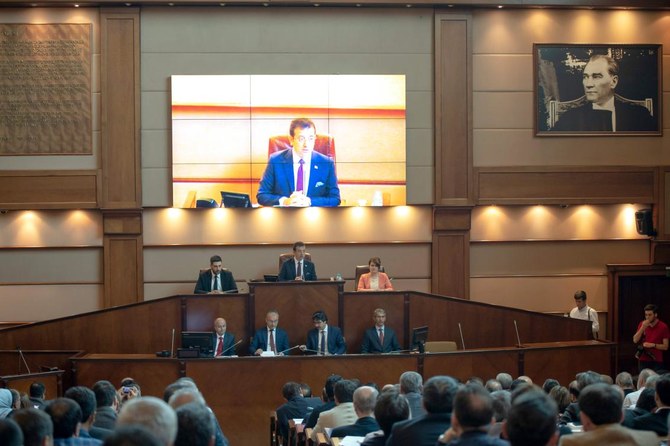
Istanbul’s new mayor Ekrem Imamoglu faces tough road ahead after landslide win
- Ekrem Imamoglu must find a way to work with Turkey’s President Recep Tayyip Erdogan
- The president has congratulated opposition leader Imamoglu and described the vote as the ‘will of the people’


Latest updates


© 2026 SAUDI RESEARCH & PUBLISHING COMPANY, All Rights Reserved And subject to Terms of Use Agreement.