

With eye to Vision 2030, Pakistan says working to send skilled workers to Saudi Arabia

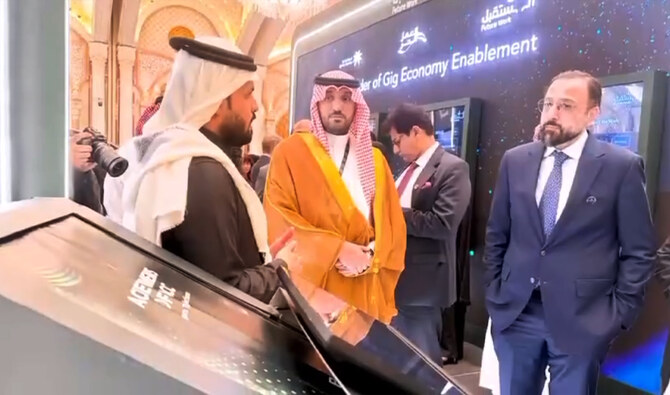
The screengrab taken from a video shows Federal Minister for Overseas Pakistanis and Human Resource Development Chaudhry Salik Hussain (right) attends the second Global Labor Market Conference in Riyadh, Saudi Arabia on January 30, 2025. (Minister for Overseas Pakistanis and Human Resource Development)
Short Url
Updated 31 January 2025
Follow

With eye to Vision 2030, Pakistan says working to send skilled workers to Saudi Arabia

  • Minister Chaudhry Salik Hussain attends second Global Labour Conference in Riyadh from Jan. 29-30
  • Although 97 percent of Pakistani workers in Kingdom are blue-collar, there is rising demand for skilled workers

ISLAMABAD: Federal Minister for Overseas Pakistanis and Human Resource Development, Chaudhry Salik Hussain, said on Thursday Islamabad was working to increase the number of skilled Pakistanis going for work to Saudi Arabia which requires innovative project management and well-trained labor as it implements the Vision 2030 economic plan, his office said in a statement. 

Pakistanis are one of the largest migrant communities in Saudi Arabia, with an estimated 2.64 million working there as of 2023. Although 97 percent of them are blue-collar workers, there is a rising demand for skilled workers in the Kingdom as it moves to consolidate its economy on modern lines under the Vision 2030 program, a strategic development framework intended to cut reliance on oil. The plan is aimed at developing public service sectors such as health, education, infrastructure, recreation and tourism.

Islamabad has been working on a new education policy to impart technical and other skills to at least a million youth per annum to export better-trained human resource to Gulf countries, including Saudi Arabia, according to Pakistan’s education ministry.

“Efforts are being made to further increase the number of skilled workers,” Hussain was quoted as saying in a statement on Thursday after he attended the second Global Labour Market Conference being held in Saudi Arabia from Jan. 29-30. “Saudi Arabia values Pakistani workers and skilled professionals.”

The Global Labor Market Conference brings together policymakers, labor leaders, academics, and business pioneers worldwide to inspire innovative solutions to labor market challenges. As the only platform of its kind, the GLMC fosters high-level discussions on workforce dynamics, skills development, and labor policies shaping the future of work. This year’s conference has over 180 speakers, 5,000 participants and more than 70 international ministers.

“Hussain emphasized that Pakistan is committed to organizing and activating the labor market in collaboration with experts,” the statement from his office added. 

“I believe the biggest benefit of such conferences [Global Labor Market Conference, Riyadh] is that even today, they mentioned that Pakistan is our number one preferred market,” Hussain said in a video shared by his ministry. 

“And god willing, soon Takamul [Saudi company] will further expand its operations in Pakistan, and they will have collaborations with several [Pakistani] universities also. 

“So, I believe it is a very encouraging thing that Saudi Arabia also gives priority to Pakistan and Pakistani workers.”

On Wednesday, Pakistan’s Ambassador to Saudi Arabia Ahmad Farooq visited the Karachi Chamber of Commerce and Industry (KCCI) where he said the next two years would be crucial for Pakistan in expanding its presence in Saudi Arabia and capitalizing on “abundant opportunities” in the Kingdom’s construction, information technology, health care and hotels and hospitality sectors.

He stressed the need for Pakistan to impart better skills to its workforce so that they could secure gainful employment in the Kingdom. 

“If we do not claim our share immediately, it will be taken by competitors but to achieve this, Pakistan needs to focus on improving its workforce by imparting training as per Saudi requirements,” Farooq added.


Pakistan urges diplomacy on Iran nuclear issue, warns sanctions would hurt civilians

Updated 10 sec ago
Follow

Pakistan urges diplomacy on Iran nuclear issue, warns sanctions would hurt civilians

  • Pakistan warns the situation has become more complex since Israel’s attack on Iran and US bombing of nuclear sites
  • It cautions against invoking the snapback mechanism, saying sanctions will further deepen mistrust, derail diplomacy

ISLAMABAD: Pakistan demanded on Tuesday that diplomacy be given a chance in addressing all issues related to Iran’s nuclear program, warning the United Nations Security Council that sanctions would hurt ordinary Iranians, as tensions remain heightened following this year’s war between Israel and Iran.

Pakistan’s comments came amid renewed debate at the Security Council over Iran’s nuclear program and the future of the Joint Comprehensive Plan of Action (JCPOA), which sought to limit Tehran’s nuclear activities in exchange for sanctions relief.

The conflict in June was dubbed the Twelve-Day War and erupted after Israel carried out a surprise attack on Iranian military and nuclear facilities while international diplomacy was still underway. The strikes derailed negotiations, with the United States later bombing Iranian nuclear sites and declaring that the attacks had substantially degraded Iran’s nuclear capabilities.

Addressing the Security Council, Pakistan’s Acting Permanent Representative Ambassador Usman Jadoon said Islamabad believed that “diplomacy and dialogue should be the guiding principles for the resolution of all outstanding issues concerning Iran’s nuclear program in accordance with the rights, obligations and responsibilities of the parties concerned.”

“Coercive measures would not help in bringing the parties closer and only exacerbate the trust deficit,” he said. “Sanctions directly hurt ordinary people the most, impact trade, affect economic development and diminish the prospects of regional connectivity.”

Jadoon said the council last met on the issue in September following developments related to the JCPOA’s “snapback” mechanism — a provision that allows the automatic re-imposition of UN sanctions on Iran in cases of alleged non-compliance — adding that Pakistan opposed what it viewed as a rushed move and cautioned against hasty action.

He said Pakistan’s stance was grounded in the belief that disputes over Iran’s nuclear program should be resolved through dialogue, with more time allowed for diplomacy to succeed, while preserving the JCPOA framework until a successor arrangement is reached.

The ambassador said divisions within the council had widened in recent months, further complicating efforts to resolve the issue.

While acknowledging that the JCPOA was not implemented as intended, Jadoon said the agreement had nonetheless provided an essential framework rooted in international law and mutual respect, and could still prove useful if there was a shared willingness to move forward in a spirit of compromise.

He stressed the need to revive the agreement’s underlying principles and restore trust in diplomatic engagement that had been damaged in recent months, urging all parties to avoid confrontation and work toward a solution-oriented approach.