



RAMALLAH: Israel released 110 Palestinian prisoners on Thursday in exchange for three Israeli hostages held in Gaza. Five Thai workers held captive in the enclave were also freed in a separate deal with Thailand. Thursday's prisoner-for-hostage swap marked the third round of exchanges as a ceasefire deal between Israel and Hamas entered its second week.
Most of the prisoners stepped off the Red Cross bus and onto the shoulders of jubilant supporters in the occupied West Bank, where U.N. data shows that one in five Palestinians has passed through Israeli jail and the release of prisoners is a source of joyous national celebration — a homecoming in which almost all Palestinians felt they could partake.
But 23 of them serving life sentences were transferred to Egypt before further deportation.
The prisoners released Thursday were all men, ranging in age from 15 to 69.
Here's a look at some prominent Palestinian prisoners released since the ceasefire deal went into effect on Jan. 19.
Zakaria Zubeidi
Zakaria Zubeidi is a prominent former militant leader and theater director whose dramatic jailbreak in 2021 thrilled Palestinians across the Middle East and stunned the Israeli security establishment.
Zubeidi once led the Al Aqsa Martyrs’ Brigade — an armed group affiliated with Fatah, the secular political party that controls the Palestinian Authority — that carried out deadly attacks against Israelis during the second intifada, or Palestinian uprising, between 2000 and 2005.
After the intifada in 2006, Zubeidi co-founded a theater in his hometown of Jenin refugee camp, a hotbed of Palestinian militancy, to promote what he described as cultural resistance to Israel. Even today, the Freedom Theater in Jenin refugee camp puts on everything from Shakespeare to stand-up comedy to plays written by residents.
In 2019, after Zubeidi had already served years in prison for attacks in the early 2000s, Israel arrested him again over his alleged involvement in shooting attacks that targeted buses of Israeli settlers but caused no injuries.
Zubeidi, who was released Thursday, had been awaiting trial in prison. He denies the charges, saying that he gave up militancy to focus on his political activism after the intifada.
In 2021, he and five other prisoners tunneled out of a maximum-security prison in northern Israel, an escape that helped solidify Zubeidi’s image among Palestinians as a folk hero. All six were recaptured days later.
In a room packed with family members and supporters smiling, laughing, and jostling for a view of him, Zubeidi shouted to be heard over the frenzy and expressed thanks for God and his loved ones. He searched for words as reporters thrust microphones toward him, offering Islamic prayers to those wounded and killed in Gaza.
Rather than set off to Jenin camp after being freed, he stayed in Ramallah on Thursday night. Israel launched an extensive military raid earlier this month in the Jenin camp that so far has killed at least 18 Palestinians and sent scores of families fleeing.
“May God grant victory to our brothers in the Jenin camp,” Zubeidi said. His son, Mohammed, was killed in an Israeli drone strike last September in the camp.
Palestinian medics, who have raised concerns about the conditions of detainees emerging from Israeli detention, said Zubeidi looked weak and malnourished. Dr. Mai Al-Kaileh, who examined him, said his ribs had been shattered and he had lost a startling amount of weight.
“His condition is very difficult,” she said. “It's not good.”
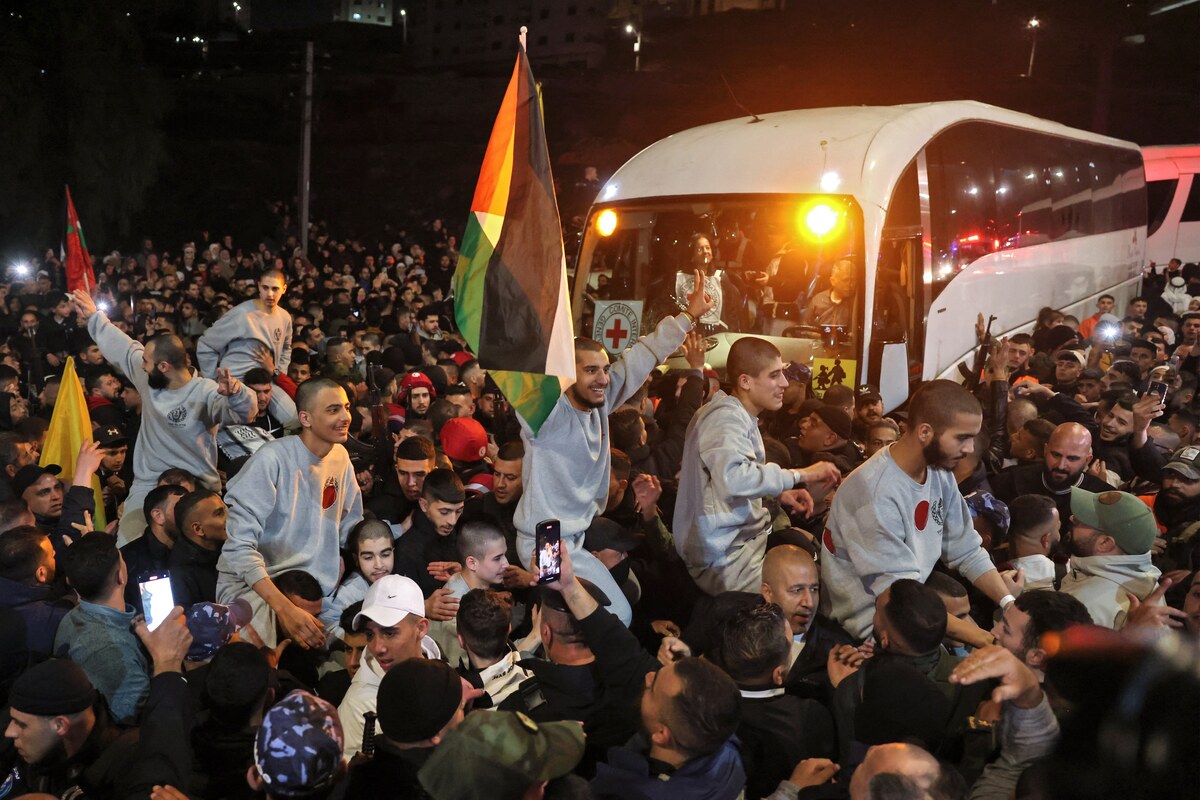
A crowd welcomes Palestinians formerly jailed by Israel as they arrive in a Red Cross convoy to Ramallah in the occupied West Bank, Jan. 30 (AFP)
Mohammed Abu Warda
A Hamas militant during the second intifada, Abu Warda helped organize a series of suicide bombings that killed over 40 people and wounded more than a hundred others. Israel arrested him in 2002, and sentenced him to 48 terms of lifetime imprisonment, among the longest sentences it ever issued.
As a young student, Abu Warda joined Hamas at the start of the intifada following Israel's killing of Yahya Ayyash, the militant group's leading bomb maker, in 1996.
Palestinian authorities said at the time that Warda had helped to recruit suicide bombers — including his cousin, his cousin’s neighbor and a classmate at the Ramallah Teachers College — whose attacks targeting crowded civilian areas in Israeli cities killed scores of people in the early 2000s.
Warda was released on Thursday.
Mohammed Aradeh, 42
An activist in Palestinian Islamic Jihad, Aradeh, was sentenced to life in prison for a range of offenses going back to the second intifada. Some of the charges, according to the Israeli Prison Service, included planting an explosive device and attempting murder.
He was credited with plotting the extraordinary prison escape in 2021, when he and five other detainees, including Zubeidi, used spoons to tunnel out one of Israel’s most secure prisons. They remained at large for days before being caught.
From an impoverished and politically active family in Jenin, in the northern occupied West Bank, Aradeh has three brothers and a sister who have all spent years in Israeli prisons.
He was welcomed as a sort of cult hero in Ramallah on Saturday as family, friends and fans swarmed him, some chanting “The freedom tunnel!” in reference to his jailbreak. When asked how he felt, Aradeh was breathless.
Over and over he muttered, “Thank God, thank God.”
Mohammed Odeh, 52, Wael Qassim, 54, and Wissam Abbasi, 48
All three men hail from the neighborhood of Silwan, in east Jerusalem, and rose within the ranks of Hamas. Held responsible for a string of deadly attacks during the second intifada, the men were sentenced to multiple life sentences in 2002.
They were accused of plotting a suicide bombing at a crowded pool hall near Tel Aviv in 2002 that killed 15 people. Later that year, they were found to have orchestrated a bombing at Hebrew University that killed nine people, including five American students. Israel had described Odeh, who was working as a painter at the university at the time, as the kingpin in the attack.
All three were transferred to Egypt last Saturday. Their families live in Jerusalem and said they will join them in exile.
The Abu Hamid brothers
Three brothers from the prominent Abu Hamid family of the Al-Amari refugee camp in Ramallah — Nasser, 51, Mohammad, 44, and Sharif, 48 — were also deported to Egypt last Saturday. They had been sentenced to life in prison over deadly militant attacks against Israelis in 2002.
Their brother, a different Nasser Abu Hamid, was one of the founders of the Al-Aqsa Martyrs’ Brigade. He was also sentenced to life in prison for several deadly attacks. His 2022 death from lung cancer behind bars unleashed a wave of angry protests across the West Bank as Palestinian officials accused Israel of medical neglect.
The family has a long arc of Palestinian militancy. The mother, Latifa Abu Hamid, 72, now has three sons exiled, one still imprisoned, one who died in prison and one who was killed by Israeli forces. Their family house has been demolished at least three times by Israel, which defends such punitive home demolitions as a deterrent against future attacks.
Mohammad al-Tous, 67
Al-Tous had held the title of longest continuous Israeli imprisonment until his release last Saturday, Palestinian authorities said.
First arrested in 1985 while fighting Israeli forces along the Jordanian border, the activist in the Fatah party spent a total of 39 years behind bars. Originally from the West Bank city of Bethlehem, he was among the prisoners exiled.


