RABAT: Morocco has halted imports of feed grains from Germany following an outbreak of foot-and-mouth disease, the head of Morocco’s grain trade federation (FNCL) said on Thursday.
The import suspension affected “all untreated plant-based feed intended for animal consumption from Germany due to the foot-and-mouth disease outbreak there,” Omar Yacoubi told Reuters.
A source at Morocco’s food safety agency ONSSA confirmed that plant-based imports from Germany for animal feed had been “suspended” until Germany is declared free of foot and mouth again or certifies local regions that are free of the disease.
Germany announced its first outbreak of foot-and-mouth disease in nearly 40 years on Jan. 10 in a herd of water buffalo near Berlin in the Brandenburg region. That remains the only reported case so far.
The outbreak has led to trade restrictions from some countries including Britain on livestock-related goods from Germany.
Germany’s agriculture ministry said on Jan. 13 that the loss of Germany’s status as a country free of foot-and-mouth disease meant exporting a wide range of farm products outside the European Union would no longer be possible.
Traders have reported that exporters have sourced some feed barley cargoes for Morocco in France instead of Germany in response to the trade restriction.
However, other importing countries were still accepting German feed grain and one cargo of German barley initially sold for Morocco would be shipped to Tunisia, traders said.
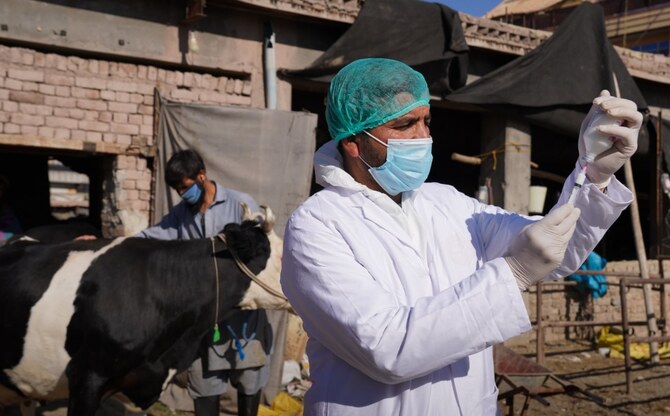
Foot-and-mouth disease is a highly infectious virus that causes fever and mouth blisters in cloven-hoofed ruminants, such as cattle, swine, sheep and goats, but poses no danger to humans.
The disease occurs regularly in parts of the world including in Africa but Morocco has not recorded an outbreak since 2019.


![]()


Morocco stops German feed grain imports over foot-and-mouth disease
Short Url
https://arab.news/gdgjw
Morocco stops German feed grain imports over foot-and-mouth disease
- A source at Morocco’s food safety agency ONSSA confirmed that plant-based imports from Germany for animal feed had been “suspended“
- The outbreak has led to trade restrictions from some countries including Britain


Syria begins circulating new post-Assad currency bills
- Presidential decree said new Syrian currency will be issued by removing two zeros from the nominal value of the old currency
- Central Bank govenor says Syrians can now exchange old Syrian pounds with new banknotes
DAMASCUS, Syria: Syria started the process of circulating new currency bills on Saturday as the nation seeks to stabilize the economy as it recovers from the fall of Bashar Assad’s government.
A decree issued earlier this week by President Ahmad Al-Sharaa said that “old Syrian currency” will be gradually withdrawn from circulation according to a timetable set by the central bank and through designated exchange centers.
Central Bank Governor Mokhles Nazer posted on X that after months of preparations, the exchange of old Syrian pounds with new banknotes officially began Saturday morning.
The presidential decree posted on the SANA state news agency stipulates that “new Syrian currency” will be issued by removing two zeros from the nominal value of the old currency. It means every 100 Syrian pounds of the old currency will now equate to one Syrian pound.
The largest denomination of the old currency was 5,000 Syrian pound, while under the new currency it is 500 pounds.
The US dollar was selling at exchange shops in Damascus on Saturday for 11,800 pounds for the old banknotes, some of which bear the images of Assad and his late father and predecessor, Hafez Assad.
At the start of Syria’s conflict in mid-March 2011, the US dollar was worth 47 Syrian pounds.
Since insurgent groups led by Al-Sharaa’s Hayat Tahrir Al-Sham marched into Damascus in December 2024 to end the Assad family’s 54-year rule, work has been ongoing by the country’s new authorities to improve the economy battered by years of war and Western sanctions.
The US and the European Union have removed most of the sanctions imposed on Syria during Assad’s rule.
A decree issued earlier this week by President Ahmad Al-Sharaa said that “old Syrian currency” will be gradually withdrawn from circulation according to a timetable set by the central bank and through designated exchange centers.
Central Bank Governor Mokhles Nazer posted on X that after months of preparations, the exchange of old Syrian pounds with new banknotes officially began Saturday morning.
The presidential decree posted on the SANA state news agency stipulates that “new Syrian currency” will be issued by removing two zeros from the nominal value of the old currency. It means every 100 Syrian pounds of the old currency will now equate to one Syrian pound.
The largest denomination of the old currency was 5,000 Syrian pound, while under the new currency it is 500 pounds.
The US dollar was selling at exchange shops in Damascus on Saturday for 11,800 pounds for the old banknotes, some of which bear the images of Assad and his late father and predecessor, Hafez Assad.
At the start of Syria’s conflict in mid-March 2011, the US dollar was worth 47 Syrian pounds.
Since insurgent groups led by Al-Sharaa’s Hayat Tahrir Al-Sham marched into Damascus in December 2024 to end the Assad family’s 54-year rule, work has been ongoing by the country’s new authorities to improve the economy battered by years of war and Western sanctions.
The US and the European Union have removed most of the sanctions imposed on Syria during Assad’s rule.
Latest updates





© 2026 SAUDI RESEARCH & PUBLISHING COMPANY, All Rights Reserved And subject to Terms of Use Agreement.