CAPE CANAVERAL, Florida: Asteroid samples fetched by NASA hold not only the pristine building blocks for life but also the salty remains of an ancient water world, scientists reported Wednesday.
The findings provide the strongest evidence yet that asteroids may have planted the seeds of life on Earth and that these ingredients were mingling with water almost right from the start.
“That’s the kind of environment that could have been essential to the steps that lead from elements to life,” said the Smithsonian Institution’s Tim McCoy, one of the lead study authors.
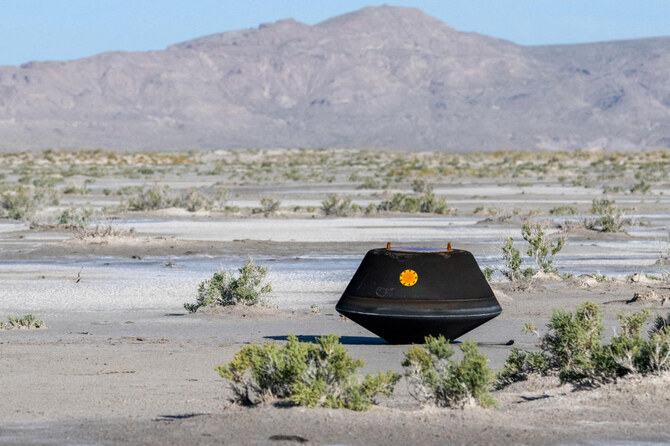
NASA’s Osiris-Rex spacecraft returned 122 grams (4 ounces) of dust and pebbles from the near-Earth asteroid Bennu, delivering the sample canister to the Utah desert in 2023 before swooping off after another space rock. It remains the biggest cosmic haul from beyond the moon. The two previous asteroid sample missions, by Japan, yielded considerably less material.
Small amounts of Bennu’s precious black grains — leftovers from the solar system’s formation 4.5 billion years ago — were doled out to the two separate research teams whose studies appeared in the journals Nature and Nature Astronomy. But it was more than enough to tease out the sodium-rich minerals and confirm the presence of amino acids, nitrogen in the form of ammonia and even parts of the genetic code.
Some if not all of the delicate salts found at Bennu — similar to what’s in the dry lakebeds of California’s Mojave Desert and Africa’s Sahara — would be stripped away if present in falling meteorites.
“This discovery was only possible by analyzing samples that were collected directly from the asteroid then carefully preserved back on Earth,” the Institute of Science Tokyo’s Yasuhito Sekine, who was not involved in the studies, said in an accompanying editorial.
Combining the ingredients of life with an environment of sodium-rich salt water, or brines, “that’s really the pathway to life,” said McCoy, the National Museum of Natural History’s curator of meteorites. “These processes probably occurred much earlier and were much more widespread than we had thought before.”
NASA’s Daniel Glavin said one of the biggest surprises was the relatively high abundance of nitrogen, including ammonia. While all of the organic molecules found in the Bennu samples have been identified before in meteorites, Glavin said the ones from Bennu are valid — “real extraterrestrial organic material formed in space and not a result of contamination from Earth.”
Bennu — a rubble pile just one-third of a mile (one-half of a kilometer) across — was originally part of a much larger asteroid that got clobbered by other space rocks. The latest results suggest this parent body had an extensive underground network of lakes or even oceans, and that the water evaporated away, leaving behind the salty clues.
Sixty labs around the world are analyzing bits of Bennu as part of initial studies, said the University of Arizona’s Dante Lauretta, the mission’s chief scientist who took part in both studies.
Most of the $1 billion mission’s cache has been set aside for future analysis. Scientists stress more testing is needed to better understand the Bennu samples, as well as more asteroid and comet sample returns. China plans to launch an asteroid sample return mission this year.
Many are pushing for a mission to collect rocks and dirt from the potentially waterlogged dwarf planet Ceres in the main asteroid belt. Jupiter’s moon Europa and Saturn’s moon Enceladus also beckon as enticing water worlds. Meanwhile, NASA has core samples awaiting pickup at Mars, but their delivery is on hold while the space agency studies the quickest and cheapest way to get them here.
“Are we alone?” McCoy said. “That’s one of the questions we’re trying to answer.”


![]()

Are we all aliens? NASA’s returned asteroid samples hold the ingredients of life from a watery world
Short Url
https://arab.news/cqakw
Are we all aliens? NASA’s returned asteroid samples hold the ingredients of life from a watery world


Latest updates


Recommended


© 2026 SAUDI RESEARCH & PUBLISHING COMPANY, All Rights Reserved And subject to Terms of Use Agreement.