Ethiopia in ‘relentless assault’ on rights groups: HRW

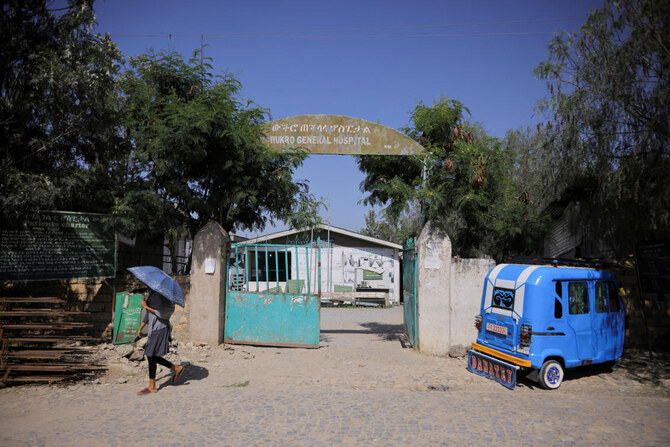
FILE PHOTO: A person walks in front of Wukro General Hospital in the Tigray Region, Ethiopia, September 21, 2024. (Reuters)
Short Url
Updated 29 January 2025
Follow

Ethiopia in ‘relentless assault’ on rights groups: HRW

ADDIS ABABA: Ethiopia is waging an “escalating crackdown” on civil society, Human Rights Watch said Wednesday, denouncing the suspension of two independent human rights groups in recent weeks.
In December, a government body overseeing civil society suspended the Ethiopian Human Rights Council (EHRC), the country’s oldest independent rights group, and the Ethiopian Human Rights Defenders Center (EHRDC).
The suspensions were based on “allegations they lacked independence and were acting beyond their mandate,” HRW said in a statement. The government move was “part of their escalating crackdown against civil society.”
“The Ethiopian authorities over the past year have waged a relentless assault against human rights groups,” said Mausi Segun, HRW’s Africa director.
“By suspending groups engaged in critical human rights documentation and advocacy, the government is showcasing its intolerance of independent scrutiny,” she added.
It follows the suspension of three other rights groups in December, the Center for the Advancement of Rights and Democracy, Lawyers for Human Rights and the Association for Human Rights in Ethiopia.
Only the latter has since had its suspension lifted.
Billene Seyoum, spokesperson for Prime Minister Abiy Ahmed, said since 2018 — when Abiy came to power — “significant measures” had been taken to create “a more inclusive and legally grounded environment for all actors to engage meaningfully in Ethiopia.”
“This includes transforming a once restricted and tightly controlled civil society space into one that allows organizations to operate freely and in a non-partisan manner, in compliance with the laws of the land,” she added.
The country of around 120 million people in the Horn of Africa is facing several armed conflicts, particularly in the most populous regions of Amhara and Oromia where federal forces are fighting armed militias.
Both federal forces and militias have been accused of human rights violations.


Indonesia’s first woman president awarded honorary doctorate by Princess Nourah University

Updated 10 February 2026
Follow

Indonesia’s first woman president awarded honorary doctorate by Princess Nourah University

  • Megawati was recognized for her leadership and contributions to social, legal affairs
  • She has received 10 other honorary degrees from Indonesian and foreign institutions

JAKARTA: Megawati Sukarnoputri, who served as Indonesia’s fifth president and was the country’s only female head of state to date, has been awarded an honorary doctorate by Princess Nourah bint Abdulrahman University in Riyadh, becoming the first foreign national to receive the title.

Megawati, the eldest daughter of Indonesia’s first President Sukarno and chairwoman of the country’s largest political party, the PDIP, served as president from 2001 to 2004.

The 79-year-old was awarded an honorary doctorate in organizational and legal affairs in Riyadh on Monday during a ceremony overseen by Princess Nourah University’s acting president, Dr. Fawzia bint Sulaiman Al-Amro.

“This recognition was given in appreciation of her efforts during her presidency, her significant contributions to social, organizational, and legal fields, and her role in strengthening institutional leadership in Indonesia,” the university said in a statement.

This is Megawati’s 11th honorary doctorate. She has received similar degrees from Indonesian and foreign universities, including the Moscow State Institute of International Relations in 2003 and the Soka University of Japan in 2020.

She has also been awarded the title of honorary professor by several institutions, including by the Seoul Institute of the Arts in 2022.

“We gather at the Princess Nourah bint Abdulrahman University, a university that stands as a symbol of women’s progress in education, knowledge and public service … To see so many intelligent women, I feel very proud,” Megawati said in her acceptance speech.

“Women’s empowerment is not a threat to any values, culture or tradition. It is actually a condition for nations that believe in their future … A great nation is one that is able to harness all of its human potential. A strong nation is one that does not allow half of its social power to be left on the sidelines of history.”

Megawati is the longest-serving political leader in Indonesia. Indonesia’s first direct presidential elections took place during her presidency, consolidating the country’s transition to democracy after the downfall of its longtime dictator Suharto in 1998.