

‘Survival mode’ for families displaced by Ethiopia quakes

1 / 2
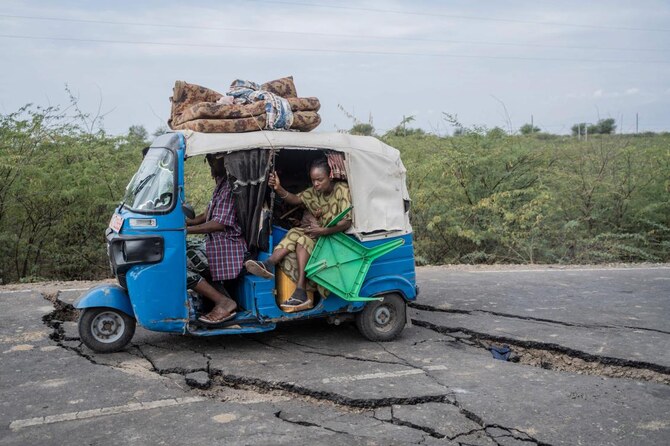
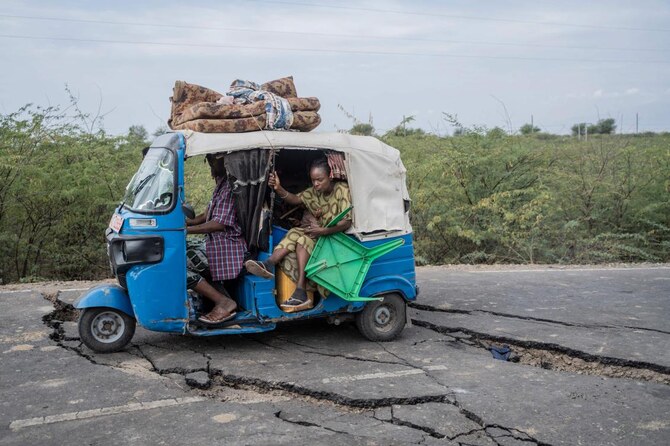
Residents ride a tuk-tuk taxi along a road damaged by multiple earthquakes near the town of Kabanna, on January 12, 2025. (Photo by Amanuel Sileshi / AFP)
2 / 2
Residents displaced by multiple earthquakes gather to fill their water jars at a water tank in a recently established displacement camp in Awash Arba, on January 11, 2025. (AFP)
Short Url
Updated 14 January 2025
Follow

‘Survival mode’ for families displaced by Ethiopia quakes

  • Ethiopia’s Rift Valley is one of the most seismically active regions in the world

AWASH: Under a makeshift shelter, Moussa Akele kills time chewing the stimulant khat, wondering where his family will get its next meal after fleeing a series of earthquakes that have shaken several regions of Ethiopia.
The 40-year-old was at home in Kabanna in the Afar region, about 250 kilometers (155 miles) northeast of the capital Addis Ababa, when an earthquake struck in late December.
“It caused widespread panic and destroyed our houses. People were terrified,” he said.
Ethiopia’s Rift Valley is one of the most seismically active regions in the world.
For several weeks, frequent tremors, including one measuring 5.8 on the Richter scale, have been shaking the rural regions of Afar and Oromia.
There are fears they could cause a major dam to collapse or lead to the eruption of a volcano, Mount Dofan, so the authorities have evacuated tens of thousands of people.
Akele, who worked in a sugar factory, found refuge with his family about 20 km from Kabanna. Like several thousand others, they now live in a tent pitched in the middle of arid vegetation.
“We were evacuated from our good and peaceful life and are now living in survival mode,” he said.
Trucks loaded with water and food arrive regularly, “but there are a lot of people and it’s not enough,” he added.
Most of the displaced are pastoralists, who had to leave their livestock behind.
Under a blazing sun and amid dust clouds caused by the trucks, several dozen women and children queue with jerry cans. Fights occasionally break out in the desperation.

Assea Ali didn’t have time to take anything with her.
“We fled for our lives,” said the 26-year-old mother of two.
“This is the condition we are living in now,” she added, pointing to a small tent and sighing: “I have no hope.”
On a small hill overlooking the camp, a health center has been set up by local authorities.
Several women rush in as soon as it opens, most to weigh their young children.
“Until the government and support agencies like UNICEF or the World Health Organization intervene, we are helping people with the resources we have,” said Abokar Hassan, 24, a health response officer.
He estimates between 200 and 300 people see him each day, mainly to prevent the spread of cholera.
According to the UN Office for Humanitarian Affairs (OCHA), Ethiopian authorities have evacuated more than 60,000 people living in high-risk areas, including some near a dam.
“A comprehensive humanitarian response is under way, but significant gaps remain,” OCHA said in a statement on Saturday.
The region is known to be a “volcanic, tectonic zone,” Cecile Doubre, a seismologist at the Strasbourg School and Observatory of Earth Sciences and a specialist in Afar, told AFP.
“There has been no eruption yet, but there is a spread of magma under the earth’s crust, between zero and 15 km. It is spreading in a large fissure, about 50 km long,” she added. “It’s a major geological event.”
Some sections of the road bear the scars of seismic activity, with the track to Kabanna partially collapsed.
In the city, there is a heavy silence, broken only by the lowing of oxen wandering the deserted streets amid several destroyed houses and businesses.
Despite the situation, Akele remains hopeful.
“The fear and uncertainty we are experiencing now are temporary, and we must not let them make us despair,” he said.


’Content to die’: Afghanistan’s hunger crisis worsened by winter, aid cuts

Updated 5 sec ago
Follow

’Content to die’: Afghanistan’s hunger crisis worsened by winter, aid cuts

  • As winter spreads across Afghanistan’s arid landscape, work opportunities have dried up, while the wave of returning Afghans has swelled the population by a tenth, said Aylieff of WFP
  • “Last year was the biggest malnutrition surge ever recorded in Afghanistan and sadly the prediction is that it’s going to get worse“

KABUL: In the dull glow of a single bulb lighting their tent on the outskirts of Kabul, Samiullah and his wife Bibi Rehana sit down to dry bread and tea, their only meal of the day, accompanied by their five children and three-month-old grandchild.
“We have reached a point where we are content with death,” said 55-year-old Samiullah, whose family, including two older sons aged 18 and 20 and their wives, is among the millions deported by neighboring Iran and Pakistan in the past year.
“Day by day, things are getting worse,” he added, after their return to a war-torn nation where the United Nations’ World Food Programme estimates 17 million battle acute hunger after massive cuts in international aid.
“Whatever happens to us has happened, but at least our children’s lives should be better.”
He was one of the returned Afghans speaking before protests in Iran sparked a massive crackdown by the clerical establishment, killing more than 2,000 in ensuing violence.
Samiullah said his family went virtually overnight from its modest home in Iran to their makeshift tent, partially propped up by rocks and rubble, after a raid by Iranian authorities led to their arrests and then deportation.
They salvaged a few belongings but were not able to carry out all their savings, which would have carried them through the winter, Samiullah added.
Reuters was unable to reach authorities in Iran for ⁠comment.
“Migrants who are newly returning to the country receive assistance as much as possible,” said Afghan administration spokesman Zabiullah Mujahid, in areas from transport to housing, health care and food.
It was impossible to eradicate poverty quickly in a country that suffered 40 years of conflict and the loss of all its revenue and resources, he added in a statement, despite an extensive rebuilding effort.
“Economic programs take time and do not have an immediate impact on people’s lives.”
The WFP says Iran and Pakistan have expelled more than 2.5 million Afghans in massive repatriation programs.
Tehran ramped up deportations last year amid a flurry of accusations that they were spying for Israel. Authorities blamed the expulsions on concerns about security and resources.
Islamabad accelerated deportations amid accusations that the Taliban was harboring militants responsible for cross-border attacks ⁠on Pakistani soil, allegations Afghanistan has denied.

NO INCOME, NO AID
As winter spreads across Afghanistan’s arid landscape, work opportunities have dried up, while the wave of returning Afghans has swelled the population by a tenth, said John Aylieff, the WFP’s country director.
“Many of these Afghans were working in Iran and Pakistan and they were sending back remittances,” he told Reuters, adding that 3 million more people now face acute hunger. “Those remittances were a lifeline for Afghanistan.”
Cuts to global programs since US President Donald Trump returned to the White House have sapped the resources of organizations such as the WFP, while other donor countries have also scaled back, putting millions at risk worldwide.
“Last year was the biggest malnutrition surge ever recorded in Afghanistan and sadly the prediction is that it’s going to get worse,” added Aylieff, estimating that 200,000 more children would suffer acute malnourishment in 2026.
At the WFP’s aid distribution site in Bamiyan, about 180 km (111 miles) from Kabul, the capital, are stacks of rice bags and jugs of palm oil, while wheelbarrows trundle in more food, but it is still too little for the long queues of people.
“I am forced to manage the winter with these ⁠supplies; sometimes we eat, sometimes we don’t,” said Zahra Ahmadi, 50, a widowed mother of eight daughters, as she received aid for the first time.

’LIFE NEVER REMAINS THE SAME’
At the Qasaba Clinic in the capital, mothers soothed their children during the wait for medicine and supplements.
“Compared to the time when there were no migrants, the number of our patients has now doubled,” said Dr. Rabia Rahimi Yadgari.
The clinic treats about 30 cases of malnutrition each day but the supplements are not sufficient to sustain the families, who previously relied on WFP aid and hospital support, she said.
Laila, 30, said her son, Abdul Rahman, showed signs of recovery after taking the supplements.
“But after some time, he loses the weight again,” she said.
After the Taliban takeover, she said, “My husband lost his (government) job, and gradually our economic situation collapsed. Life never remains the same.”
The United States led a hasty withdrawal of international forces from Afghanistan in July 2021, after 20 years of war against the Taliban, opening the doors for the Islamists to take control of Kabul.
As dusk gathers and the temperature falls, Samiullah brings in firewood and Bibi Rehama lights a stove for warmth.
“At night, when it gets very cold, my children say, ‘Father, I’m cold, I’m freezing.’ I hold them in my arms and say, ‘It’s OK.’ What choice do we have?” Samiullah said.
“(When) I worked in Iran, at least I could provide a full meal. Here, there is neither work nor livelihood.”