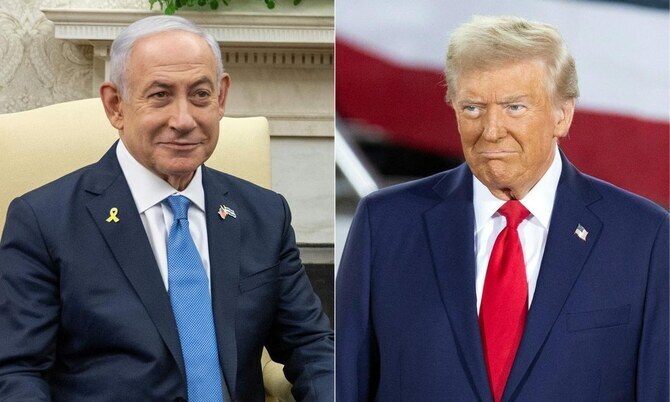
Israeli PM says Trump has invited him to the White House on Feb. 4

Israeli Prime Minister Benjamin Netanyahu said Tuesday that President Donald Trump has invited him to visit the White House on Feb. 4, which would make him the first foreign leader to do so in Trump’s second term. (AFP/File)
Short Url
Updated 29 January 2025
Follow

Israeli PM says Trump has invited him to the White House on Feb. 4

  • This would make Benjamin Netanyahu the first foreign leader to visit the White House in Trump’s second term
  • Meeting would be chance for Netanyahu to remind world of US support, defend Israel’s conduct of Gaza war

WADI GAZA: Israeli Prime Minister Benjamin Netanyahu said Tuesday that President Donald Trump has invited him to visit the White House on Feb. 4, which would make him the first foreign leader to do so in Trump’s second term.
The announcement came as the United States pressures Israel and Hamas to continue a ceasefire that has paused a devastating 15-month war in Gaza. Talks about the ceasefire’s more difficult second phase, which aims to end the war, are set to begin on Feb. 3.
There was no immediate comment from the White House. Trump teased the upcoming visit in a conversation with reporters aboard Air Force One on Monday, but didn’t provide details. “I’m going to be speaking with Bibi Netanyahu in the not too distant future,” he said.
The meeting would be a chance for Netanyahu, under pressure at home, to remind the world of the support he has received from Trump over the years, and to defend Israel’s conduct of the war. Last year, the two men met face-to-face for the first time in nearly four years at Trump’s Florida Mar-a-Lago estate.
Israel is the largest recipient of US military aid, and Netanyahu is likely to encourage Trump not to hold up some weapons deliveries the way the Biden administration did, though it continued other deliveries and overall military support.
Even before taking office this month, Trump was sending his special Middle East envoy, Steve Witkoff, to the region to apply pressure along with the Biden administration to get the current Gaza ceasefire achieved.
But Netanyahu has vowed to renew the war if Hamas doesn’t meet his demands in negotiations over the ceasefire’s second phase of the ceasefire, meant to discuss a complete Israeli withdrawal from Gaza and a “sustainable calm.”
Under the deal, more than 375,000 Palestinians have crossed into northern Gaza since Israel allowed their return on Monday morning, the United Nations said Tuesday. That represents over a third of the million people who fled in the war’s opening days.
Many of the Palestinians trudging along a seaside road or crossing in vehicles after security inspections were getting their first view of shattered northern Gaza under the fragile ceasefire, now in its second week.
They were determined, if homes were damaged or destroyed, to pitch makeshift shelters or sleep outdoors amid the vast piles of broken concrete or perilously leaning buildings. After months of crowding in squalid tent camps or former schools in Gaza’s south, they would finally be home.
“It’s still better for us to be on our land than to live on a land that’s not yours,” said Fayza Al-Nahal as she prepared to leave the southern city of Khan Younis for the north.
At least two Palestinians set off for the north by sea, crowding into a rowboat with a bicycle and other belongings.
Hani Al-Shanti, displaced from Gaza City, looked forward to feeling at peace in whatever he found, “even if it is a roof and walls without furniture, even if it is without a roof.” One newly returned woman hung laundry in the ruins of her home, its walls blown out.
Under the ceasefire, the next release of hostages held in Gaza, and Palestinian prisoners from Israeli custody, is set to occur on Thursday, followed by another exchange on Saturday.


Geoeconomic confrontation tops global risks in 2026: WEF report

Updated 14 January 2026
Follow

Geoeconomic confrontation tops global risks in 2026: WEF report

  • Also armed conflict, extreme climate, public polarization, AI
  • None ‘a foregone conclusion,’ says WEF’s MD Saadia Zahidi

DUBAI: Geoeconomic confrontation has emerged as the top global risk this year, followed by state-based armed conflict, according to a new World Economic Forum report.

The Global Risks Report 2026, released on Wednesday, found that both risks climbed eight places year-on-year, underscoring a sharp deterioration in the global outlook amid increased international competition.

The top five risks are geoeconomic confrontation (18 percent of respondents), state-based armed conflict (14 percent), extreme weather events (8 percent), societal polarization (7 percent) and misinformation and disinformation (7 percent).

The WEF’s Managing Director Saadia Zahidi said the report “offers an early warning system as the age of competition compounds global risks — from geoeconomic confrontation to unchecked technology to rising debt — and changes our collective capacity to address them.

“But none of these risks are a foregone conclusion.”

The report assesses risks across three timeframes: immediate (2026); short-to-medium term (next two years); and long term (next 10 years).

Economic risks show the largest overall increase in the two-year outlook, with both economic downturn and inflation jumping eight positions.

Misinformation and disinformation rank fifth this year but rise to second place in the two-year outlook and fourth over the 10-year horizon.

The report suggests this reflects growing anxiety around the rapid adoption of artificial intelligence, with adverse outcomes linked to AI surging from 30th place in the two-year timeframe to fifth in the 10-year outlook.

Uncertainty dominates the global risk outlook, according to the report.

Surveyed leaders and experts view both the short- and long-term outlook negatively, with 50 percent expecting a turbulent or stormy global environment over the next two years, rising to 57 percent over the next decade.

A further 40 percent and 32 percent, respectively, describe the outlook as unsettled across the two- and 10-year timeframes, while just 1 percent anticipate a calm global outlook in either period.

Environmental risks ease slightly in the short-term rankings. Extreme weather fell from second to fourth place and pollution from sixth to ninth. Meanwhile, critical changes to Earth systems and biodiversity loss dropped seven and five positions, respectively.

However, over the next decade, environmental threats re-emerge as the most severe, with extreme weather, biodiversity loss, and critical changes to Earth systems topping the global risk rankings.

Looking ahead over the next decade, around 75 percent of respondents anticipate a turbulent or stormy environmental outlook, making it the most pessimistic assessment across all risk categories.

Zahidi said that “the challenges highlighted in the report underscore both the scale of the potential perils we face and our shared responsibility to shape what comes next.”

Despite the gloomy outlook, Zahidi signaled a positive shift in global cooperation.

 “It is also clear that new forms of global cooperation are already unfolding even amid competition, and the global economy is demonstrating resilience in the face of uncertainty.”

Now in its 21st year, the Global Risks Report highlights a core message: global risks cannot be managed without cooperation.

As competition intensifies, rebuilding trust and new forms of collaboration will be critical, with the report stressing that today’s decisions will shape future outcomes.

The report was released ahead of WEF’s annual meeting, which will be held in Davos from Jan. 19 to 23.