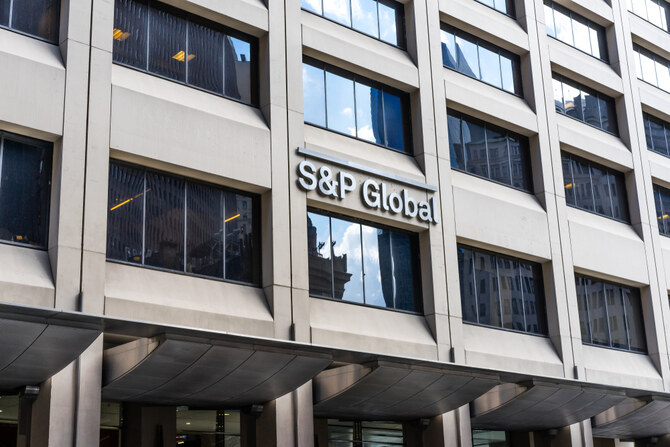

RIYADH: Saudi Arabia’s Walaa Cooperative Insurance Co. maintained its “A-” long-term insurer financial strength rating by S&P Global, with a stable outlook.
The New York-based credit rating agency also affirmed its “gcAAA” long-term Gulf Cooperation Council regional scale rating and “ksaAAA” long-term Saudi national scale assessment for Walaa, highlighting the insurer’s capital position and planned business growth initiatives.
This comes as the company completed an SR468 million ($124.8 million) rights issue in December 2024, initially announced in September 2023.
The additional capital will support the firm’s growth strategy and enhance its regulatory solvency margin.
S&P said Walaa’s capital adequacy exceeded its 99.99 percent confidence level before the reserve increase, with the recent capital injection further strengthening the company’s financial stability.
The rating agency expects Walaa to maintain this level of capital adequacy over the next two years, underpinning its stable outlook.
The firm’s stock price has already seen a significant 5.26 percent increase by 2:20 p.m. Saudi time to reach SR24.
Despite its strong capital position, Walaa’s operating performance has lagged behind similarly rated peers, according to S&P.
At the end of the third quarter of last year, the company ranked as the fifth largest insurer in the Kingdom, with insurance revenue reaching SR2.4 million and a growth rate of 17 percent.
However, the insurer faced challenges in profitability, driven by its medical insurance segment.
The combined ratio — a key measure of underwriting performance — stood at 101 percent for the third quarter of 2024, compared to 98 percent during the same period the previous year.
While the motor insurance segment, which experienced losses between 2021 and 2023, returned to profitability in 2024, reporting a service result of SR18 million for the third quarter, Walaa’s medical insurance business posted a significant loss of SR85 million during the same period.
This marks a sharp decline from the SR4 million loss recorded in the third quarter of 2023. The company plans to expand its medical insurance segment over the next two years, aiming for breakeven by the year’s end.
S&P said the goal may be challenging due to the competitive and concentrated nature of the medical insurance market in Saudi Arabia, which is projected to reach $4.33 billion this year, according to German online data gathering platform Statista.
The medical segment is dominated by The Co. for Cooperative Insurance and Bupa Arabia for Cooperative Insurance, which collectively accounted for 76 percent of market revenue and most of the segment’s profitability in the third quarter of 2024, according to S&P.
Walaa’s ability to achieve breakeven in this segment will play a critical role in the recovery of its overall performance.
S&P expects Walaa to gradually improve its combined ratio to about 98 percent in 2025— 2026 as it continues to diversify its business and recover its operating performance.
The agency also flagged potential risks, including the possibility of a negative rating action if Walaa’s underwriting performance is weaker than its local and regional peers or if its capital adequacy falls below the 99.95 percent confidence level.
S&P views the likelihood of a rating upgrade as limited during the outlook period. Any positive rating action would depend on Walaa’s ability to significantly increase and diversify its premium income without impairing operating performance, while maintaining capital adequacy at the 99.99 percent confidence level and a low-risk investment portfolio.