

US has not stopped military aid to Ukraine, Zelensky says

1 / 2
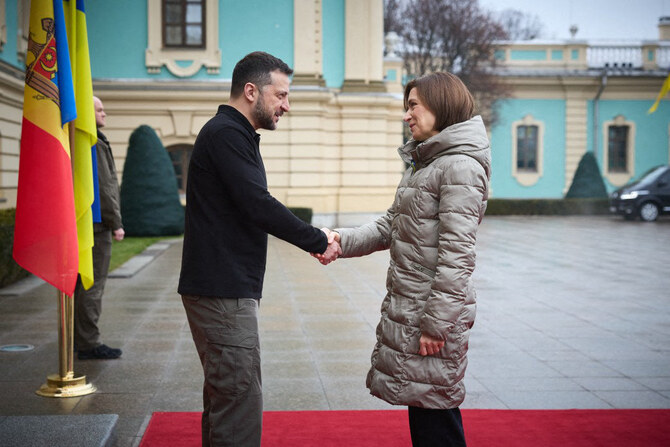
Moldova's President Maia Sandu and Ukraine's President Volodymyr Zelensky attend a joint press conference in Kyiv o
2 / 2
Moldova's President Maia Sandu and Ukraine's President Volodymyr Zelensky attend a joint press conference in Kyiv on January 25, 2025, amid Russia's attack on Ukraine. (Reuters)
Short Url
Updated 26 January 2025
Follow

US has not stopped military aid to Ukraine, Zelensky says

  • Trump had previously said Ukraine's President Zelensky should have made a deal with Putin to avoid the conflict
  • But he recently threatened to impose stiff tariffs and sanctions on Russia if an agreement isn’t reached to end the fighting in Ukraine

KYIV: Ukrainian President Volodymyr Zelensky said Saturday the US has not stopped military aid to Ukraine after newly sworn in US Secretary of State Marco Rubio announced he would pause foreign aid grants for 90 days.
Zelensky did not clarify whether humanitarian aid had been paused. Ukraine relies on the US for 40 percent of its military needs. “I am focused on military aid; it has not been stopped, thank God,” he said at a press conference with Moldovan President Maia Sandu.
The two leaders met in Kyiv on Saturday to discuss the energy needs of Moldova’s Russian-occupied Transnistria region, which saw its natural gas supplies halted on Jan. 1 due to Ukraine’s decision to stop Russian gas transit. Ukraine has said it can offer coal to the Transnistrian authorities to make up for the shortfall.
The future of US aid to Ukraine remains uncertain as President Donald Trump begins his second term in office. The American leader has repeatedly said he wouldn’t have allowed Russia’s invasion of Ukraine to start if he had been in office, although he was president as fighting grew in the east of the country between Kyiv’s forces and separatists aligned with Moscow, ahead of Putin sending in tens of thousands of troops in 2022.
On Thursday, Trump told Fox News that Zelensky should have made a deal with Putin to avoid the conflict. A day earlier, Trump also threatened to impose stiff tariffs and sanctions on Russia if an agreement isn’t reached to end the fighting in Ukraine.
Speaking in Kyiv on Saturday, Zelensky said he had enjoyed “good meetings and conversations with President Trump” and that he believed the US leader would succeed in his desire to end the war.
“This can only be done with Ukraine, and otherwise it simply will not work because Russia does not want to end the war, and Ukraine does,” Zelensky said.
Grinding eastern offensive
With Trump stressing the need to quickly broker a peace deal, both Moscow and Kyiv are seeking battlefield successes to strengthen their negotiating positions ahead of any prospective talks.

Opinion

This section contains relevant reference points, placed in (Opinion field)

For the past year, Russian forces have been waging an intense campaign to punch holes in Ukraine’s defenses in the Donetsk region and weaken Kyiv’s grip on the eastern parts of the country. The sustained and costly offensive has compelled Kyiv to give up a series of towns, villages and hamlets.
Russia’s Defense Ministry claimed Friday that Russian troops had fought their way into the center of the strategically important eastern of Velyka Novosilka, although it was not possible to independently confirm the claim.
Elsewhere, three civilians were killed Saturday in shelling in the Russian-occupied area of Ukraine’s Kherson region, Moscow-installed Gov. Vladimir Saldo said.
He urged the residents of Oleshky, which sits close to the frontline in southern Ukraine, to stay in their homes or in bomb shelters.
Russia also attacked Ukraine with two missiles and 61 Shahed drones overnight Saturday. Ukrainian air defenses shot down both missiles and 46 drones, a statement from the air force said. Another 15 drones failed to reach targets due to Ukrainian countermeasures.
The downed drones caused damage in the Kyiv, Cherkasy and Khmelnytskyi regions, with Ukrainian emergency services saying that five people had to be from a 9-story apartment block in the Ukrainian capital.
Russia also struck Ukraine’s eastern Kharkiv region with drones causing casualties and damage, local authorities said Saturday.
Drones targeted the city’s Shevchenkivskyi, Kyivskyi and Kholodnohirskyi districts, said Mayor Ihor Terekhov.
Russia used a Molniya drone – an inexpensive weapon that has been developed and recently deployed by Russia – in the Shevchenkivskyi district, sparking a fire. The attacks disrupted the city’s water and electricity supplies, the mayor said.
Terekhov said the number of victims was still being determined, while Kharkiv’s governor, Oleh Syniehubov, said three people, two women and a man, were injured in the strikes.


Geoeconomic confrontation tops global risks in 2026: WEF report

Updated 20 min 53 sec ago
Follow

Geoeconomic confrontation tops global risks in 2026: WEF report

  • Also armed conflict, extreme climate, public polarization, AI
  • None ‘a foregone conclusion,’ says WEF’s MD Saadia Zahidi

DUBAI: Geoeconomic confrontation has emerged as the top global risk this year, followed by state-based armed conflict, according to a new World Economic Forum report.

The Global Risks Report 2026, released on Wednesday, found that both risks climbed eight places year-on-year, underscoring a sharp deterioration in the global outlook amid increased international competition.

The top five risks are geoeconomic confrontation (18 percent of respondents), state-based armed conflict (14 percent), extreme weather events (8 percent), societal polarization (7 percent) and misinformation and disinformation (7 percent).

The WEF’s Managing Director Saadia Zahidi said the report “offers an early warning system as the age of competition compounds global risks — from geoeconomic confrontation to unchecked technology to rising debt — and changes our collective capacity to address them.

“But none of these risks are a foregone conclusion.”

The report assesses risks across three timeframes: immediate (2026); short-to-medium term (next two years); and long term (next 10 years).

Economic risks show the largest overall increase in the two-year outlook, with both economic downturn and inflation jumping eight positions.

Misinformation and disinformation rank fifth this year but rise to second place in the two-year outlook and fourth over the 10-year horizon.

The report suggests this reflects growing anxiety around the rapid adoption of artificial intelligence, with adverse outcomes linked to AI surging from 30th place in the two-year timeframe to fifth in the 10-year outlook.

Uncertainty dominates the global risk outlook, according to the report.

Surveyed leaders and experts view both the short- and long-term outlook negatively, with 50 percent expecting a turbulent or stormy global environment over the next two years, rising to 57 percent over the next decade.

A further 40 percent and 32 percent, respectively, describe the outlook as unsettled across the two- and 10-year timeframes, while just 1 percent anticipate a calm global outlook in either period.

Environmental risks ease slightly in the short-term rankings. Extreme weather fell from second to fourth place and pollution from sixth to ninth. Meanwhile, critical changes to Earth systems and biodiversity loss dropped seven and five positions, respectively.

However, over the next decade, environmental threats re-emerge as the most severe, with extreme weather, biodiversity loss, and critical changes to Earth systems topping the global risk rankings.

Looking ahead over the next decade, around 75 percent of respondents anticipate a turbulent or stormy environmental outlook, making it the most pessimistic assessment across all risk categories.

Zahidi said that “the challenges highlighted in the report underscore both the scale of the potential perils we face and our shared responsibility to shape what comes next.”

Despite the gloomy outlook, Zahidi signaled a positive shift in global cooperation.

 “It is also clear that new forms of global cooperation are already unfolding even amid competition, and the global economy is demonstrating resilience in the face of uncertainty.”

Now in its 21st year, the Global Risks Report highlights a core message: global risks cannot be managed without cooperation.

As competition intensifies, rebuilding trust and new forms of collaboration will be critical, with the report stressing that today’s decisions will shape future outcomes.

The report was released ahead of WEF’s annual meeting, which will be held in Davos from Jan. 19 to 23.