

‘Between Sacred Cities’: Pakistan’s Imran Qureshi unveils largest installation at Islamic Arts Biennale

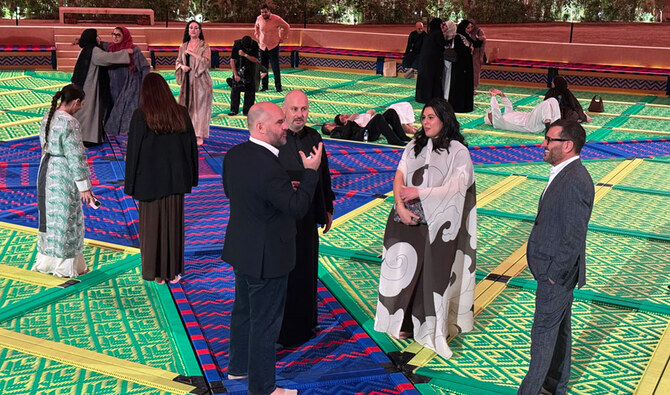
The handout photo released on January 25, 2025, shows visitors standing on a large art piece by Pakistani artist Imran Qureshi at the Islamic Arts Biennale 2025 in Jeddah, Saudi Arabia. (Supplied)
Short Url
Updated 25 January 2025
Follow

‘Between Sacred Cities’: Pakistan’s Imran Qureshi unveils largest installation at Islamic Arts Biennale

  • Installation reimagines historic route that stretched from Kufa in Iraq to holy city of Makkah
  • Qureshi, a Pakistani visual artist, has featured artworks in local and international exhibitions

ISLAMABAD: Pakistani artist Imran Qureshi on Saturday unveiled “Between Sacred Cities,” the largest installation at the Islamic Arts Biennale 2025 in Jeddah, his art reimagining a historic route that once stretched from Kufa in Iraq to the holy city of Makkah. 

The Islamic Arts Biennale 2025 provides a platform for new discourse about Islamic arts, featuring contemporary and newly commissioned artworks with historical objects from Islamic cultures. It offers artists a platform to explore themes of spirituality, identity, and the intersection of past and present. This year’s biennale will run from Jan. 25-May 25. 
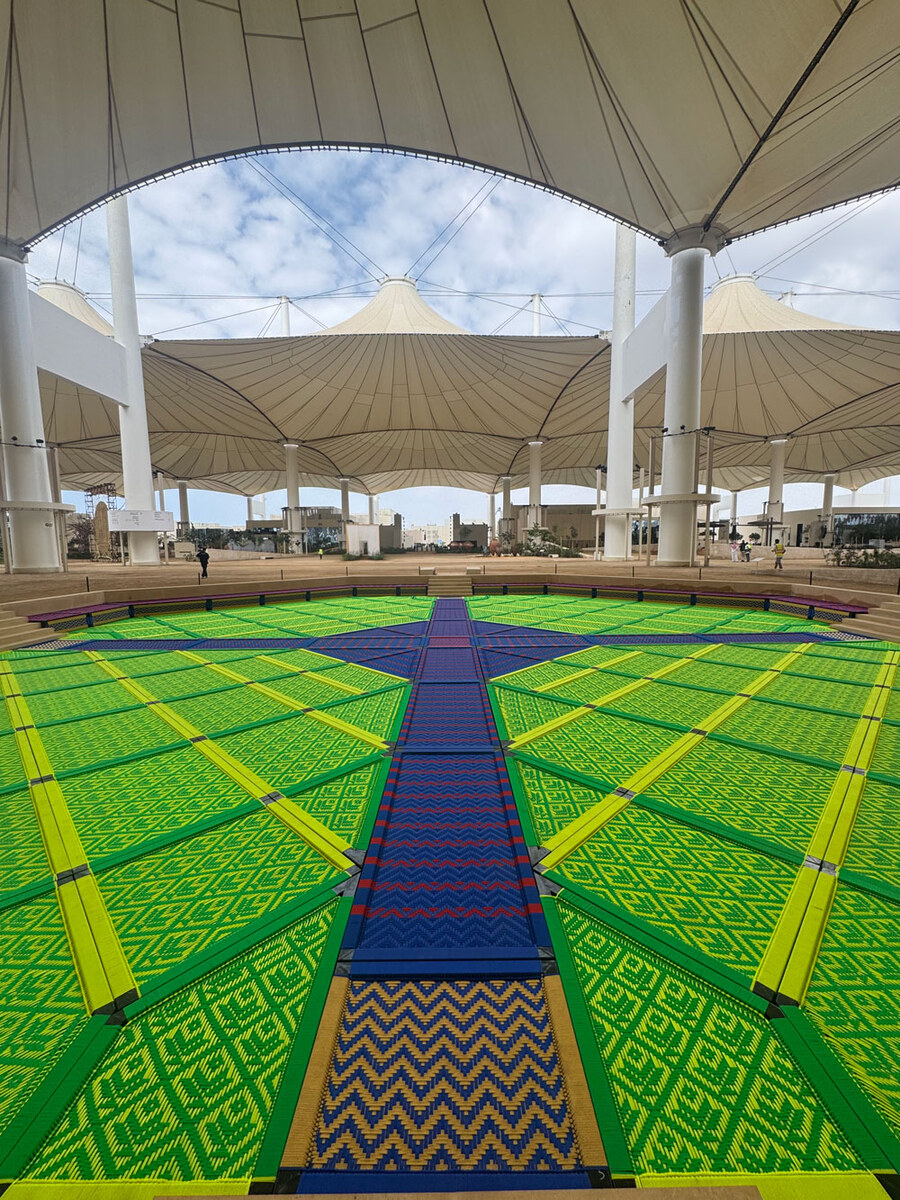
According to Lotus, a public relations agency, the installation is situated between the iconic Makkah and Madina pavilions at the Western Hajj Terminal. 

“The installation reimagines a historic route that once stretched from Kufa, Iraq, to Makkah,” Lotus said. 

“Designed to aid pilgrims on their Hajj journey, this route served as a network of resting stations and water sources, inspiring Qureshi’s interpretation of an oasis as a sanctuary of rest, reflection, and unity.”
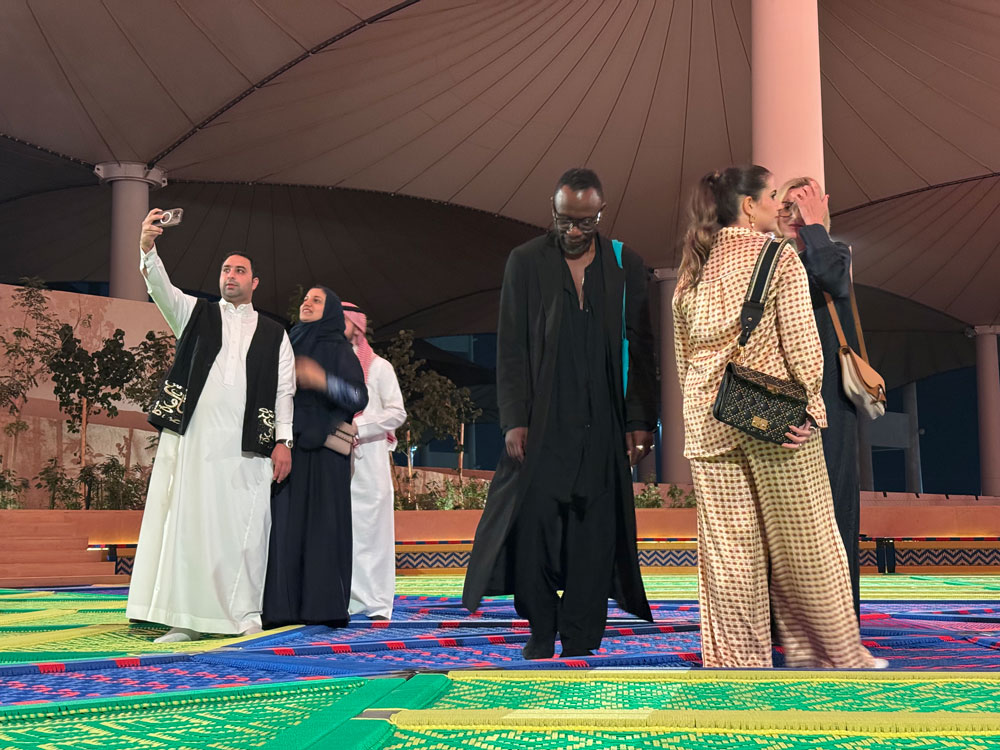
The statement said that the concept of an oasis in the installation is transformed into an interactive and contemplative garden-like structure, central to which is an octagonal design. 

“Drawing on the spiritual essence of the journey between Makkah and Madina, the installation incorporates the holy water of Zamzam and lush greenery reminiscent of Madina’s tranquillity,” it added. 

Qureshi has used vibrant woven strips to symbolize flowing water while the surrounding greenery evokes a sense of life, Lotus said. 
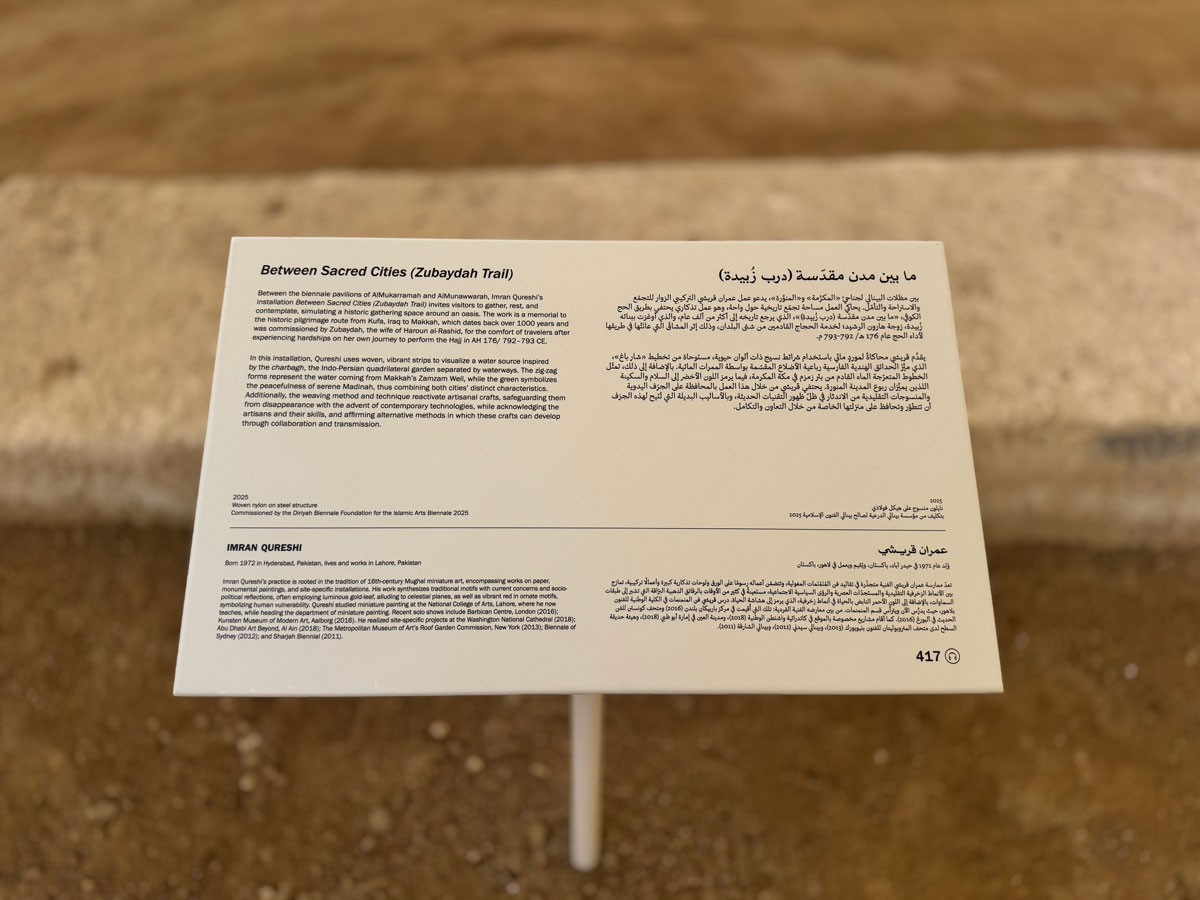
The installation has been commissioned by the Diriyah Biennale Foundation and curated by acclaimed artist Muhannad Shono. 

“Between Sacred Cities will be on display from January 25, 2025, to May 25, 2025, offering visitors an unparalleled opportunity to explore the universal themes of travel, spirituality, and interconnectedness,” Lotus said. 

Qureshi is a visual artist from Pakistan’s southern Sindh province. With a career spanning twenty-nine years, encompassing local and international exhibitions, he has emerged as a prominent Pakistani artist.

In 2013, he created a large-scale, site-specific work for The Metropolitan Museum of Art’s Roof Garden Commission in New York. The same year he was awarded the Deutsche Bank’s Artist of the Year and exhibited solo for the first time in Europe at the Deutsche Bank Kunsthalle in Berlin. 

Qureshi’s work has since been shown in numerous solo exhibitions, including the Barbican Center, London (2016), Kunsten Museum of Modern Art, Aalborg, Denmark (2016), along with executing site-specific projects at the Washington National Cathedral, Washington, D.C. (2018) and Al Ain, Abu Dhabi, United Arab Emirates (2018), to name a few. 

In 2021 he was awarded the Sitara-e-Imtiaz (Star of Excellence) by Pakistan’s government.


Captain Agha reiterates Pakistan’s refusal to play India at the T20 World Cup

Updated 06 February 2026
Follow

Captain Agha reiterates Pakistan’s refusal to play India at the T20 World Cup

  • India vs. Pakistan is usually the showpiece match in world tournaments, with the eyeballs on it rising into the hundreds of millions
  • The boycott has caused an uproar and the International Cricket Council is trying to resolve the issue with the Pakistan Cricket Board

COLOMBO: Pakistan captain Salman Ali Agha has reiterated that his team will abide by his government’s ruling not to play India in the much-anticipated Twenty20 World Cup fixture next week.

India vs. Pakistan is usually the showpiece match in world tournaments — the eyeballs on it rise into the hundreds of millions. The boycott has caused an uproar and the International Cricket Council is trying to resolve the problem with the Pakistan Cricket Board.

At a captains’ media conference on Thursday, Agha repeated the team will follow its government’s advice.

“The India game is not in our control,” Agha said. “The government has decided and we respect that. Whatever they are saying we’ll do.

“We are playing three other (group) games and we are excited about that.”

Pakistan’s World Cup opener is against the Netherlands on Saturday in Colombo. It will play all of its games in co-host Sri Lanka. Namibia and the United States are also in the group. The India game is scheduled for Feb. 15 in Colombo.

In Mumbai, India captain Suryakumar Yadav said they were going to Colombo whether the match was on or not.

“(Our) mindset is pretty clear,” Yadav said. “We did not refuse to play them. The refusal came from them. ICC organized the fixture. BCCI and (Indian) government decided to play in neutral venue in coordination with ICC. Our flight to Colombo is booked. So we are going. We’ll see what happens later.”

The Pakistan government decision came after Bangladesh was kicked out of the World Cup by the ICC. Bangladesh refused to play in India for security reasons and wanted its games moved to Sri Lanka but the ICC dismissed those concerns.

Agha said he was saddened that Bangladesh wasn’t playing in the World Cup for the first time and asked Bangladeshi fans to back his team.

Pakistan has accused the ICC of double standards and not accommodating security concerns. India and Pakistan do not play in each other’s territory and meet in ICC tournaments only at neutral venues.

Their countries are embroiled in military and diplomatic tensions which have spilled into sports for more than a decade. Last year at the men’s Asian Cup and Women’s World Cup, the teams did not shake hands when they met.