

UNICEF deputy director urges innovative partnerships to protect the world’s children 

Speaking at a WEF panel discussion on Friday, UNICEF Deputy Executive Director Kitty van der Heijden stressed the urgency of integrating children’s needs into global climate policies. (WEF photo)
Short Url
Updated 24 January 2025
Follow

UNICEF deputy director urges innovative partnerships to protect the world’s children 

  • By collaborating with private sector, UNICEF is better able to combat challenges of conflict and climate change, says Kitty van der Heijden
  • Aid agency executive says partnerships with insurers and logistics firms facilitates the rapid deployment of resources to crisis zones

DUBAI: Kitty van der Heijden, deputy executive director of the UN children’s fund, has praised the collaboration between UNICEF and the private sector to address the many urgent challenges facing the world’s children.

In an interview with Arab News on the fringes of the World Economic Forum in Davos, van der Heijden explained how UNICEF’s partnerships are aiding its response to conflicts, mass displacements, climate change, and natural disasters.

“We are here in Davos to meet with the private and corporate entities who are present,” van der Heijden said. “We are already in partnership with some across a range of sectors like humanitarian aid, education, AI, and non-communicable diseases, among others.

“We see that a lot of companies are willing to work with UNICEF as we are able to reach where they can’t necessarily go.

“We have more conflicts than ever around the world that are destroying humanity’s ability to survive and thrive. We need to deliver prosperity and keep environmental triggers and human misery under control.”

To confront crises, van der Heijden says UNICEF has now partnered with insurance companies, as well as logistics and shipping firms that prioritize humanitarian aid over their commercial goods in times of need.

“We developed the first ever parametric climate insurance with a focus on children. For example, hurricanes are routine problems in some countries and small islands. Whenever a hurricane takes place, not only are the communities there extremely affected but so is the GDP of the country.

“The moment wind speeds go up to a certain level, the parametric tool detects the change and automatically submits a cash deposit to UNICEF.”

Van der Heijden says this rapid response ensures that financial support reaches those in need without bureaucratic delays and complications.

“We are able to offer cash directly to affected communities, ensuring that aid arrives right when it’s needed. This builds resilience in the face of recurring disasters, while also providing an early warning system to help communities prepare for future events.”

Another cross sector collaboration between UNICEF and private companies focuses on mental health.

“Prevention is the mother of all cures,” said van der Heijden. “UNICEF is joining forces with lots of health companies such as AstraZeneca and Zurich Foundation to address obesity and mental health issues.

“These problems are prevalent across all societies and all ages. The reasons might be different, but it is there.

“Seventy percent of preventable deaths stem from risk exposure and unhealthy behaviors as a child. If you approach this issue holistically, you can prevent so many negative cycles between mental health, anxiety, and obesity.”

Van der Heijden also said children are uniquely vulnerable to the effects of climate change. From heatwaves that affect maternal health to pollution that exacerbates respiratory problems, the risks children face are not only immediate but long term.

Children, particularly in disadvantaged communities, lack access to cooling systems or safe environments, leaving them at higher risk of heat related illnesses.

“Children breathe twice as fast as adults, and their exposure to pollution can be devastating,” said van der Heijden. “They don’t have the physical ability to cool down through sweating, which makes them vulnerable during extreme heat events.

“The effects of climate change are already being felt by the world’s most vulnerable populations, and children are bearing the brunt.”
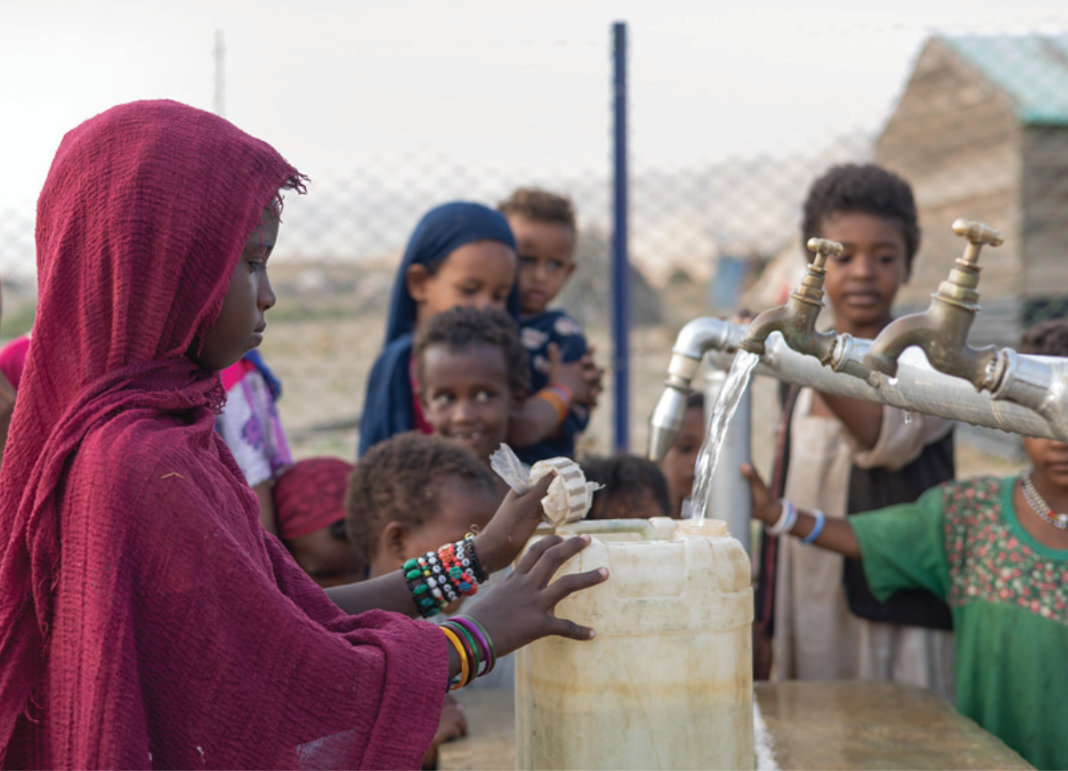


small village of Gelhanty in Agig locality, Red Sea state. (UNICEF photo)

The repercussions of climate change extend beyond health, as related economic shocks often lead to unintended social consequences, such as an increase in child marriages.

In regions impacted by heatwaves, families may marry off young girls to reduce financial burdens. The economic strain caused by extreme weather events can push parents to take drastic steps “to have one less mouth to feed.”

Van der Heijden stressed the urgency of integrating children’s needs into global climate policies. While countries around the world are set to submit their new climate plans this year, UNICEF is leading a global campaign to ensure that these plans are child-centric.

“The year 2025 is a pivotal year,” she said. “We will have a number of opportunities to act and set the record straight. Unless we understand the unique vulnerabilities of children, we cannot craft effective policies.

“We need to make sure that every country’s climate plan reflects the impacts on children and ensures that their needs are front and center.”


Hegseth says he won’t publicly release video of boat strike that killed survivors in the Caribbean

Updated 4 sec ago
Follow

Hegseth says he won’t publicly release video of boat strike that killed survivors in the Caribbean

  • “Of course we’re not going to release a top secret, full, unedited video of that to the general public,” Hegseth told reporters
  • Rubio told reporters the campaign is a “counter-drug mission” that is “focused on dismantling the infrastructure of these terrorist organizations

WASHINGTON: Defense Secretary Pete Hegseth said Tuesday the Pentagon will not publicly release unedited video of a US military strike that killed two survivors of an initial attack on a boat allegedly carrying cocaine in the Caribbean, as questions mounted in Congress about the incident and the overall buildup of US military forces near Venezuela.
Hegseth said members of the Armed Services Committee in the House and Senate would have an opportunity this week to review the video, but did not say whether all members of Congress would be allowed to see it as well, even though a defense policy bill demands that the footage be released to lawmakers.
“Of course we’re not going to release a top secret, full, unedited video of that to the general public,” Hegseth told reporters as he exited a closed-door briefing with senators.
President Donald Trump’s Cabinet members overseeing national security were on Capitol Hill on Tuesday to defend a campaign that has killed at least 95 people in 25 known strikes on vessels in international waters in the Caribbean and eastern Pacific.
Overall, they defended the campaign as a success, saying it has prevented drugs from reaching American shores, and they pushed back on concerns that it is stretching the bounds of lawful warfare.
Secretary of State Marco Rubio told reporters the campaign is a “counter-drug mission” that is “focused on dismantling the infrastructure of these terrorist organizations that are are operating in our hemisphere, undermining the security of Americans, killing Americans, poisoning Americans.”
Lawmakers have been focused on the Sept. 2 attack on two survivors as they sift through the rationale for a broader US military buildup in the region. On the eve of the briefings, the US military said it attacked three more boats believed to have been smuggling drugs in the eastern Pacific Ocean, killing eight people.
Lawmakers left in the dark about Trump’s goal with Venezuela
Senate Democratic leader Chuck Schumer said Hegseth had come “empty handed” to the briefing, without the video of the Sept. 2 strike.
“If they can’t be transparent on this, how can you trust their transparency on all the other issues swirling about in the Caribbean?” the New York Democrat said.
Senators on both sides of the aisle said the officials left them in the dark about Trump’s goals when it comes to Venezuelan President Nicolás Maduro or sending US forces directly to the South American nation.
“I want to address the question, is it the goal to take him out? If it’s not the goal to take him out, you’re making a mistake,” said Sen. Lindsey Graham, a South Carolina Republican who defended the legality of the campaign and said he wanted to see Maduro removed from power.
The US has deployed warships, flown fighter jets near Venezuelan airspace and seized an oil tanker as part of its campaign against Maduro, who has insisted the real purpose of the US military operations is to force him from office. Maduro said on a weekly state television show Monday that his government still does not know the whereabouts of the tanker’s crew. He criticized the United Nations for not speaking out against what he described as an “act of piracy” against “a private ship carrying Venezuelan oil.”
Trump’s Republican administration has not sought any authorization from Congress for action against Venezuela. The go-it-alone approach, experts say, has led to problematic military actions, none more so than the strike that killed two people who had climbed on top of part of a boat that had been partially destroyed in an initial attack.
“If it’s not a war against Venezuela, then we’re using armed force against civilians who are just committing crimes,” said John Yoo, a Berkeley Law professor who helped craft the George W. Bush administration’s legal arguments and justification for aggressive interrogation after the Sept. 11, 2001, attacks. “Then this question, this worry, becomes really pronounced. You know, you’re shooting civilians. There’s no military purpose for it.”
Yet for the first several months, Congress received little more than a trickle of information about why or how the US military was conducting the operations. At times, lawmakers have learned of strikes from social media after the Pentagon posted videos of boats bursting into flames.
Hegseth now faces language included in an annual military policy bill that threatens to withhold a quarter of his travel budget if the Pentagon does not provide the video to lawmakers.
The demand for release of video footage
For some, the controversy over the footage demonstrates the flawed rationale behind the entire campaign.
“The American public ought to see it. I think shooting unarmed people floundering in the water, clinging to wreckage, is not who we are as a people,” said Sen. Rand Paul, a Kentucky Republican who has been an outspoken critic of the campaign.
But senators were told the Trump administration won’t release all of the Sept. 2 attack footage because it would reveal US military practices on intelligence gathering, said Democratic Sen. Elizabeth Warren of Massachusetts. She said the reasoning ignores that the military has already released footage of the initial attack.
“They just don’t want to reveal the part that suggests war crimes,” she said.
Some GOP lawmakers are determined to dig into the details of the Sept. 2 attack. Adm. Frank “Mitch” Bradley, who ordered the second strike, was expected back on Capitol Hill on Wednesday for classified briefings with the Senate and House Armed Services committees.
Still, many Republicans emerged from the briefings backing the campaign, defending their legality and praising the “exquisite intelligence” that is used to identify targets. House Speaker Mike Johnson called the strike “certainly appropriate” and “necessary to protect the United States and our interests.”