
AI can offer solutions for water scarcity say WEF panelists

1 / 3
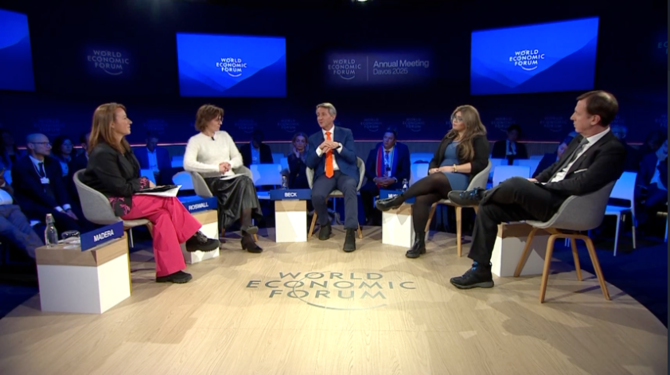
A panel of experts told WEF 2025 that AI can be used to reduce wastewater and redesign systems to facilitate resource recycling. (Screengrab)
2 / 3
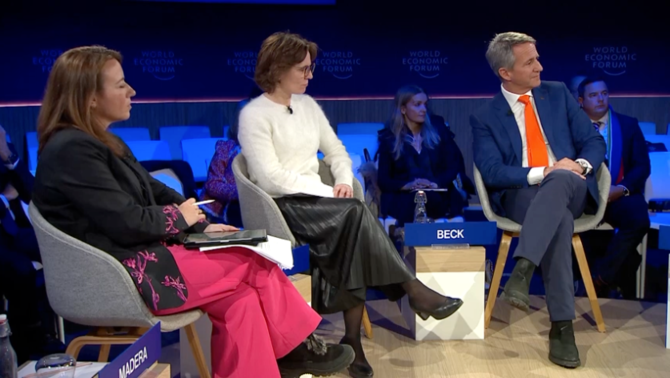
A panel of experts told WEF 2025 that AI can be used to reduce wastewater and redesign systems to facilitate resource recycling. (Screengrab)
3 / 3
A panel of experts told WEF 2025 that AI can be used to reduce wastewater and redesign systems to facilitate resource recycling. (Screengrab)
Short Url
Updated 23 January 2025
Follow

AI can offer solutions for water scarcity say WEF panelists

  • Christophe Beck: We need to redesign our processes being data centers, mill production, or processors in ways that the water never leaves the site
  • Fabrizio Palermo: AI can also help in the transportation of water because it’s a question of managing data

DUBAI: Artificial intelligence can be used to reduce wastewater and redesign systems to facilitate resource recycling, a panel of experts told the World Economic Forum in Davos.

Christophe Beck, chairman and CEO of Ecolab, said countries are becoming aware of the need for water to produce chips that get into the AI chain, which could, in return, be used to reduce wastewater.

According to UN figures, by 2030, more than half of the world’s population will be water stressed, affecting economics, health and existing food scarcity and threatening $1.6 trillion in assets.

“We need to redesign our processes being data centers, mill production, or processors in ways that the water never leaves the site. That’s what we do in data centers related to chip cooling where water never leaves the data centers, unlike the old technologies,” Beck said.

He called for legislations that enable the use of new technologies to reuse water, which ultimately saves energy. “Up to 75 percent of the energy used by power plants is used to manage, heat, cool, transport and treat water. When we reuse and recycle the water, we save energy and money, as well as reduce carbon footprint,” Beck said.

The Water Resilience Coalition aims to get 150 companies that affect a third of the world’s water usage to make three commitments: to save water by saving energy and leveraging technology; work on the 100 most critical basins that are serving 3 billion people; and provide water to 300 million people.

“It is business driven, and it is capital that’s invested at a return, creating a business model that is ultimately much more sustainable and provides water for people in need,” Beck said.

Fabrizio Palermo, CEO and general manager of Acea, emphasized the need for investment and funding in water resilience, given water’s importance to agriculture, industry, energy and AI.

An ecosystem needs to be created to protect sources, collect rainwater properly and achieve maintenance on basins, he said.

“AI can also help in the transportation of water because it’s a question of managing data. This infrastructure in Europe has been designed more than 56 years ago where the landscape in terms of technology was completely different and no one is in a situation to do predictive maintenance on this infrastructure,” Palermo said.

He called for net zero in water to avoid waste and curb government spending on health.

“It is very important that the water is reused and not sent to the rivers and then to the sea because water is linked with water. Government spending on health is related to water because the consequences of not having proper fresh water are evident nowadays,” Palermo said.

Meanwhile, Fajer Mushtaq, co-founder and CEO of Oxyle, warned of the effects of synthetic chemicals, known as PFAS compounds, on water contamination in Europe, calling for regulations and corporate responsibility to tackle water treatment and monitor the safety of discharged substances.

“I think it’s a systematic problem. The biggest barrier is to enable a proper treatment of water, which is not just going to be from a PFAS perspective, but our system that makes micropollutants.”

Technology needs to be directed at creating a new ecosystem, guided by clear regulations, to ensure safe water is provided for communities, Mushtaq said.


Closing Bell: Saudi main index rises to 10,894

Updated 13 January 2026
Follow

Closing Bell: Saudi main index rises to 10,894

RIYADH: Saudi Arabia’s Tadawul All Share Index extended its upward trend for a third consecutive day this week, gaining 148.18 points, or 1.38 percent, to close at 10,893.63 on Tuesday. 

The total trading turnover of the benchmark index stood at SR6.05 billion ($1.61 billion), with 144 listed stocks advancing and 107 declining. 

The Kingdom’s parallel market Nomu also rose by 81.35 points to close at 23,668.29. 

The MSCI Tadawul Index edged up 1.71 percent to 1,460.89. 

The best-performing stock on the main market was Zahrat Al Waha for Trading Co., with its share price advancing 10 percent to SR2.75. 

Shares of CHUBB Arabia Cooperative Insurance Co. increased 8.27 percent to SR23.04, while Abdullah Saad Mohammed Abo Moati for Bookstores Co. saw its stock climb 6.17 percent to SR50.60. 

Conversely, the share price of Naseej International Trading Co. declined 9.90 percent to SR31.48. 

On the announcements front, Arabian Drilling Co. said it secured three contract extensions for land rigs with energy giant Saudi Aramco, totaling SR1.4 billion and adding 25 active rig years to its backlog. 

In a Tadawul statement, the company said one rig is currently operational, the second will begin operations by the end of January, and the third — currently suspended — is expected to resume operations in 2026. 

Since November 2025, Arabian Drilling has secured seven contract extensions amounting to SR3.4 billion, representing 55 committed rig years. 

The three contracts have durations of 10 years, 10 years, and five years, respectively.

“Securing a total of SR1.4 billion in new contracts and expanding our backlog by 25 rig-years demonstrates both the trust our clients place in us and our ability to consistently deliver quality and reliability,” said Ghassan Mirdad, CEO of Arabian Drilling, in a statement. 

Shares of Arabian Drilling Co. rose 3.15 percent to SR104.70. 

Separately, Alkhorayef Water and Power Technologies Co. said it signed a 36-month contract valued at SR43.35 million with National Water Co. to operate and maintain water networks, pumping stations, wells, reservoirs, and related facilities in Tabuk. 

In October, Alkhorayef Water and Power Technologies Co. announced it had been awarded the contract by NWC. 

In a Tadawul statement, the company said the financial impact of the deal began in the fourth quarter of 2025. 

The share price of Alkhorayef Water and Power Technologies Co. declined 0.49 percent to SR120.70.