

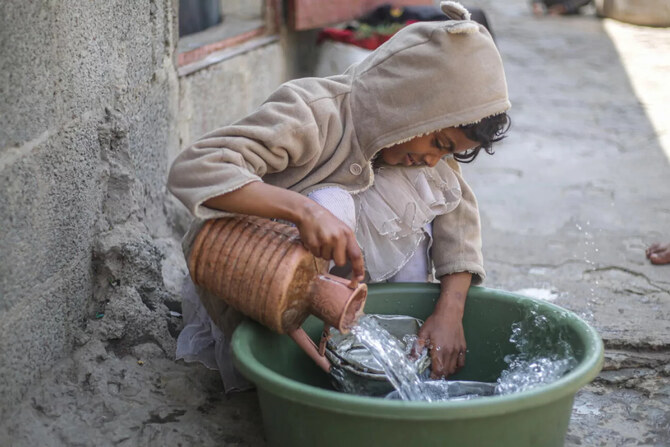
Arab Fund to launch observatory to address water scarcity

The observatory will provide vital data and insights to stakeholders, helping them make informed decisions to address the growing challenges of water scarcity. File
Short Url
Updated 11 December 2024
Follow

Arab Fund to launch observatory to address water scarcity

  • Observatory will foster collaboration and attract investments to solve the region's urgent water management challenges
  • Fund reaffirmed its commitment to enhancing regional water and food security

RIYADH: The Arab Fund for Economic and Social Development is set to launch a new Water Observatory aimed at boosting investments in sustainable water solutions across the region.

Announced at the 16th session of the UN Convention to Combat Desertification’s Conference of the Parties in Riyadh, this initiative is designed to improve data collection and accessibility on water-related projects.

The observatory will provide vital data and insights to stakeholders, helping them make informed decisions to address the growing challenges of water scarcity.

The initiative is aligned with the Arab Fund’s ongoing commitment to combat water scarcity, a critical issue in a region where 12 countries face severe water shortages, each with less than 500 cubic meters of water per capita annually.

“Addressing water scarcity requires billions in investments, but these resources must be strategically allocated to create meaningful, long-term impact,” said Merza Hasan, senior adviser to the chairman of the Arab Fund for Economic and Social Development.

“By collaborating with regional and global partners from the public and private sectors, as well as financial institutions, we can address overconsumption and ensure water sustainability for future generations.”

The fund’s statement emphasized that the observatory will foster collaboration and attract investments to solve the region's urgent water management challenges.

At COP16, the fund reaffirmed its commitment to enhancing regional water and food security, noting its support for the Riyadh Green Initiative. This is part of a broader $10 billion pledge by the Arab Coordination Group to promote sustainable development in the region.

In addition, the fund hosted two events. One focused on advancing water management policies, exploring innovative financing mechanisms, and fostering international partnerships. The other brought together private sector leaders to share strategies and experiences on successful water-related investments, emphasizing the essential role the private sector plays in addressing water scarcity.

Moreover, the Arab Fund held high-level bilateral meetings with ACG member states, senior government officials, and representatives from regional and global development organizations, including UN agencies. These discussions aimed to explore potential partnerships and co-financing opportunities to advance the Sustainable Development Goals across the Arab region.

To date, the Arab Fund has financed 671 projects totaling 10.72 billion Kuwaiti dinars ($34.87 billion), benefiting 22 countries.


IMF raises Saudi Arabia’s 2026 growth forecast to 4.5% 

Updated 4 sec ago
Follow

IMF raises Saudi Arabia’s 2026 growth forecast to 4.5% 

RIYADH: The International Monetary Fund raised its 2026 growth forecast for Saudi Arabia to 4.5 percent, citing higher oil output, resilient domestic demand, and continued economic reforms across the region. 

The revised projection marks a 0.5 percentage point upgrade from the IMF’s October report, according to the fund’s latest World Economic Outlook Update. Saudi Arabia’s economy is expected to have grown 4.3 percent in 2025, with expansion set to ease to 3.6 percent in 2027. 

This comes as the World Bank said earlier this month that Saudi Arabia’s gross domestic product is expected to grow by 4.3 percent in 2026 and 4.4 percent in 2027, up from an estimated 3.8 percent in 2025. 

The IMF expects growth momentum to build across the broader Middle East and North Africa and the Gulf Cooperation Council region. 

In its latest report, the IMF stated: “In the Middle East and Central Asia, growth is projected to accelerate from 3.7 percent in 2025 to 3.9 percent in 2026 and to 4.0 percent in 2027, supported by higher oil output, resilient local demand, and ongoing reforms.” 

Similarly, the Middle East and North Africa region is forecast to see growth rise from 3.4 percent in 2025 to 3.9 percent in 2026 and 4 percent in 2027. 

The broader report underscores a global economy holding steady at 3.3 percent growth in 2026, but noted this stability rests on a “narrow base of drivers,” primarily technology investment and fiscal support, making growth vulnerable.

Key risks include a potential reevaluation of artificial intelligence productivity gains, escalating trade tensions, and geopolitical flare-ups. 

“Headwinds from shifting trade policies are offset by tailwinds from surging investment related to technology, including artificial intelligence, more so in North America and Asia than in other regions, as well as fiscal and monetary support, broadly accommodative financial conditions, and adaptability of the private sector,” the IMF stated in its report. 

For energy commodities, a factor critical to regional revenues, the IMF expects prices to fall about 7 percent in 2026 due to “tepid global demand growth and strong supply growth,” but noted a soft floor is provided by higher-cost producers and strategic stockpiling. 

On inflation, the IMF projects a continued decline worldwide. Global headline inflation is expected to fall from an estimated 4.1 percent in 2025 to 3.8 percent in 2026 and further to 3.4 percent in 2027. The report stated that “overarching trends of softening demand and lower energy prices” are expected to remain intact. 

The IMF also provided updated growth forecasts for other major economies. Among advanced economies, the US is projected to grow by 2.4 percent in 2026, while the euro area is expected to expand by 1.3 percent. Japan’s growth is forecast to moderate to 0.7 percent.

For key emerging markets, China’s growth is projected at 4.5 percent in 2026, and India is expected to grow by 6.4 percent. 

The IMF’s policy advice emphasized rebuilding fiscal buffers, maintaining central bank independence, and reducing policy uncertainty to foster sustainable medium-term growth, advice particularly relevant for commodity-exporting regions navigating energy transition and diversification.