

Political will, financial empowerment essential for gender equality: WEF panelists

1 / 3
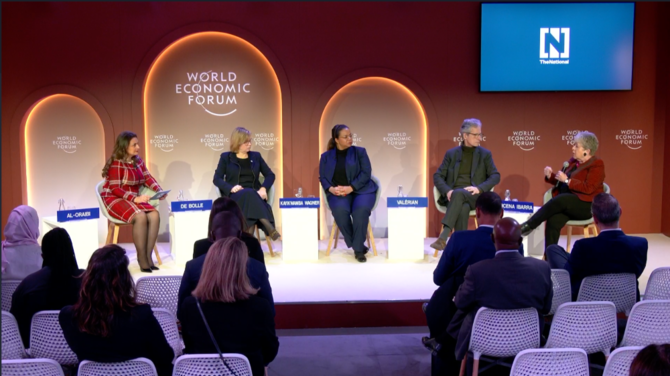
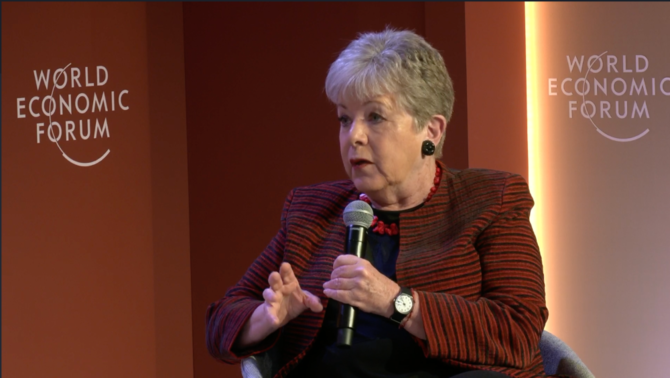
Panelists called for more concerted efforts to bridge the gender gap in political power. (Screengrab)
2 / 3
Panelists called for more concerted efforts to bridge the gender gap in political power. (Screengrab)
3 / 3
Panelists called for more concerted efforts to bridge the gender gap in political power. (Screengrab)
Short Url
Updated 23 January 2025
Follow

Political will, financial empowerment essential for gender equality: WEF panelists

  • Alicia Barcena Ibarra: When women have economic autonomy, it’s easier for them to participate on many fronts
  • Ibarra: We don’t want only women or only men. We need both because they have complementary visions

DUBAI: Political will is crucial for bridging the global gender gap and empowering women financially against pressing challenges, a panel of experts told the World Economic Forum in Davos on Wednesday.

Panelists acknowledged some progress in advancing female political representation, as 15.5 percent of heads of state around the world have been women over the past decade.

However, they called for more concerted efforts to bridge the gender gap in political power. According to WEF’s Global Gender Gap Report, it will take 168 years to reach gender parity, but if every economy had a gender-balanced Cabinet, global gender parity could be within reach in 54 years.

Alicia Barcena Ibarra, Mexico’s secretary of environment and natural resources, stressed that building women’s economic autonomy was key to advancing their political representation.

“When women have economic autonomy, it’s easier for them to participate on many fronts because when they are dependent on economic terms, that’s when they are vulnerable to corruption, dependency and abuse,” Ibarra said.

In Mexico, the first female president, Claudia Sheinbaum, was elected in October last year in a historic moment for the country. Under law, Congress now has to include 50 percent women, paving the way for the the first woman to lead the country’s Supreme Court, as well as the first female governor of the central bank.

While these strides on the political level have reflected positively on women’s social participation and inspired a young generation of Mexicans, Ibarra said that it revealed the pressure on women to perform.

“[The new president] has to do double the work because it’s not naturally accepted to have a female in the highest level of power, so she has to do even better than than men in many fronts to demonstrate that it's possible.”

Complementing her sentiments, Francois Valerian, chair of Transparency International, said that the lack of financial resources for women compared to men made females more vulnerable to abuses of power, state corruption and climate change.

“Pakistan’s floods, for example, left many women and children in need to receive aid,” said Valerian, calling for parity in political power to solve these issues at the community level.

Even during elections, women needed more financial resources for their campaigns “because they have less money, they are outsiders, and need to convince people they are to be trusted. Also, they need money for their safety in many countries,” Valerian said, as he urged governments to empower women to run for election through dedicating funds for this.

Therese Kayikwamba Wagner, minister of state and minister of foreign affairs of the Democratic Republic of the Congo, stressed that gender parity was necessary in all sectors to advance peacemaking and peacebuilding initiatives. So far, women’s inclusion had been achieved at the grassroot level.

She said that women needed to be included in decision-making and negotiating peace at the top level to ensure female concerns were well represented.

“There’s a need to think about how do we make sure that this is a cross-cutting approach and not just women at the local level who then have to own what is decided at the top level,” Wagner said.

At the UN General Assembly last year, only 19 speakers were women, including five heads of state and three heads of government, according to UN figures.

Wagner said that the starting point should be international organizations reflecting the progress on gender equality, and called for a female UN secretary-general.

“I think all our eyes are shifting toward Latin America because of the geographic rotation, with a lot of expectations that a continent that has distinguished itself with so many women that have assumed positions of leadership will also help us achieve that important milestone,” she said.

In peacemaking, the role of both genders was necessary for progress. “We don’t want only women or only men. We need both because they have complementary visions,” Mexico’s Ibarra said.


Trump says Greenland will ‘work out’ after Denmark fails to bridge gap

Updated 14 sec ago
Follow

Trump says Greenland will ‘work out’ after Denmark fails to bridge gap

  • Trump has appeared emboldened on Greenland — which he views as in the US backyard — since ordering a deadly January 3 attack in Venezuela that removed president Nicolas Maduro

WASHINGTON, United States: US President Donald Trump held open the possibility Wednesday for a resolution on his designs over Greenland after Denmark’s top diplomat said he failed to change the administration’s mind on wanting to conquer the island.
The foreign ministers of Denmark and Greenland, an autonomous territory under Copenhagen’s sovereignty, met at the White House with Vice President JD Vance and Secretary of State Marco Rubio in a meeting the visitors had requested to clear up “misunderstandings” after Trump’s bellicose language toward the fellow NATO member.
Trump, speaking after the meeting which he did not attend, for the first time sounded conciliatory on Greenland, acknowledging Denmark’s interests even if he again said he was not ruling out any options.
“I have a very good relationship with Denmark, and we’ll see how it all works out. I think something will work out,” Trump said without explaining further.
He again said Denmark was powerless if Russia or China wanted to occupy Greenland, but added: “There’s everything we can do.”
Danish Foreign Minister Lars Lokke Rasmussen, speaking after leaving the White House, said a US takeover of Greenland was “absolutely not necessary.”
“We didn’t manage to change the American position. It’s clear that the president has this wish of conquering over Greenland,” Lokke told reporters.
“We therefore still have a fundamental disagreement, but we also agree to disagree.”
He said the issue was “very emotional” for the people of Greenland and Denmark, a steadfast US ally whose troops died alongside Americans in Afghanistan and, controversially, Iraq.
“Ideas that would not respect territorial integrity of the Kingdom of Denmark and the right of self-determination of the Greenlandic people are, of course, totally unacceptable,” Lokke said.
He nonetheless said the tone was “constructive” and said the sides would form a committee that would meet within weeks to see if there was possible headway.
Referring to the British prime minister who trumpeted his diplomacy with Hitler, Lokke said, “I am not a Chamberlain to say “Peace for our time,” but we must seize the opportunities that present themselves.”

Mocking tone

While the talks were underway, the White House posted on X: “Which way, Greenland man?“
The post included a drawing of two dogsleds — one heading toward the White House and a huge US flag, and the other toward Chinese and Russian flags over a lightning-bathed Kremlin and Great Wall of China.
Neither country has claimed Greenland, and Lokke said no Chinese ship had been spotted there in a decade and that there were no major Chinese investments.
Denmark promised ahead of the meeting to ramp up its military presence further in the vast, sparsely populated and strategically located island.
Trump has derided recent Danish efforts to increase security for Greenland as amounting to “two dogsleds.” Denmark says it has invested almost $14 billion in Arctic security.
Denmark also announced immediate military exercises that will include aircraft, vessels and soldiers, with Sweden also participating.
In another show of solidarity with Denmark following Trump’s threats, Germany and France both said Wednesday they will send troops to Greenland. German’s defense ministry said it would send a 13-person team.

Signs of relief

On the quiet streets of the capital Nuuk, red and white Greenlandic flags flew in shop windows, on apartment balconies, and on cars and buses, in a show of national unity during the talks.
Ivaana Egede Larsen, 43, said she felt relief that the meeting appeared to be cordial.
“I am more calm now, and I feel more safe. I had felt very much unsafe lately,” she said.
In Copenhagen, Thomas Fallesen, 56, voiced similar sentiments.
“They are now at least talking together instead of talking through the press. I think it’s a very positive thing,” he said.
Vance, who slammed Denmark as a “bad ally” during an uninvited visit to Greenland last year, is known for a hard edge, which was on display when he publicly berated Ukrainian President Volodymyr Zelensky in the Oval Office last February.
Wednesday’s meeting, however, was closed to the press, meaning there was no on-camera confrontation.
Trump has appeared emboldened on Greenland — which he views as in the US backyard — since ordering a deadly January 3 attack in Venezuela that removed president Nicolas Maduro.