

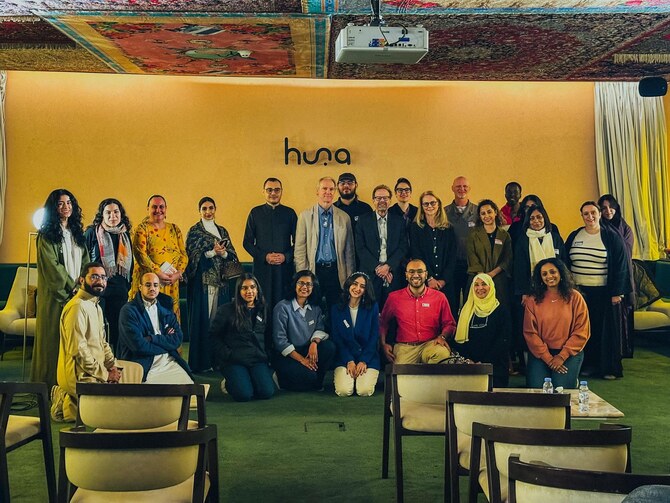

RIYADH: Bookworms and aspiring writers alike were given space to explore their creative talent and learn from seasoned authors at Al Jalees Book Club’s “Writing Across Nations” dialogue session in Riyadh this week.
The club was founded in 2014 by Rana Hajjar, a Jeddah native who wanted to create a productive and welcoming community for local readers and writers.
“Al Jalees is my passion project, I started it because I wanted a space to fit in, a community that understands my interest,” she said.
Hajjar said that although the literary community has very much always been alive in Saudi Arabia, it was very difficult to find each other. So the main goal of the club was for her and others to feel less alone.

Elizabeth Willis, professor of poetry at the University of Iowa at Al Jalees Book Club “Writing Across Nations” dialogue session in Riyadh. (Supplied, Al Jalees Book Club)
Al Jalees has an English department, run by Hajjar in Riyadh, and an Arabic department, run by her sister Rabab, in Jeddah.
Hosted in collaboration with the US Embassy, writers from a wide range of genres and diverse backgrounds were encouraged to attend the “Writing Across Nations” discussion to listen to and engage with American poets, novelists, and academics eager to share the toolkits they have developed to hone their craft.
According to Tom Sleigh, a poet, dramatist and essayist with 11 books of poetry in his arsenal, a common mistake up-and-coming writers commit is comparing their style with that of other authors and trying to live up to those standards, when true talent and audience intrigue comes from the uniqueness one offers in one’s work.
“The idiosyncrasy with which each person approaches their relationship to language meant that there was a kind of utterly unapologetic relationship to writing differently than each other,” he said.
Echoing Sleigh’s words, Cate Dicharry, director of the Writing and Humanities Program at the University of Iowa, said that although she has always been an avid reader, writing seemed unachievable, partly because many of the writers she admired had passed on, creating an enigmatic image of the published author that seemed impossible to emulate.

Al Jalees Book Club hosts “Writing Across Nations” dialogue session in Riyadh. (Supplied, Al Jalees Book Club)
Dicharry also said that young, ambitious students are “reading really good work that is in its final form,” and getting very discouraged when their first drafts do not sound as advanced, creating a fearful cycle that dims potential rather than develops it.
Toxic comparisons aside, all panelists agreed that the key to becoming a great writer is to be a great reader.
Christpher Merril, director of the International Writing Program at the University of Iowa, said that new writers will “fall in love” with a poet and begin imitating them, and if they are lucky enough, they will bore themselves and look for another poet to be encapsulated by.
“Bit by bit you fall in love with different poems (and poets) and then you find your way to writing your own poem,” he said.
In an interview with Arab News, Hajjar said that one non-fiction book everyone should read is “Feel the Fear and Do It Anyway” by Susan Jeffers, a self-help book Hajjar uses to advocate for breast and ovarian cancer awareness and prevention.
The fiction book she recommends is “East of Eden” by John Steinbeck, a multi-generational novel that explores the struggle between good and evil through the interconnected lives of two families in California’s Salinas Valley.
Recalling his time covering the war in former Yugoslavia, in preparation for writing his book: “Only the Nails Remain: Scenes from the Balkan Wars”, Merril spoke about how writing first begins with observing, whether that means observing people’s behaviors or the settings around you.
“Part of your job as a writer is you are paying attention, you’re taking notes, and you’re trying to think: how is he doing that?”
Through writing comes understanding; even if situations seem unclear at first, write them down first and examine the chaos later, Merril said.

Al Jalees Book Club hosts “Writing Across Nations” dialogue session in Riyadh. (Supplied, Al Jalees Book Club)
Responding to a question from Arab News, Merril said: “I am not going to imagine that I am writing from a place of knowledge about myself, I am writing from a place of vast ignorance, with the hope that some lights might go off along the way.”
Elizabeth Willis, professor of poetry at the University of Iowa, emphasized that writing fiction or other literary forms and understanding yourself as a person are both lifelong practices, so do not make your craft wait for you or it will be waiting forever.
Sleigh said that the quiet that comes with writing inadvertently gives you the space and freedom to work through matters in your own life, mirroring Merril’s “through writing comes understanding external concept internally.
Al Jalees hosts large events every month and over the years they have accumulated more than 120 speakers to join their sessions in over 700 events.
Moving Al Jalees online during the COVID pandemic helped open it up to the rest of the world
“When a book club turns into a culture club, turns into a club where everybody intellectual is all around it, it is a very positive impact for you, for your children, for your family, for your friends, and then you make friends through the thousands of people that you meet,” Hajjar said.
Readers and writers of all levels and backgrounds, as well as those simply interested in the community, are welcome to join their events, she said.
“Language is not just words; it is a lifestyle.”
Al Jalees hopes to expand its Jeddah-based Arabic chapter to Riyadh in the upcoming months, as well as to expand the English chapter to biweekly events.


