


DUBAI: The World Bank Group’s forecast suggests that between 2024 and 2026, countries that collectively account for more than 80 percent of the world’s population and global GDP will still be growing more slowly than they did in the decade before COVID-19.
Moreover, new trade barriers introduced have nearly tripled since 2019, according to the UN.
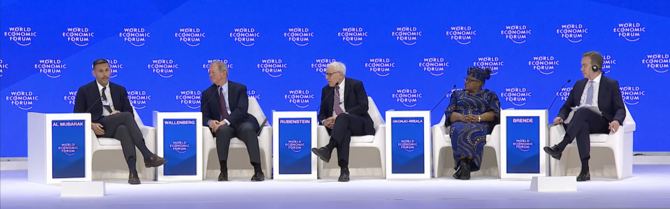
In this environment, how do global economies find growth? That was the question being explored by a World Economic Forum panel “Finding Growth in Uncertain Times” in Davos.
Moderated by WEF President and CEO Borge Brende, the panel featured Ngozi Okonjo-Iweala, director-general of the World Trade Organization; David Rubenstein, co-founder and co-chairman of global investment firm Carlyle; Marcus Wallenberg, chairman of Swedish bank Skandinaviska Enskilda Banken and Khaldoon Khalifa Al-Mubarak, group CEO, Mubadala Investment Company.
Okonjo-Iweala laid out four requirements for growth: maintaining or restoring macroeconomic stability and good management including fiscal consolidation; openness and predictability of global markets, which requires strengthening resilience in economies; “re-globalization,” which means decentralizing and diversifying supply chains; and lastly, adopting technology and AI, which will increase productivity and lower trade costs in a way that allows for double-digit growth in trade from now until 2040.
There are many questions about US policy with President Donald Trump stepping into office on Monday. Rubenstein addressed some of these questions and concerns saying that in just a day, Trump has issued several executive orders.
“I think you will see him (Trump) doing a lot of fairly robust things that might not have been anticipated before,” he said.
He went on to explain some of the new administration’s policies, such as tax cuts, aimed at spurring growth; imposing tariffs as a negotiation tool for greater trade cooperation; and increasing production of natural gas and oil, which is already at its highest in the country.
“The biggest impediments to growth,” not just for the US but globally, are the wars in the Middle East, Rubenstein said.
He added: “The US’s problems are not the biggest problems. The biggest challenge for economic growth around the world is the Global South, which, because of the challenges of the last 15 years went further behind the developed markets than desired.”
The US is feeling “fairly bullish” about the economy for the near future, and so, it has to ensure it is helping out other countries in terms of wars and access to technology, Rubenstein added.
Europe, on the other hand, is lagging behind with weak growth forecasts. This is partly due to Europe not being as competitive, according to Wallenberg.
He said: “Over the years, Europe has tended to perhaps not understand our competitive situation and the strategic position that we find ourselves (in) with a very strong United States and a very strong China, and therefore our competitiveness has been challenged.”
Wallenberg pointed out that Europe is a rather larger market, which means there is potential for scale. But first, it needs to revive its confidence as well as that of its consumers along with “a singular capital market that is unified” and “a number of institutions that can provide more risk capital,” among other things.
“We have all the ingredients to make it happen,” he said. “Now, we just have to stand up and get it done.”
Turning to the Middle East, Mubadala’s Al-Mubarak underlined the importance of sovereign wealth funds.
Because they are “highly capitalized” and have a “high liquidity position” as well as the ability to think and invest long term, sovereign funds are becoming more and more important to support global growth, he said.
He explained why the UAE is a good example of a growth story. For example, its capital Abu Dhabi was rated the safest city in the world for the seventh year running; it ranked fifth globally in AI competitiveness according to a Stanford study; and it recorded the largest inflow of high-net-worth individuals globally in 2024, he said.
The UAE sets the example of “growth in this new world,” particularly “how to create growth and diversify from one sector to a multi-faceted economy,” Al-Mubarak said.


