

Pakistan invites global stakeholders to invest in priority sectors during WEF summit

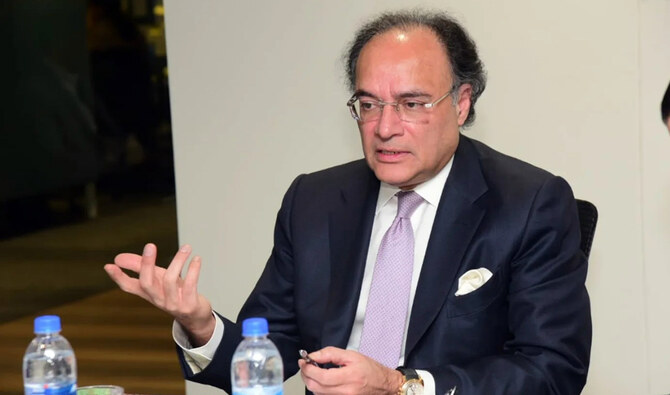
Pakistan’s finance minister Muhammad Aurangzeb speaks during a meeting of Pakistan Business Council in Karachi on December 16, 2024. (Ministry of Finance/File)
Short Url
Updated 21 January 2025
Follow

Pakistan invites global stakeholders to invest in priority sectors during WEF summit

  • Pakistan’s finance minister is in Davos to attend annual WEF summit from Jan. 20-24
  • Invites global investors to invest in agriculture, IT, mining, minerals and energy sectors

ISLAMABAD: Pakistan’s Finance Minister Muhammad Aurangzeb on Tuesday invited global investors and stakeholders to invest in Pakistan’s priority sectors during the ongoing World Economic Forum (WEF) summit in Davos. 

Aurangzeb is in the Swiss city to attend the WEF’s annual summit from Jan. 20-24 where the world’s top business and political leaders are meeting to address key global and regional challenges.

Pakistan, which has struggled with a prolonged economic crisis for the past two years, is struggling to bring about an economic revival. Prime Minister Shehbaz Sharif’s coalition government has vowed to do that by privatizing state-owned enterprises, reducing interest rates, slashing inflation and increasing exports to achieve a 6 percent growth rate in the coming years. 

“Global stakeholders are invited to support Pakistan’s journey by investing in priority sectors such as agriculture, IT, renewable energy, mining and minerals, textiles and apparels, pharmaceuticals, while capitalizing on Special Economic Zones (SEZs),” Aurangzeb wrote in an article for the WEF. 

The minister said Pakistan is addressing structural inefficiencies in revenue collection, energy and SOEs. 

“Rightsizing the federal government, reforming SOEs, and fostering export-led growth will strengthen internal revenue streams and reduce reliance on international funding programs,” he added. 

He said Pakistan was on a path to economic recovery, noting that inflation had dropped to 4.1 percent, and foreign exchange reserves now provide over two months of import coverage.

The Pakistani finance minister said the current account had recorded a surplus for three consecutive months while the country’s goods exports have risen by 7.1 percent, 

“Pakistan’s global default risk has dropped by 93 percent, signaling renewed faith in the country’s fiscal stability,” he said. 

“Local and foreign investors, including global giants like Aramco, BYD and Samsung, are contributing to this economic revival, reflecting Pakistan’s potential as a lucrative investment hub.”

The minister said the cornerstone of Pakistan’s economic transformation is visionary leadership and political will. 

“With a remarkable workforce, abundant natural resources, and immense production potential, Pakistan is poised to soar to new heights – contributing to regional stability and global economic progress,” he said. 

Aurangzeb’s activities at the forum would include taking part in panel discussions on the rising global debt burden on developing economies. 
He will also take part as a panelist in a discussion on the revolutionary impact of new technologies, especially Artificial Intelligence and automation, in promoting trade and investment, the finance ministry said this week. 
It said the minister will also give interviews to selected international media representatives during the summit.


Pakistan launches privatization process for five power distributors under IMF reforms

Updated 10 sec ago
Follow

Pakistan launches privatization process for five power distributors under IMF reforms

  • Power-sector losses have pushed circular debt above $9 billion, official documents show
  • Move is tied to IMF and World Bank conditions aimed at cutting subsidies and fiscal risk

KARACHI: Pakistan has appointed financial advisers and launched sell-side due diligence for the privatization of five electricity distribution companies, marking a long-awaited step in power-sector reforms tied to International Monetary Fund (IMF) and World Bank programs, according to official documents shared with media on Monday.

The five companies, namely Islamabad Electric Supply Company (IESCO), Faisalabad Electric Supply Company (FESCO), Gujranwala Electric Power Company (GEPCO), Hyderabad Electric Supply Company (HESCO) and Sukkur Electric Power Company (SEPCO), supply electricity to tens of millions of customers and have long been a major source of financial losses for the state.

Pakistan’s power sector has accumulated more than Rs2.6 trillion (about $9.3 billion) in circular debt as of mid-2025, driven largely by distribution losses, electricity theft and weak bill recovery, according to official government data cited in the documents. The shortfall has repeatedly forced the government to provide subsidies, adding pressure to public finances in an economy under IMF supervision.

“The objective is to reduce losses, improve efficiency and limit the government’s fiscal exposure by transferring electricity distribution operations to the private sector,” the documents said, adding that sell-side due diligence for five distribution companies is under way as a prerequisite for investor engagement.

Two utilities, the Quetta Electric Supply Company and Tribal Areas Electric Supply Company, are excluded from the current privatization phase due to security and structural constraints, the documents said.

Power-sector reform is a central pillar of Pakistan’s IMF bailout program, under which Islamabad has committed to restructuring state-owned enterprises, improving governance and reducing budgetary support. The World Bank has also linked future energy-sector financing to progress on structural reforms.

Electricity distribution companies in Pakistan routinely report losses exceeding 20 percent of supplied power, far above international benchmarks, according to official figures. These inefficiencies have been a persistent obstacle to economic growth, investment and reliable power supply.

Previous attempts to privatize power distributors have stalled amid political resistance, labor union opposition and concerns over tariff increases. While officials have not announced a timeline for completing transactions, the launch of due diligence marks the most concrete step taken in years. International lenders and investors will now be closely watching whether Pakistan can translate this phase into completed sales, a key test of its ability to deliver on IMF-backed reforms.

In a related development in Pakistan’s privatization agenda, the government last month concluded the long-delayed sale of a 75 percent stake in national flag carrier Pakistan International Airlines (PIA) in a publicly televised auction. A consortium led by the Arif Habib Group emerged as the highest bidder with a Rs135 billion ($482 million) offer for the controlling stake, in a transaction officials have said will end decades of state-funded bailouts and inject fresh capital into the loss-making airline.