

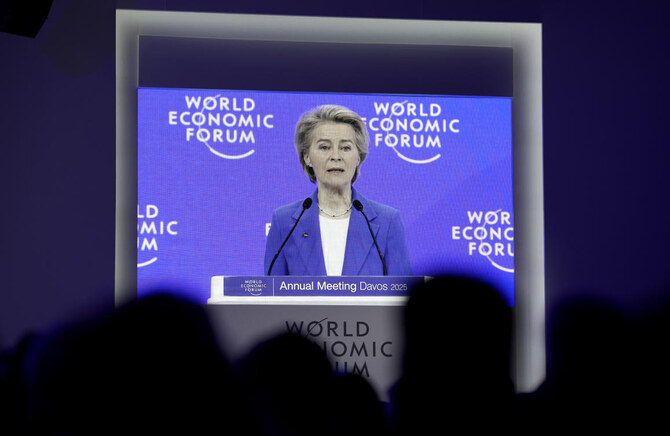

DAVOS: EU chief Ursula von der Leyen declared Tuesday that Europe was ready to negotiate with US President Donald Trump but the bloc will also seek to improve ties with China and other nations as global competition heats up.
Von der Leyen insisted that the United States remains an important partner, taking a conciliatory tone in a speech to the annual meeting of global elites in Davos, Switzerland.
The EU’s “first priority will be to engage early, discuss common interests, and be ready to negotiate” with Trump, she said.
“We will be pragmatic, but we will always stand by our principles. To protect our interests and uphold our values,” she said.
Trump returned to the White House on Monday, bringing with him fears he will deliver on promises to slap heavy tariffs on China and US allies including Canada and the European Union.
After his inauguration, Trump said he may impose 25 percent tariffs on Canada and Mexico as early as February 1.
He also announced the United States’ withdrawal from the Paris climate accord, which the European Commission president defended as the “best hope for all humanity” and vowed “Europe will stay the course.”
China’s Vice Premier Ding Xuexiang — also a member of the Chinese Communist Party’s apex of power that rules the country — will speak immediately after von der Leyen.
The EU chief reiterated her commitment to free trade during her speech, pointing to recent deals with Switzerland, the Latin American bloc Mercosur and Mexico.
Von der Leyen also said she and Indian Prime Minister Narendra Modi wanted to “upgrade” their partnership.
She stressed that Europe “must engage constructively with China — to find solutions in our mutual interest” despite escalating trade tensions between the two.
“2025 marks 50 years of our Union’s diplomatic relations with China. I see it as an opportunity to engage and deepen our relationship with China, and where possible, even to expand our trade and investment ties,” she said.
China is taking a cautious approach to Trump.
After Chinese President Xi Jinping’s conversation with Trump by phone on Friday, he said he hoped for a “good start” to relations with the new administration.
Although Trump said he would undertake sweeping trade penalties against China, he has also indicated he wants to improve ties — and even stepped in to reverse a US ban of Chinese-owned social media platform TikTok on national security grounds.
Ukraine is also keeping a very close eye on what Trump’s second mandate will involve.
Ukrainian President Volodymyr Zelensky is expected to call on world leaders and company executives to maintain — and even ramp up — their support for his country’s fight against Russia.
Zelensky on Monday said he is hopeful Trump will help achieve a “just peace.”
Embattled German Chancellor Olaf Scholz will also address the forum, likely his last as leader ahead of elections next month.
Also speaking on Tuesday will be conservative leader Friedrich Merz, the favorite to succeed him as chancellor.
Europeans are fretting the most about Trump’s return while countries from Brazil to China and India to Turkiye believe he will be good for their countries and global peace, according to a survey last week from the European Council on Foreign Relations (ECFR).
The report accompanying the survey of over 28,500 people across 24 countries serves as a warning for European leaders to act cautiously.
“Europeans will struggle to find internal unity or global power in leading an outright resistance to the new administration,” the ECFR report’s authors said.
Middle East conflicts will also be high on the agenda as Israeli President Isaac Herzog and Qatari Prime Minister Sheikh Mohammed bin Abdulrahman bin Jassim Al-Thani speak in separate sessions during the first full day of the forum.
As a fragile ceasefire holds in the Israel-Hamas war, the WEF will host a discussion on how to improve aid delivery to the Palestinian territory of Gaza and how to kickstart the reconstruction and recovery after heavy bombardment.
Despite suggestions Trump’s return would overshadow the forum that began on the same day as his inauguration in Washington, WEF President Borge Brende said the president had brought fresh interest to the gathering.
“It has increased the interest in Davos because people feel they need to come together to better understand what’s on its way,” Brende told AFP in an interview.


