Pakistani province bordering Afghanistan to send talks’ delegation to Kabul within two weeks — CM

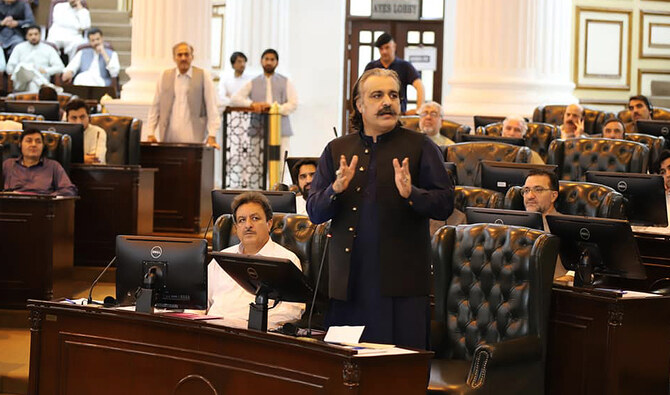
In this file photo, taken on June 3, 2024, Pakistan’s Khyber Pakhtunkhwa Chief Minister Ali Amin Gandapur speaks at the provincial assembly in Peshawar. (Photo courtesy: Facebook/pakpgov/File)
Short Url
Updated 21 January 2025
Follow

Pakistani province bordering Afghanistan to send talks’ delegation to Kabul within two weeks — CM

  • Islamabad says it has consistently taken up the issue of cross-border militancy with Kabul
  • Afghan Taliban say do not allow Afghan soil to be used by militants against other nations

ISLAMABAD: The chief minister of Pakistan’s northwestern Khyber Pakhtunkhwa province said this week he would send a delegation to neighboring Afghanistan within two weeks for discussions on ongoing tensions, including cross-border militancy. 
Already strained relations between the neighbors have deteriorated in recent months amid a spike in militant attacks in Pakistan that it blames on insurgents harboring in Afghanistan. Kabul’s Afghan rulers deny state complicity and say they do not allow Afghan soil to be used by militant groups against other nations. 
Last year, KP CM Ali Amin Gandapur said he would hold direct talks with Kabul and send an emissary to Afghanistan to arrange a meeting to resolve outstanding issues. At the time, the central government led by Prime Minister Shehbaz Sharif, a main rival of Gandapur’s PTI party that rules KP, said the offer amounted to a “direct attack on the federation” as no province could open talks with a foreign country, which was the jurisdiction of the government at the center. 
“Now I will have to play my role. We held a provincial meeting and now I am sending a delegation to Afghanistan soon,” Gandapur told reporters on Monday. “Within two weeks a delegation that I am forming will go to Afghanistan and talk to them [Afghan government].”
A second delegation comprising main tribes from KP province would also visit Afghanistan subsequently, the chief minister added. 
“A delegation comprising all tribes will also go and talk to them. I have full faith that they [Afghan authorities] will cooperate with our jirga.”
Islamabad says it has consistently taken up the issue of cross-border attacks with the Taliban administration. The issue has also led to clashes between the border forces of the two countries on multiple occasions in recent months.
In December, the Afghan Taliban said bombardment by Pakistani military aircraft in Afghanistan’s eastern Paktika province had killed at least 46 people, most of whom were children and women. Just days later, the Afghan defense ministry said Taliban forces targeted “several points” in neighboring Pakistan, further straining tense ties. 
Relations between the two countries have also soured since Pakistan launched a deportation drive in November 2023 against illegal aliens residing in the country. Though Pakistan insists the campaign does not only target Afghans but all those residing in Pakistan unlawfully, it has disproportionately hit Afghans, with at least 800,000 repatriated so far.


Pakistan terms climate change, demographic pressures as ‘pressing existential risks’

Updated 06 December 2025
Follow

Pakistan terms climate change, demographic pressures as ‘pressing existential risks’

  • Pakistan has suffered frequent climate change-induced disasters, including floods this year that killed over 1,000
  • Pakistan finmin highlights stabilization measures at Doha Forum, discusses economic cooperation with Qatar 

ISLAMABAD: Pakistan’s Finance Minister Muhammad Aurangzeb on Saturday described climate change and demographic pressures as “pressing existential risks” facing the country, calling for urgent climate financing. 

The finance minister was speaking as a member of a high-level panel at the 23rd edition of the Doha Forum, which is being held from Dec. 6–7 in the Qatari capital. Aurangzeb was invited as a speaker on the discussion titled: ‘Global Trade Tensions: Economic Impact and Policy Responses in MENA.’

“He reaffirmed that while Pakistan remained vigilant in the face of geopolitical uncertainty, the more pressing existential risks were climate change and demographic pressures,” the Finance Division said. 

Pakistan has suffered repeated climate disasters in recent years, most notably the 2022 super-floods that submerged one-third of the country, displaced millions and caused an estimated $30 billion in losses. 

This year’s floods killed over 1,000 people and caused at least $2.9 billion in damages to agriculture and infrastructure. Scientists say Pakistan remains among the world’s most climate-vulnerable nations despite contributing less than 1 percent of global greenhouse-gas emissions.

Aurangzeb has previously said climate change and Pakistan’s fast-rising population are the only two factors that can hinder the South Asian country’s efforts to become a $3 trillion economy in the future. 

The finance minister noted that this year’s floods in Pakistan had shaved at least 0.5 percent off GDP growth, calling for urgent climate financing and investment in resilient infrastructure. 

When asked about Pakistan’s fiscal resilience and capability to absorb external shocks, Aurangzeb said Islamabad had rebuilt fiscal buffers. He pointed out that both the primary fiscal balance and current account had returned to surplus, supported significantly by strong remittance inflows of $18–20 billion annually from the Middle East and North Africa (MENA) and Gulf Cooperation Council (GCC) regions. 

Separately, Aurangzeb met his Qatari counterpart Ali Bin Ahmed Al Kuwari to discuss bilateral cooperation. 

“Both sides reaffirmed their commitment to strengthening economic ties, particularly by maximizing opportunities created through the newly concluded GCC–Pakistan Free Trade Agreement, expanding trade flows, and deepening energy cooperation, including long-term LNG collaboration,” the finance ministry said. 

The two also discussed collaboration on digital infrastructure, skills development and regulatory reform. They agreed to establish structured mechanisms to continue joint work in trade diversification, technology, climate resilience, and investment facilitation, the finance ministry said.