ROME: The UN’s World Food Programme said Sunday it was moving full throttle to get food to as many Gazans as possible after border crossings reopened as part of a long-awaited ceasefire deal.
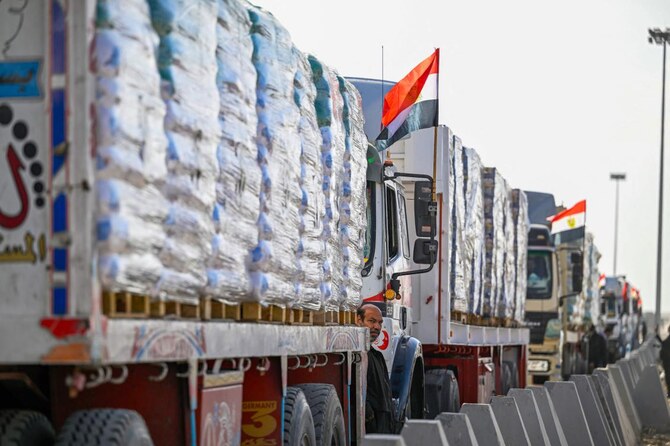
“We’re trying to reach a million people within the shortest possible time,” the WFP’s Deputy Executive Director Carl Skau told AFP, as the Rome-based UN agency’s trucks began rolling into the strip.
“We’re moving in with wheat flour, ready to eat meals, and we will be working all fronts trying to restock the bakeries,” Skau said, adding the agency would attempt to provide nutritional supplements to the most malnourished.
An initial 42-day truce between Israel and Hamas is meant to enable a surge of sorely needed humanitarian aid into the Palestinian territory after 15 months of war.
“The agreement is for 600 trucks a day... All the crossings will be open,” Skau said.
The first WFP trucks entered Gaza through the Kerem Shalom crossing in the south and through the Zikim crossing in the north, the agency said in a statement, as it began trying to pull “the war-ravaged territory back from starvation.”
“We have 150 trucks lined up for every day for the next at least 20 days,” Skau said, adding that the WFP was “hopeful that the border crossings will be open and efficient.”
There needs to be “an environment inside (Gaza) that is secure enough for our teams to move around,” so that food “does not just get over the border but also gets into the hands of the people.”
“It seems so far that things have been working relatively well.... We need to now sustain that over several days over weeks,” he said.
Before the ceasefire came into effect, WFP was operating just five out of the 20 bakeries it partners with due to dwindling supplies of fuel and flour, as well as insecurity in northern Gaza.
“We’re hoping that we will be up and running on all those bakeries as soon as possible,” Skau said, stressing that it was “one of our top priorities” to get bread to “tens of thousands of people each day.”
“It also has a psychological effect to be able to put warm bread into the hands of the people.”
WFP also wants to “get the private sector and commercial goods in there as soon as possible,” he said.
That would mean the UN agency could replace ready meals with vouchers and cash for people to buy their own food “to bring back some dignity” and allow them “frankly to start rebuilding their lives.”
WFP said in a statement that it has enough food pre-positioned along the borders — and on its way to Gaza — to feed over a million people for three months.
Vast areas of Gaza have been devastated by Israel’s retaliatory assault on the territory after the October 7 Hamas attack last year sparked the war.
The attack, the deadliest in Israel’s history, resulted in the deaths of 1,210 people, mostly civilians, according to an AFP tally of Israeli official figures.
Israel’s retaliatory campaign has killed at least 46,913 people, also mostly civilians, according to figures from the Hamas-run territory’s health ministry that the United Nations considers reliable.


UN races to feed one million Gazans after truce
https://arab.news/jgk9w
UN races to feed one million Gazans after truce

- World Food Programme trying to reach a million people within the shortest possible time
- First WFP trucks entered Gaza through the Kerem Shalom crossing in the south and through the Zikim crossing in the north


Gaza’s Rafah crossing with Egypt to reopen on Sunday, Israel’s COGAT says
- Israeli government agency that coordinates civilian policy in Gaza makes announcement
JERUSALEM: Israel will reopen the Rafah border crossing on Sunday for people to travel between Gaza and Egypt, the Israeli government agency that coordinates civilian policy in Gaza, COGAT, said on Friday.
“The return of residents from Egypt to the Gaza Strip will be permitted, in coordination with Egypt, for residents who left Gaza during the course of the war only, and only after prior security clearance by Israel,” COGAT said.
The Rafah crossing is effectively the sole route in or out of Gaza for nearly all of the more than 2 million people who live there.
Israel seized the border crossing in May 2024, about nine months into the Gaza war. Reopening it was an important requirement under the first phase of US President Donald Trump’s plan to stop fighting between Israel and Hamas militants, which followed a ceasefire agreed in October.
Israel had said it would reopen it only after recovering the body of the last Israeli hostage in Gaza, which took place this week.


