

Israeli forces start withdrawing from areas in Gaza ahead of ceasefire, say pro-Hamas media

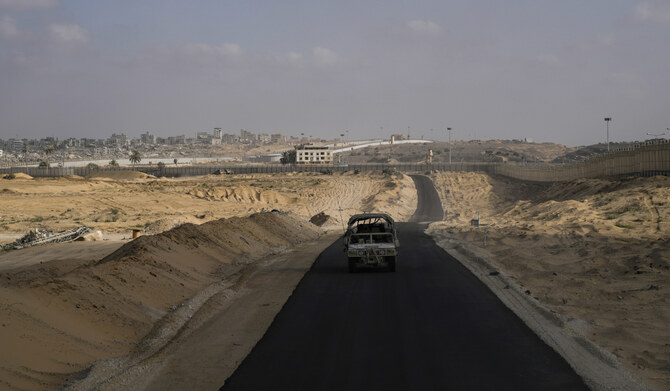
Israeli soldiers move along the Philadelphi Corridor along the border with Egypt, in the Gaza Strip on Friday, Sept. 13, 2024. (AP)
Short Url
Updated 19 January 2025
Follow

Israeli forces start withdrawing from areas in Gaza ahead of ceasefire, say pro-Hamas media

  • Gaza ceasefire and release of hostages set to begin with 3 females on Sunday afternoon
  • Hamas hostages to be released in return for 30 Palestinian prisoners each

JERUSALEM/CAIRO: Israeli forces started withdrawing from areas in Gaza’s Rafah to the Philadelphi corridor along the border between Egypt and Gaza ahead of the start of the ceasefire agreement, pro-Hamas media reported early on Sunday.

A ceasefire in Gaza between Israel and Hamas is set to come into effect on Sunday morning with a hostage release to follow hours later, opening the way to a possible end to a 15-month war that has upended the Middle East.

The agreement followed months of on-off negotiations brokered by Egypt, Qatar and the United States, and came just ahead of the Jan. 20 inauguration of US President-elect Donald Trump.
The three-stage ceasefire will come into effect at 0630 GMT on Sunday.
Its first stage will last six weeks, during which 33 of the remaining 98 hostages — women, children, men over 50, the ill and wounded — will be released in return for almost 2,000 Palestinian prisoners and detainees.
They include 737 male, female and teen-aged prisoners, some of whom are members of militant groups convicted of attacks that killed dozens of Israelis, as well as hundreds of Palestinians from Gaza in detention since the start of the war.
Three female hostages are expected to be released on Sunday afternoon through the Red Cross, in return for 30 prisoners each.
After Sunday’s hostage release, lead US negotiator Brett McGurk said, the accord calls for four more female hostages to be freed after seven days, followed by the release of three further hostages every seven days thereafter.
During the first phase the Israeli army will pull back from some of its positions in Gaza and Palestinians displaced from areas in northern Gaza will be allowed to return.
US President Joe Biden’s team worked closely with Trump’s Middle East envoy Steve Witkoff to push the deal over the line.
As his inauguration approached, Trump had repeated his demand that a deal be done swiftly, warning repeatedly that there would be “hell to pay” if the hostages were not released.

Post-war Gaza?
But what will come next in Gaza remains unclear in the absence of a comprehensive agreement on the postwar future of the enclave, which will require billions of dollars and years of work to rebuild.
And although the stated aim of the ceasefire is to end the war entirely, it could easily unravel.
Hamas, which has controlled Gaza for almost two decades, has survived despite losing its top leadership and thousands of fighters.
Israel has vowed it will not allow Hamas to return to power and has cleared large stretches of ground inside Gaza, in a step widely seen as a move toward creating a buffer zone that will allow its troops to act freely against threats in the enclave.
In Israel, the return of the hostages may ease some of the public anger against Prime Minister Benjamin Netanyahu and his right-wing government over the Oct. 7 security failure that led to the deadliest single day in the country’s history.


But hard-liners in his government have already threatened to quit if war on Hamas is not resumed, leaving him pressed between Washington’s desire to see the war end, and his far-right political allies at home.
And if war resumes, dozens of hostages could be left behind in Gaza.

Mideast shockwaves
Outside Gaza, the war sent shockwaves across the region, triggering a war with the Tehran-backed Lebanese Hezbollah movement and bringing Israel into direct conflict with its arch-foe Iran for the first time.
More than a year later, the Middle East has been transformed. Iran, which spent billions building up a network of militant groups around Israel, has seen its “Axis of Resistance” wrecked and was unable to inflict more than minimal damage on Israel in two major missile attacks.
Hezbollah, whose huge missile arsenal was once seen as the biggest threat to Israel, has been humbled, with its top leadership killed and most of its missiles and military infrastructure destroyed.
In the aftermath, the decades-long Assad regime in Syria was overturned, removing another major Iranian ally and leaving Israel’s military effectively unchallenged in the region.
But on the diplomatic front, Israel has faced outrage and isolation over the death and devastation in Gaza.
Netanyahu faces an International Criminal Court arrest warrant on war crimes allegations and separate accusations of genocide at the International Court of Justice.
Israel has reacted with fury to both cases, rejecting the charges as politically motivated and accusing South Africa, which brought the original ICJ case as well as the countries that have joined it, of antisemitism.
The war was triggered by Hamas’ Oct. 7, 2023, attack on southern Israel in which 1,200 people were killed and more than 250 taken hostage, according to Israeli tallies. More than 400 Israeli soldiers have been killed in combat in Gaza since.
Israel’s 15-month campaign in Gaza has killed nearly 47,000 Palestinians, according to Gaza health ministry figures, which do not distinguish between fighters and civilians, and left the narrow coastal enclave a wasteland of rubble.
Health officials say most of the dead are civilians. Israel says more than a third are fighters.


STC announces dissolution

Updated 50 min 28 sec ago
Follow

STC announces dissolution

RIYADH: The Yemeni separatist group Southern Transitional Council (STC) has announced it will dissolve following talks in Saudi Arabia. Several STC members are in Riyadh for discussions on ending unrest in southern Yemen. The group praised Saudi Arabia’s efforts, while former STC leader Aidarous al-Zubaidi, now wanted by the Presidential Council for high treason, has fled Yemen and has not participated in the talks. 

A Yemeni source told Arab News: “this announcement and ease shown in the televised video statement shows that in fact Al Zubaidi was the obstacle, and that most southerners are open to resolving their matter via dialogue and discussion”

The members of the Southern Transitional Council (STC) in Yemen spoke during the Riyadh Southern Dialogue Conference on Friday.

During the meeting, the Council said military operations in Hadramout and Mahra harmed the Southern cause in Yemen. 

The Council said they did not participate in the decision for the military operations in Hadramout and Mahra. 

"We hope to reach a vision and concept for resolving the Southern issue at the Riyadh Conference,” said the Council.

The Council thanked Saudi Arabia for hosting the dialogue conference in Riyadh.

  • Below is a full translation of the STC announcement as reported by the Arabic language Yemeni news agency (SABA):  

Announcement of the Dissolution of the Southern Transitional Council

The Presidency of the Southern Transitional Council, the Supreme Executive Leadership, the General Secretariat, and the other affiliated bodies convened a meeting to assess the recent unfortunate events in the governorates of Hadramout and Al-Mahrah, and the subsequent rejection of all efforts toward de-escalation and resolution. These developments have led to serious and painful consequences. Referring to the statement issued by the Ministry of Foreign Affairs of the Kingdom of Saudi Arabia regarding its sponsorship of a southern dialogue to resolve the southern issue—and in order to safeguard the future of the southern cause and the right of the southern people to restore their state according to their will and aspirations, and to preserve peace and social security in the South and the broader region—we make the following declaration:

The Southern Transitional Council was established to carry the cause of the southern people, represent them, and lead them toward achieving their aspirations and restoring their state. We founded it with the belief that the goal was to achieve this mission—not to cling to it as a means of gaining power, monopolizing decision-making, or excluding others.

Since we were not involved in the decision to launch the military operation in Hadramout and Al-Mahrah—an operation that harmed southern unity and damaged relations with the coalition led by the Kingdom of Saudi Arabia, which has made and continues to make great sacrifices and provide ongoing political, economic, and military support—the continued existence of the Council no longer serves the purpose for which it was created. In light of this and our historical responsibility toward the southern cause, we hereby announce the dissolution of the Southern Transitional Council, the disbanding of all its main and subsidiary bodies, and the closure of all its offices inside and outside the country. We will instead work to achieve our just southern goal by preparing for and participating in the comprehensive southern conference under the Kingdom’s sponsorship.

We commend the Kingdom of Saudi Arabia for its clear and explicit commitments and the sincere concern it has shown for our cause in seeking solutions that meet the aspirations and will of the southern people.

We call on all active southern figures and leaders to engage in the path of the comprehensive southern dialogue conference, hoping that the participants will reach a vision and framework to resolve the southern issue and fulfill the people’s aspirations through their free will, and to establish an inclusive southern framework.

From this platform, we call on the people of the South, our colleagues in the capital Aden, and all the governorates of our beloved South to recognize the gravity of this moment, the sensitivity of the current phase, and the importance of uniting efforts to preserve our gains and protect the South from chaos or instability.

We reaffirm our continued commitment to serving the just and legitimate cause of the southern people and achieving their aspirations according to their will. We also extend our gratitude to the leadership and people of the Kingdom of Saudi Arabia for hosting the comprehensive southern dialogue conference and for their support of the South, its cause, and its people across all fields and stages.