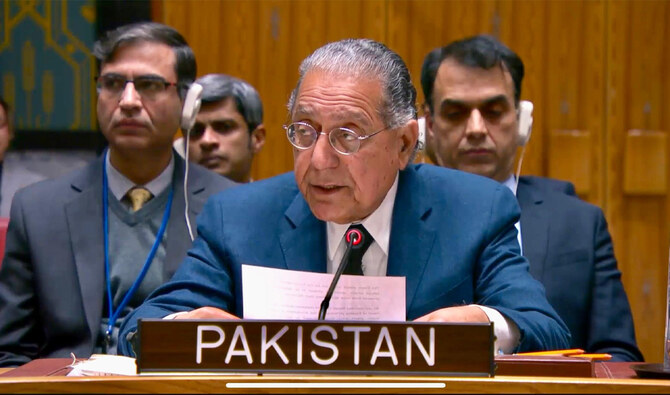
ISLAMABAD: Pakistan has called on Israel to withdraw from Lebanese and Syrian territories, including Golan Heights, and allow United Nations (UN) peacekeepers to freely operate in the region to ensure compliance with international agreements, Pakistani state media reported on Saturday, citing Islamabad’s UN envoy.
The remarks by Pakistan’s permanent representative, Ambassador Munir Akram, followed a briefing by two senior UN peacekeeping officials on recent developments in Lebanon and Syria, and the challenges facing “blue helmets” there.
Speaking at the UN Security Council, Ambassador Akram voiced “deep concern” over the increasing threats faced by peacekeepers from the UN Interim Force in Lebanon (UNIFIL) and the United Nations Truce Supervision Organization (UNTSO).
The Pakistani envoy strongly condemned ongoing Israeli “aggression” in Syrian territories and the illegal incursion of Israeli military forces in the separation areas established under the 1974 Disengagement Agreement between Israel and Syria.
“That agreement remains binding and must be upheld without exception,” Ambassador Akram was quoted as saying by Pakistan’s APP news agency,
“Any unilateral actions that undermine this agreement are unacceptable,” Akram said, that no force except the United Nations Disengagement Observer Force (UNDOF) should have a military presence in the territory.
Similarly, Ambasador Akram said, Pakistan recognized the essential role of UNIFIL in maintaining stability in southern Lebanon under the Security Council resolution 1,701.
The Pakistani envoy welcomed a November 26 ceasefire agreement between Lebanon and Israel, but voiced alarm over continuing violations of the arrangement by Israeli forces, including airspace violations, airstrikes and restrictions on UNIFIL’s movement.
“Israel must adhere to the 60-day timeline stipulated in the arrangement and complete its withdrawal from southern Lebanon,” he said, urging that any security concerns must be reported to appropriate mechanisms, including UNIFIL, instead of resorting to unilateral violations.
“The unrestricted freedom of movement of UNIFIL and full deployment of the Lebanese Armed Forces (LAF) are crucial to achieving the security and stability [of Lebanon].’
The Security Council was briefed by UN Under-Secretary-General for Peace Operations Jean-Pierre Lacroix and Maj. Gen. Patrick Gauchat, head of the United Nations Truce Supervision Organization (UNTSO) who is temporarily in charge of the UN force in the Golan, UNDOF. Lacroix is currently in Lebanon, where the UNIFIL monitors the Blue Line border of separation with Israel. He is accompanying UN Secretary-General Antonio Guterres and the officials visited the mission’s area of operations on Friday.
The Pakistani envoy urged the Security Council to ensure complete implementation of the mandates of both UNDOF and UNIFIL, saying they must be equipped with adequate resources and modern technologies to enhance their operational efficiency.
“Those who attack UN peacekeepers must be held accountable,” he added.
Ambassador Akram also hoped that the Gaza ceasefire “is real and it will be the first step toward a comprehensive solution, including two-state solution and establishment of an independent and sovereign Palestinian state.”
Pakistan does not recognize nor have diplomatic relations with Israel and calls for an independent Palestinian state based on “internationally agreed parameters.”
The South Asian country has so far dispatched several relief consignments for Gaza and Lebanon, besides establishing the ‘Prime Minister’s Relief Fund for Gaza and Lebanon’ that aims to collect public donations for the war-affected people.


![]()

Pakistan demands Israel withdraw from Lebanon, Syrian buffer zone and allow UN peacekeepers to operate
Short Url
https://arab.news/mbt4v
Pakistan demands Israel withdraw from Lebanon, Syrian buffer zone and allow UN peacekeepers to operate
- The remarks by Pakistan’s representative to the United Nations followed a briefing by two senior UN peacekeeping officials
- Ambassador Munir Akram says no force except United Nations Disengagement Observer Force should have a presence in the region
Latest updates



Recommended


© 2026 SAUDI RESEARCH & PUBLISHING COMPANY, All Rights Reserved And subject to Terms of Use Agreement.