

India uses AI to avoid stampedes at gathering of 400 million pilgrims

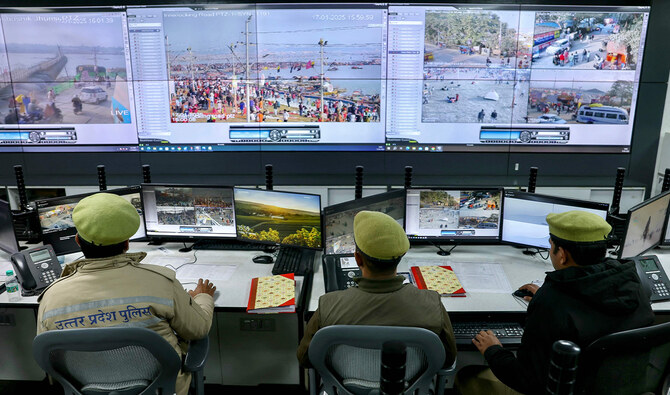
Police monitor the situation via screens at the Integrated Command and Control Center, set up to manage and control the crowd, during the Maha Kumbh Mela festival in Prayagraj on January 17, 2025. (AFP)
Short Url
Updated 18 January 2025
Follow

India uses AI to avoid stampedes at gathering of 400 million pilgrims

  • Deadly crowd crushes are a notorious feature of Indian religious festivals
  • Kumbh Mela, with unfathomable throngs, has grim track record of stampedes

PRAYAGRAJ: Keen to improve India’s abysmal crowd management record at large-scale religious events, organizers of the world’s largest human gathering are using artificial intelligence to try to prevent stampedes.
Organizers predict up to 400 million pilgrims will visit the Kumbh Mela, a millennia-old sacred show of Hindu piety and ritual bathing that began Monday and runs for six weeks.
Deadly crowd crushes are a notorious feature of Indian religious festivals, and the Kumbh Mela, with its unfathomable throngs of devotees, has a grim track record of stampedes.
“We want everyone to go back home happily after having fulfilled their spiritual duties,” Amit Kumar, a senior police officer heading tech operations in the festival, told AFP.
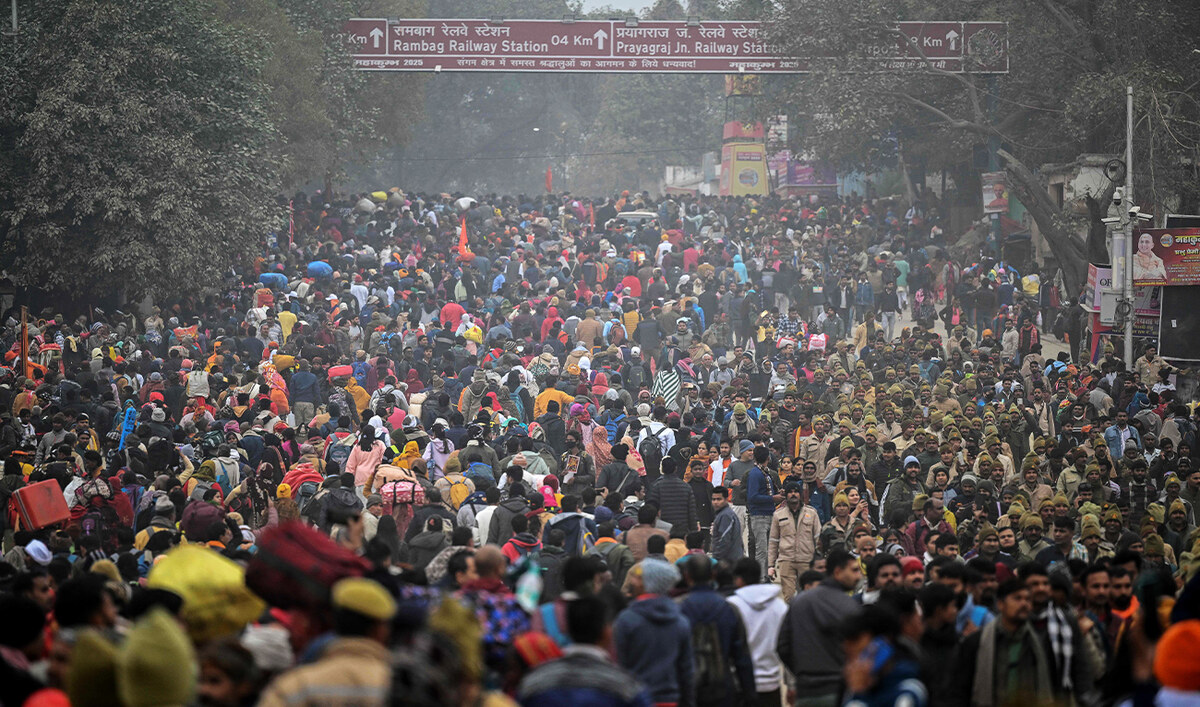


Pilgrims arrive at Sangam, the confluence of Ganges, Yamuna and mythical Saraswati rivers, to take part in Shahi Snan or ‘royal bath’, to mark the Maha Kumbh Mela festival in Prayagraj, India on January 14, 2025 (AFP/File)

“AI is helping us avoid reaching that critical mass in sensitive places.”
More than 400 people died after being trampled or drowned at the Kumbh Mela on a single day of the festival in 1954, one of the largest tolls in a crowd-related disaster globally.
Another 36 people were crushed to death in 2013, the last time the festival was staged in the northern city of Prayagraj.
But this time, authorities say the technology they have deployed will help them gather accurate estimates of crowd sizes, allowing them to be better prepared for potential trouble.
Police say they have installed around 300 cameras at the festival site and on roads leading to the sprawling encampment, mounted on poles and a fleet of overhead drones.
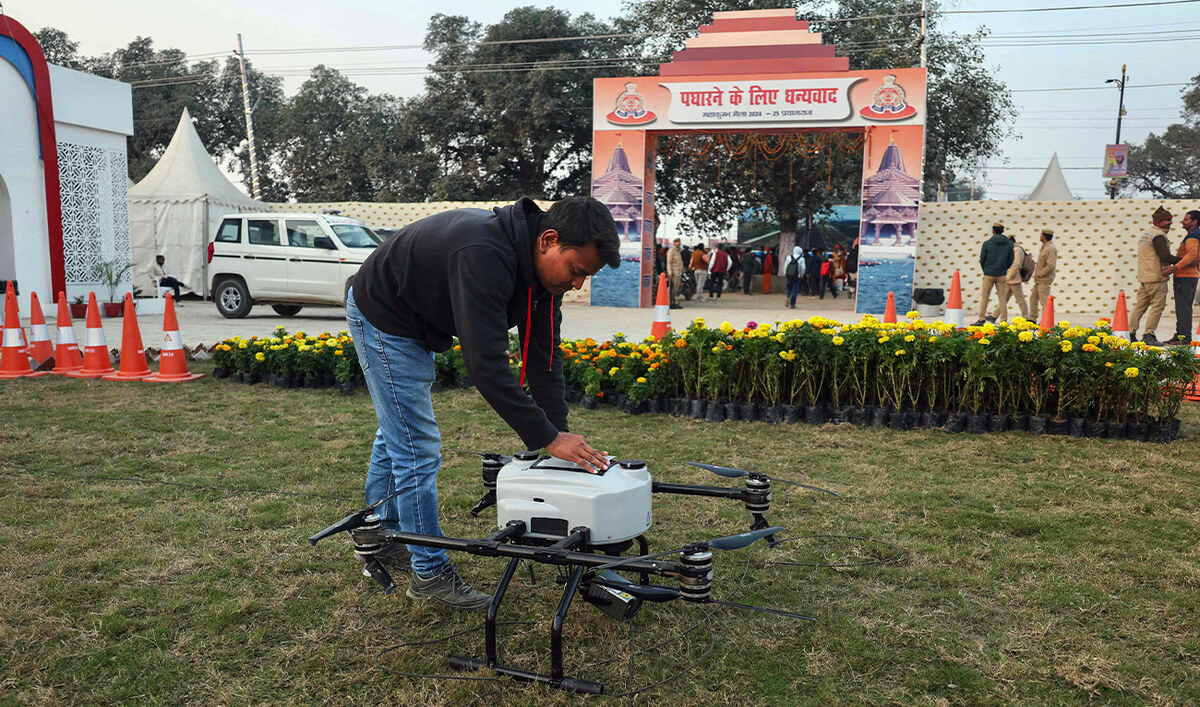


An engineer checks a drone equipped with artificial intelligence (AI), which enables the state police to surveil the crowd during the Maha Kumbh Mela festival in Prayagraj, India, on January 17, 2025. (AFP)

Not far from the spiritual center of the festival at the confluence of the Ganges and Yamuna rivers, the network is overseen in a glass-panelled command and control room by a small army of police officers and technicians.
“We can look at the entire Kumbh Mela from here,” said Kumar. “There are camera angles where we cannot even see complete bodies and we have to count using heads or torsos.”
Kumar said the footage fed into an AI algorithm that gives its handlers an overall estimate of a crowd stretching for miles in every direction, cross-checked against data from railways and bus operators.
“We are using AI to track people flow, crowd density at various inlets, adding them up and then interpolating from there,” he added.
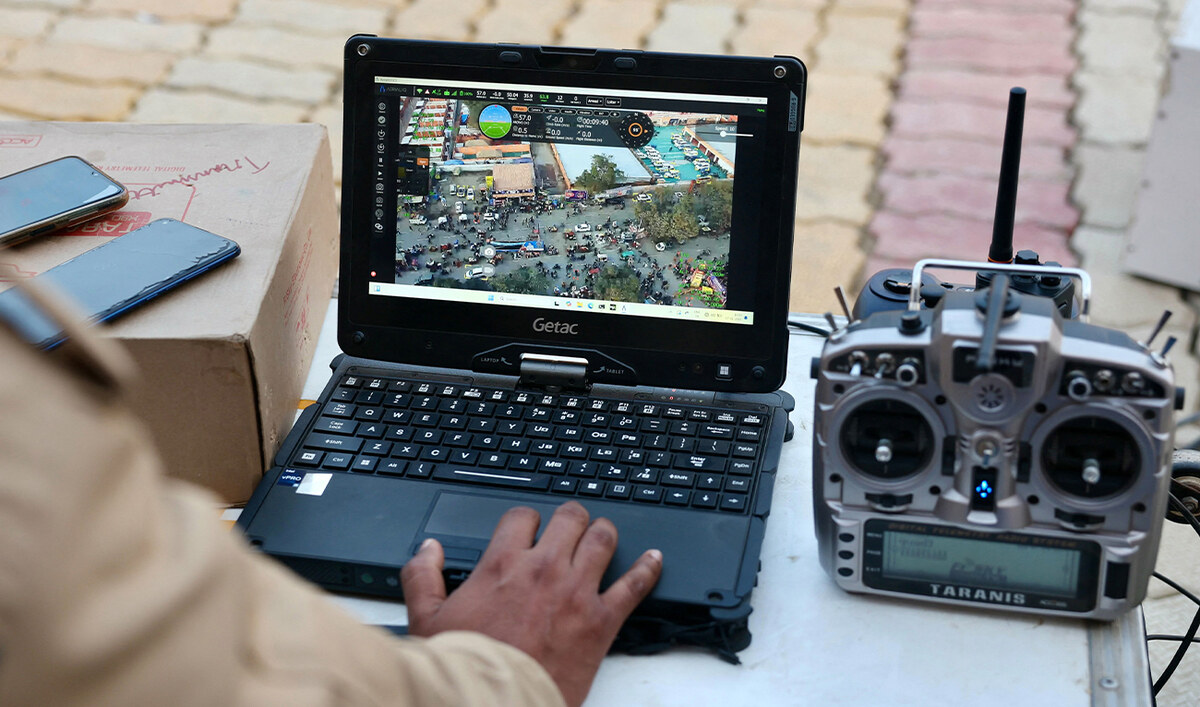


A state police drone operator looks at footage taken with a drone to monitor the crowd during the Maha Kumbh Mela festival in Prayagraj, India, on January 17, 2025. (AFP)

The system sounds the alarm if sections of the crowd get so concentrated that they pose a safety threat.
The Kumbh Mela is rooted in Hindu mythology, a battle between deities and demons for control of a pitcher containing the nectar of immortality.
Organizers say the scale of this year’s festival is that of a temporary country — with numbers expected to total around the combined populations of the United States and Canada.
Some six million devotees took a dip in the river on the first morning of the festival, according to official estimates.
With a congregation that size, Kumar said that some degree of crowd crush is inevitable.
“The personal bubble of an individual is quite big in the West,” said Kumar, explaining how the critical threshold at which AI crowd control systems ring the alarm is higher than in other countries using similar crowd management systems.
“The standard there is three people per square foot,” he added. “But we can afford to go several times higher than that.”
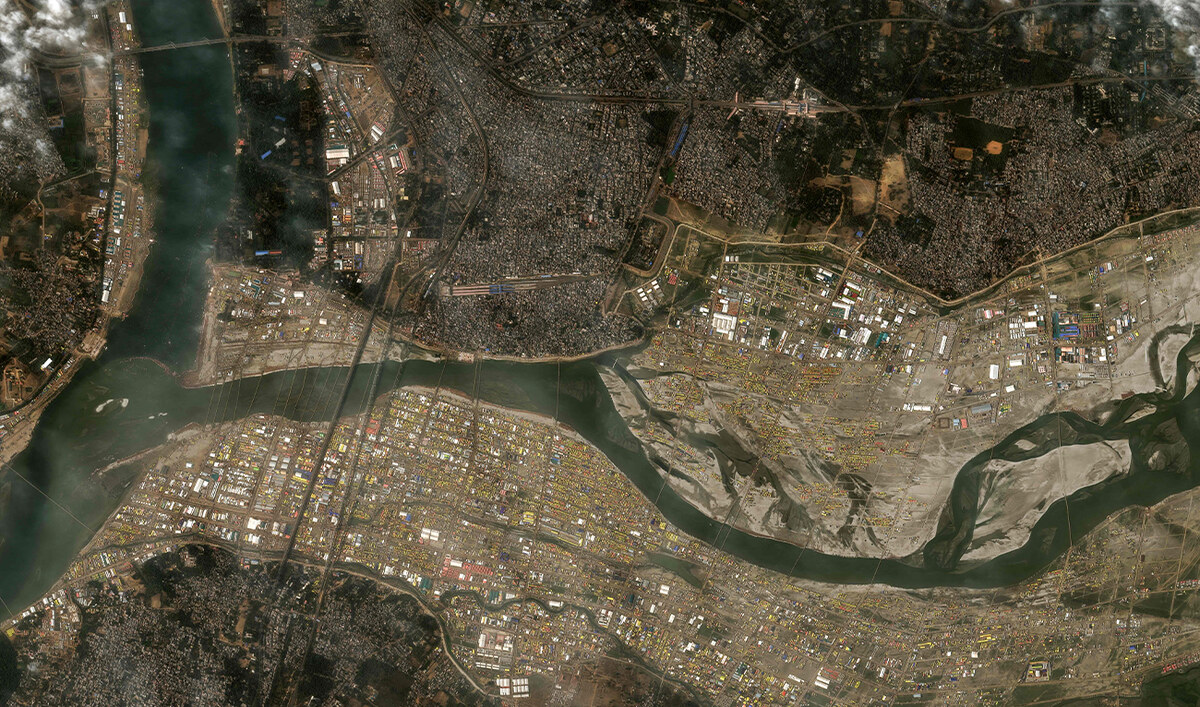


This satellite image taken and released by Maxar Technologies on January 17, 2025, shows an overview of the Maha Kumbh Mela along the banks of Sangam, the confluence of Ganges, Yamuna and mythical Saraswati rivers, during the Maha Kumbh Mela festival in Prayagraj, India.

Organizers have been eager to tout the technological advancements of this year’s edition of the Kumbh Mela and their attendant benefits for pilgrims.
Uttar Pradesh chief minister Yogi Adityanath, a devout Hindu monk whose government is responsible for organizing the festival, has described it as an event “at the confluence of faith and modernity.”
“The fact that there are cameras and drones makes us feel safe,” 28-year-old automotive engineer Harshit Joshi, one of the millions of pilgrims to arrive for the start of the festival, told AFP.


House votes to slap back Trump’s tariffs on Canada in rare bipartisan rebuke

Updated 12 February 2026
Follow

House votes to slap back Trump’s tariffs on Canada in rare bipartisan rebuke

WASHINGTON: The House voted Wednesday to slap back President Donald Trump’s tariffs on Canada, a rare if largely symbolic rebuke of the White House agenda as Republicans joined Democrats over the objections of GOP leadership.
The tally, 219-211, was among the first times the House, controlled by Republicans, has confronted the president over a signature policy, and drew instant recrimination from Trump himself. The resolution seeks to end the national emergency Trump declared to impose the tariffs, though actually undoing the policy would require support from the president, which is highly unlikely. It next goes to the Senate.
Trump believes in the power of tariffs to force US trade partners to the negotiating table. But lawmakers are facing unrest back home from businesses caught in the trade wars and constituents navigating pocketbook issues and high prices.
“Today’s vote is simple, very simple: Will you vote to lower the cost of living for the American family or will you keep prices high out of loyalty to one person — Donald J. Trump?” said Rep. Gregory Meeks of New York, the top Democrat on the House Foreign Affairs Committee, who authored the resolution.
Within minutes, as the gavel struck, Trump fired off a stern warning to those in the Republican Party who would dare to cross him.
“Any Republican, in the House or the Senate, that votes against TARIFFS will seriously suffer the consequences come Election time, and that includes Primaries!” the president posted on social media.
The high-stakes moment provides a snapshot of the House’s unease with the president’s direction, especially ahead of the midterm elections as economic issues resonate among voters. The Senate has already voted to reject Trump’s tariffs on Canada and other countries in a show of displeasure. But both chambers would have to approve the tariff rollbacks, and send the resolution to Trump for the president’s signature — or veto.
Six House Republicans voted for the resolution, and one Democrat voted against it.
From Canada, Ontario, Premier Doug Ford on social media called the vote “an important victory with more work ahead.” He thanked lawmakers from both parties “who stood up in support of free trade and economic growth between our two great countries. Let’s end the tariffs and together build a more prosperous and secure future.”
Trump recently threatened to impose a 100 percent tariff on goods imported from Canada over that country’s proposed China trade deal, intensifying a feud with the longtime US ally and Prime Minister Mark Carney.
GOP defections forced the vote
House Speaker Mike Johnson tried to prevent this showdown.
Johnson insisted lawmakers wait for a pending Supreme Court ruling in a lawsuit about the tariffs. He engineered a complicated rules change to prevent floor action. But Johnson’s strategy collapsed late Tuesday, as Republicans peeled off during a procedural vote to ensure the Democratic measure was able to advance.
“The president’s trade policies have been of great benefit,” Johnson, R-Louisiana, had said. “And I think the sentiment is that we allow a little more runway for this to be worked out between the executive branch and the judicial branch.”
Late Tuesday evening, Johnson could be seen speaking to holdout Republican lawmakers as the GOP leadership team struggled to shore up support during a lengthy procedural vote, but the numbers lined up against him.
“We’re disappointed,” Kevin Hassett, the director of the White House’s National Economic Council, told reporters at the White House on Wednesday morning. “The president will make sure they don’t repeal his tariffs.”
Terminating Trump’s emergency
The resolution put forward by Meeks would terminate the national emergency that Trump declared a year ago as one of his executive orders.
The administration claimed illicit drug flow from Canada constitutes an unusual and extraordinary threat that allows the president to slap tariffs on imported goods outside the terms of the US-Mexico-Canada trade agreement.
The Republican chairman of the House Foreign Affairs Committee, Rep. Brian Mast of Florida, said the flow of fentanyl into the US is a dire national emergency and the policy must be left in place.
“Let’s be clear again about what this resolution is and what it’s not. It’s not a debate about tariffs. You can talk about those, but that’s not really what it is,” Mast said. “This is Democrats trying to ignore that there is a fentanyl crisis.”
Experts say fentanyl produced by cartels in Mexico is largely smuggled into the US from land crossings in California and Arizona. Fentanyl is also made in Canada and smuggled into the US, but to a much lesser extent.
Torn between Trump and tariffs
Ahead of voting, some rank-and-file Republican lawmakers expressed unease over the choices ahead as Democrats — and a few renegade Republicans — impressed on their colleagues the need to flex their power as the legislative branch rather than ceding so much power to the president to take authority over trade and tariff policy.
Rep. Don Bacon, R-Nebraska, said he was unpersuaded by Johnson’s call to wait until the Supreme Court makes its decision about the legality of Trump’s tariffs. He voted for passage.
“Why doesn’t the Congress stand on its own two feet and say that we’re an independent branch?” Bacon said. “We should defend our authorities. I hope the Supreme Court does, but if we don’t do it, shame on us.”
Bacon, who is retiring rather than facing reelection, also argued that tariffs are bad economic policy.
Other Republicans had to swiftly make up their minds after Johnson’s gambit — which would have paused the calendar days to prevent the measure from coming forward — was turned back.
“At the end of the day, we’re going to have to support our president,” said Rep. Keith Self, R-Texas.
Rep. Darrell Issa, R-Calif., said he doesn’t want to tie the president’s hands on trade and would support the tariffs on Canada “at this time.”