

China’s population falls for a third straight year, posing challenges for its government and economy

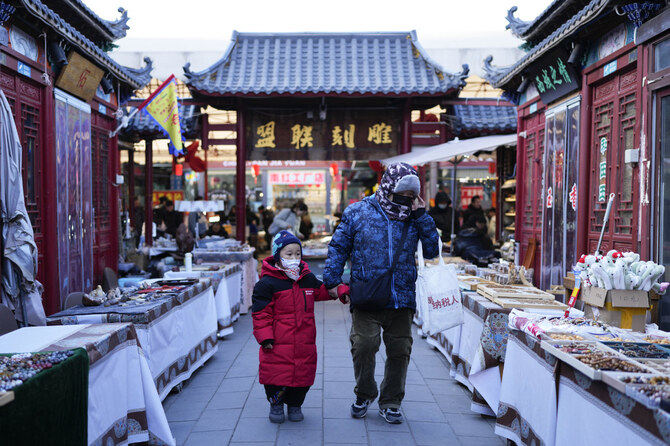
A boy and a woman shop at a market in Beijing on Jan. 16, 2025. (AP)
Short Url
Updated 18 January 2025
Follow

China’s population falls for a third straight year, posing challenges for its government and economy

  • China’s population stood at 1.408 billion at the end of 2024, a decline of 1.39 million from the previous year
  • Rising costs of living are causing young people to put off or rule out marriage and child birth while pursuing higher education and careers
  • China has long been among the world’s most populous nations, enduring invasions, floods and other natural disasters

TAIPEI, Taiwan: China’s population fell last year for the third straight year, its government said Friday, pointing to further demographic challenges for the world’s second most populous nation, which is now facing both an aging population and an emerging shortage of working age people.
China’s population stood at 1.408 billion at the end of 2024, a decline of 1.39 million from the previous year.
The figures announced by the government in Beijing follow trends worldwide, but especially in East Asia, where Japan, South Korea and other nations have seen their birth rates plummet. China three years ago joined Japan and most of Eastern Europe among other nations whose population is falling.
The reasons are in many cases similar: Rising costs of living are causing young people to put off or rule out marriage and child birth while pursuing higher education and careers. While people are living longer, that’s not enough to keep up with rate of new births.
Countries such as China that allow very little immigration are especially at risk.
China has long been among the world’s most populous nations, enduring invasions, floods and other natural disasters to sustain a population that thrived on rice in the south and wheat in the north. Following the end of World War II and the Communist Party’s rise to power in 1949, large families re-emerged and the population doubled in just three decades, even after tens of millions died in the Great Leap Forward that sought to revolutionize agriculture and industry and the Cultural Revolution that followed a few years later.


After the end of the Cultural Revolution and leader Mao Zedong’s death, Communist bureaucrats began to worry the country’s population was outstripping its ability to feed itself and began implementing a draconian “one child policy.” Though it was never law, women had to apply for permission to have a child and violators could face forced late-term abortions and birth control procedures, massive fines and the prospect of their child being deprived an identification number, effectively making them non-citizens.
Rural China, where the preference for male offspring was especially strong and two children were still ostensibly allowed, became the focus of government efforts, with women forced to present evidence they were menstruating and buildings emblazoned with slogans such as “have fewer children, have better children.”
The government sought to stamp out selective abortion of female children, but with abortions legal and readily available, those operating illicit sonogram machines enjoyed a thriving business.
That has been the biggest factor in China’s lopsided sex ratio, with as many as millions more boys born for every 100 girls, raising the possibility of social instability among China’s army of bachelors. Friday’s report gave the sex imbalance as 104.34 men to every 100 women, though independent groups give the imbalance as considerably higher.
More disturbing for the government was the drastically falling birthrate, with China’s total population dropping for the first time in decades in 2023 and China being narrowly overtaken by India as the world’s most populous nation in the same year. A rapidly aging population, declining workforce, lack of consumer markets and migration abroad are putting the system under severe pressure.
While spending on the military and flashy infrastructure projects continues to rise, China’s already frail social security system is teetering, with increasing numbers of Chinese refusing to pay into the underfunded pension system.
Already, more than one-fifth of the population is aged 60 or over, with the official figure given as 310.3 million or 22 percent of the total population. By 2035, this number is forecast to exceed 30 percent, sparking discussion of changes to the official retirement age, which one of the lowest in the world. With fewer students, some vacant schools and kindergartens are meanwhile being transformed into care facilities for older people.
Such developments are giving some credence to the aphorism that China, now the world’s second largest economy but facing major headwinds, will “grow old before it grows rich.”
Government inducements including cash payouts for having up to three children and financial help with housing costs have had only temporary effects.
Meanwhile, China continued its transition to an urban society, with 10 million more people moving to cities for an urbanization rate of 67 percent, up almost a percentage point from the previous year.


Trump warns Maduro against playing ‘tough’ as US escalates pressure campaign on Venezuela

Updated 23 December 2025
Follow

Trump warns Maduro against playing ‘tough’ as US escalates pressure campaign on Venezuela

  • Venezuelan President Nicolas Maduro on Monday fired back at Donald Trump, who has ordered US naval forces to blockade the South American country's oil wealth, saying the US president would be "better off" focusing on domestic issues rather than threatenin
  • The Defense Department, under Trump’s orders, continues its campaign of attacks on smaller vessels in the Caribbean and eastern Pacific Ocean that it alleges are carrying drugs to the United States and beyond

WEST PALM BEACH, Florida: President Donald Trump on Monday delivered a new warning to Venezuelan President Nicolás Maduro as the US Coast Guard steps up efforts to interdict oil tankers in the Caribbean Sea as part of the Republican administration’s escalating pressure campaign on the government in Caracas.
Trump was surrounded by his top national security aides, Secretary of State Marco Rubio and Defense Secretary Pete Hegseth, as he suggested that he remains ready to further escalate his four-month pressure campaign on the Maduro government, which began with the stated purpose of stemming the flow of illegal drugs from the South American nation but has developed into something more amorphous.
“If he wants to do something, if he plays tough, it’ll be the last time he’ll ever be able to play tough,” Trump said of Maduro as he took a break from his Florida holiday vacation to announce plans for the Navy to build a new, large warship.
Trump levied his latest threat as the US Coast Guard on Monday continued for a second day to chase a sanctioned oil tanker that the Trump administration describes as part of a “dark fleet” Venezuela is using to evade US sanctions. The tanker, according to the White House, is flying under a false flag and is under a US judicial seizure order.
“It’s moving along and we’ll end up getting it,” Trump said.
It is the third tanker pursued by the Coast Guard, which on Saturday seized a Panama-flagged vessel called Centuries that US officials said was part of the Venezuelan shadow fleet.
The Coast Guard, with assistance from the Navy, seized a sanctioned tanker called Skipper on Dec. 10, also part of the shadow fleet of tankers that the US says operates on the fringes of the law to move sanctioned cargo. That ship was registered in Panama.
Trump, after that first seizure, said the US would carry out a “blockade” of Venezuela. Trump has repeatedly said that Maduro’s days in power are numbered.
Last week, Trump demanded that Venezuela return assets that it seized from US oil companies years ago, justifying anew his announcement of a blockade against sanctioned oil tankers traveling to or from the South American country.
Homeland Security Secretary Kristi Noem, whose agency oversees the Coast Guard, said in a Monday appearance on “Fox & Friends” that the targeting of tankers is intended to send “a message around the world that the illegal activity that Maduro is participating in cannot stand, he needs to be gone, and that we will stand up for our people.”
Russian diplomats evacuate families from Caracas
Meanwhile, Russia’s Foreign Ministry started evacuating the families of diplomats from Venezuela, according to a European intelligence official speaking on condition of anonymity to discuss sensitive information.
The official told The Associated Press the evacuations include women and children and began on Friday, adding that Russian Foreign Ministry officials are assessing the situation in Venezuela in “very grim tones.” The ministry said in an X posting that it was not evacuating the embassy but did not address queries about whether it was evacuating the families of diplomats.
Venezuela’s Foreign Minister Yván Gil on Monday said he spoke by phone with his Russian counterpart, Sergey Lavrov, who he said expressed Russia’s support for Venezuela against Trump’s declared blockade of sanctioned oil tankers.
“We reviewed the aggressions and flagrant violations of international law that have been committed in the Caribbean: attacks against vessels and extrajudicial executions, and the unlawful acts of piracy carried out by the United States government,” Gil said in a statement.
The scene on a Venezuelan beach near a refinery
While US forces targeted the vessels in international waters over the weekend, a tanker that’s considered part of the shadow fleet was spotted moving between Venezuelan refineries, including one about three hours west of the capital, Caracas.
The tanker remained at the refinery in El Palito through Sunday, when families went to the town’s beach to relax with children now on break from school.
Music played on loudspeakers as people swam and surfed with the tanker in the background. Families and groups of teenagers enjoyed themselves, but Manuel Salazar, who has parked cars at the beach for more than three decades, noticed differences from years past, when the country’s oil-dependent economy was in better shape and the energy industry produced at least double the current 1 million barrels per day.
“Up to nine or 10 tankers would wait out there in the bay. One would leave, another would come in,” Salazar, 68, said. “Now, look, one.”
The tanker in El Palito has been identified by Transparencia Venezuela, an independent watchdog promoting government accountability, to be part of the shadow fleet.
Area residents on Sunday recalled when tankers would sound their horns at midnight New Year’s Eve, while some would even send up fireworks to celebrate the holiday.
“Before, during vacations, they’d have barbecues; now all you see is bread with bologna,” Salazar said of Venezuelan families spending the holiday at the beach next to the refinery. “Things are expensive. Food prices keep going up and up every day.”
Venezuela’s ruling party-controlled National Assembly on Monday gave initial approval to a measure that would criminalize a broad range of activities that could be linked to the seizure of oil tankers.
Lawmaker Giuseppe Alessandrello, who introduced the bill, said people could be fined and imprisoned for up to 20 years for promoting, requesting, supporting, financing or participating in “acts of piracy, blockades or other international illegal acts against” commercial entities operating with the South American country.
The Defense Department, under Trump’s orders, continues its campaign of attacks on smaller vessels in the Caribbean and eastern Pacific Ocean that it alleges are carrying drugs to the United States and beyond.
At least 104 people have been killed in 28 known strikes since early September. The strikes have faced scrutiny from US lawmakers and human rights activists, who say the administration has offered scant evidence that its targets are indeed drug smugglers and that the fatal strikes amount to extrajudicial killings.