Gunmen attack aid convoy enroute to Pakistani district hit by sectarian clashes, injuring 4

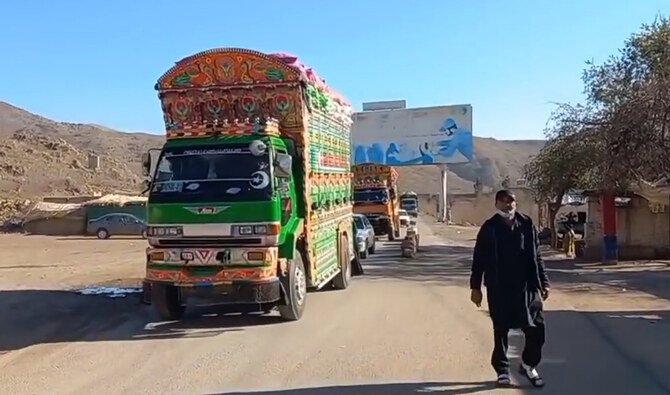
In this file photo, taken on January 8, 2025, shows aid convoy arriving in Baggan, Kurram district of Khyber Pakhtunkhwa province. (Photo courtesy: Kurram Media/File)
Short Url
Updated 16 January 2025
Follow

Gunmen attack aid convoy enroute to Pakistani district hit by sectarian clashes, injuring 4

  • At least 136 have been killed due to sectarian, land disputes in Kurram district since Nov. 21
  • Five persons were injured on Jan. 4 in same locality when armed men attacked an aid convoy

PESHAWAR: Four persons were injured when an aid convoy enroute to Pakistan’s northwestern Kurram district, which has been rocked by sectarian clashes in recent months, was attacked by unidentified armed men on Thursday, police and health officials confirmed, as authorities struggle to main law and order in the restive area.
Kurram, a northwestern district of around 600,000 people in Pakistan’s Khyber Pakhtunkhwa (KP) province, has been hit hard by tribal and sectarian clashes since Nov. 21, 2024, when gunmen attacked a convoy of Shia passengers, killing 52. Sporadic clashes since then have killed at least 136 people before the provincial government brokered a peace agreement among the warring tribes this month.
The attack sparked further violence and blockade of a main road connecting Kurram’s main town of Parachinar with the provincial capital of Peshawar, causing medicine, food and fuel shortages in the area.
This is the second such attack on an aid convoy enroute to the district, in the locality. Unidentified gunmen attacked an aid convoy at Bagan, a tense locality, on Jan. 4, injuring five people including a top administration official. Thursday’s attack also took place in Began.
“The aid convoy of more than 30 vehicles en route to Upper Kurram was attacked with gunfire by unknown armed men in Bagan area,” a police official, who spoke on condition of anonymity as he was not authorized to speak to the media, told Arab News.
“A few of the trucks which were loaded with food items were put on fire and have been burnt,” he added.
Police and law enforcement agencies are investigating the matter, the official said.
The attack caused injuries to four persons, according to Zakir Khan, the senior medical officer at the Basic Health Unit in Manduri, Lower Kurram.
“Four injured were brought to the hospital (BHU Manduri) among whom two were serious,” he said, adding that patients critically wounded had been referred to Peshawar for treatment.
The attack takes place days after authorities started demolishing bunkers in Lower Kurram, more than a week after the peace agreement was reached.
Under the peace agreement signed on Jan. 1, both sides agreed on the demolition of bunkers and the handover of heavy weapons to authorities within two weeks.
Any party that launches an attack after the signing of the deal will be considered a “terrorist” and action will be taken against it, as per the agreement. A fine of Rs10 million ($35,933) will be imposed on those who violate the terms of the deal by using weapons against each other, it said. 
The agreement called for land disputes in the volatile district to be settled on a priority basis with the cooperation of local tribes and the district administration. 
It also said that opening offices of banned outfits will be prohibited in the district, while social media accounts spreading hate will be discouraged via collective efforts backed by the government.


Pakistani, Chinese firms sign 79 MoUs worth $4.5 billion at Islamabad agriculture summit — minister

Updated 11 sec ago
Follow

Pakistani, Chinese firms sign 79 MoUs worth $4.5 billion at Islamabad agriculture summit — minister

  • The summit saw participation from over 300 Pakistani, Chinese firms focusing on modern agricultural techniques and solutions
  • Food security minister says these investments will modernize Pakistan’s agricultural value chains and enhance productivity

KARACHI: The Pakistan–China Agriculture Investment Conference in Islamabad has resulted in 79 Memoranda of Understanding (MoUs) between Pakistani and Chinese companies with an approximate investment value of $4.5 billion, Pakistani Food Security Minister Rana Tanveer Hussain said on Tuesday, signaling confidence of Chinese investors in Pakistan’s agriculture and food sectors.

At least 119 Chinese companies and over 191 Pakistani firms participated in the event held on Monday, focusing on fertilizers, seed varieties, machinery, precision farming and smart irrigation systems, according to the organizers.

The conference was billed by Pakistan’s Ministry of National Food Security and Research as a platform for deepening bilateral agricultural ties and supporting broader economic engagement between the two countries.

Hussain said the scale and depth of investment commitments at the conference reflected a decisive shift from dialogue to on-ground, investment-led collaboration between the two countries.

“The conference was specifically structured to deliver tangible outcomes through direct B2B (business to business) matchmaking, targeted sectoral engagement and project-based investment facilitation, rather than conventional discussions,” he was quoted as saying by his ministry.

Pakistan and China have been expanding cooperation in agriculture under the China-Pakistan Economic Corridor (CPEC) framework, with a focus on mechanization, high-yield seeds, livestock development and value-added food processing. Officials say stronger agricultural ties could help Pakistan boost exports, ensure food security and create jobs, while offering Chinese companies access to a large farming market and new investment opportunities.

Pakistan’s exports to China reached approximately $2.38 billion in Fiscal Year 2024–25 that ended in June, while imports stood at $16.3 billion, reflecting growing demand on both sides despite global economic headwinds, according to the minister.

The food security ministry undertook extensive preparatory work prior to the conference, including structured engagements with Pakistani industry bodies and Chinese enterprises, to align investment proposals with market demand, technology requirements and national priorities, according to Hussain.

As a result, investment agreements were concluded across ten high-impact agricultural and allied sub-sectors, including food processing and value addition, agri-technology, seeds and plant protection, livestock and dairy, meat and poultry, fruits and vegetables, fisheries and aquaculture, animal feed, post-harvest infrastructure, and agricultural inputs.

“These investments will modernize Pakistan’s agricultural value chains, introduce advanced production and processing technologies, and significantly enhance productivity,” the minister said.

“The inflow of capital and technology is expected to generate large-scale employment, particularly in rural areas, strengthen farm-to-market linkages, and reduce post-harvest losses, thereby improving farmer incomes and rural livelihoods.”