Fire-ravaged Los Angeles in path of dangerous Santa Ana winds

1 / 2
Wildfire smoke and burned houses are seen from the Palisades Fire on January 10, 2025 in the Pacific Palisades neighborhood of Los Angeles, California. (AFP)
2 / 2
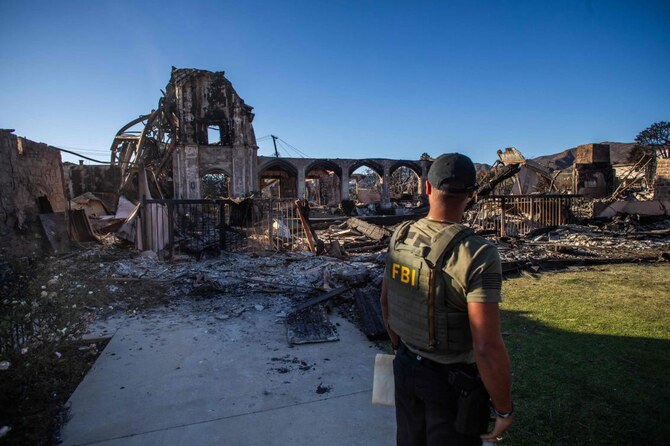
An FBI agent investigates illegal drone activity around the Palisades Fire area on January 12, 2025 in the Pacific Palisades neighborhood of Los Angeles, California. (AFP)
Short Url
Updated 14 January 2025
Follow

Fire-ravaged Los Angeles in path of dangerous Santa Ana winds

  • Santa Ana winds could reach 75 mph, threatening firefighting efforts
  • At least 24 people dead, 12,000 structures damaged or destroyed

LOS ANGELES: Los Angeles firefighters braced for high winds overnight into Tuesday, gusts that could fuel two monstrous wildfires that have already leveled entire neighborhoods, killed at least two dozen people, and burned an area the size of Washington, D.C.
Dry, dangerous Santa Ana wind gusts reached 30 to 50 mph (48 to 80 kph) later on Monday, but the red flag warning was not due to start until 10 p.m. PST (0600 GMT) with the peak winds that could hit 75 mph (120 kph) starting around 4 a.m. Tuesday (1200 GMT), said David Roth, a meteorologist with the National Weather Service’s Weather Prediction Center.
More than 8,500 firefighters attacked the fires from the air and on the ground, preventing the conflagrations at either end of Los Angeles from spreading overnight.
“This setup is about as bad as it gets,” and Los Angeles City Fire Chief Kristin Crowley told Angelenos, “We are not in the clear.”
Officials said the state was pre-positioning firefighting crews in vulnerable areas, not just in Los Angeles but also in other Southern California counties that were also under elevated fire danger.
The two main wildfires erupted last week, fueled by hurricane-force winds bringing dry air from the inland deserts.
At least 24 people have died in the fires since then, the Los Angeles County Medical Examiner reported.
The wildfires have destroyed or damaged more than 12,000 structures, turning entire neighborhoods into smoldering ash and piles of rubble, leaving an apocalyptic landscape.
As of Monday, more than 92,000 people in Los Angeles County were under evacuation orders — down from a previous high of more than 150,000 — while another 89,000 faced evacuation warnings.
The Palisades Fire, which wiped out upscale communities on the western flank of Los Angeles, burned 23,713 acres (96 square km) and was 14 percent contained, a figure representing the percentage of the fire’s perimeter that firefighters have under control.
The Eaton Fire in the foothills of the San Gabriel Mountains east of the city consumed another 14,117 acres (57 sq km) and was 33 percent contained, the California Department of Forestry and Fire Protection (Cal Fire) reported.
A third fire of 799 acres (3.2 sq km) north of town was 95 percent contained and three other fires in the county have been fully brought under control in recent days.
The Eaton fire damaged the Altadena home of Lorraine Bryan, 63, and destroyed two other dwellings on her property. She told Reuters she worries about getting additional doses of insulin that she needs to manage her diabetes.
“I’m worried about insurance and about rebuilding and getting back on my feet,” Bryan said Monday, standing in the doorway of her charred home. “I need my medication. I’m trying to see who can help us.”
Death and arrests
Deputies are finding human remains every day as they search through burned-out parts of Altadena, where the Eaton fire first ignited, Los Angeles County Sheriff Robert Luna said.
“It is a very grim task,” Luna said, adding that he expected the confirmed death toll to rise in the days ahead.
California Governor Gavin Newsom has said the firestorm could rank as the most devastating natural disaster in US history. It is already the costliest wildfire in terms of insured losses.
Los Angeles County District Attorney Nathan Hochman on Monday said 10 people had been arrested in connection to the fires. Nine people were arrested for residential burglaries of fire-stricken areas. One other person was arrested for arson, for allegedly attempting to light a tree on fire in the city of Azusa, about 20 miles (32 km) northeast of downtown Los Angeles.
US Senator Adam Schiff, a Democrat from California, said during a Monday press conference there was “a special place in hell” for looters.
Flanked by law enforcement personnel, he added: “And if the folks behind me have anything to say about it, there’ll be a special place in jail for you too.”
Meanwhile, the Los Angeles Department of Water and Power was sued on Monday on claims that it failed to properly manage water supplies critical to fighting the deadly Palisades Fire, a court filing showed. Residents who sued allege the department should have maintained water in a nearby reservoir, which was dry at the time the fire first erupted last Tuesday.
Aid and politics
“Our hearts ache for the 24 innocent souls we have lost in the wildfires across Los Angeles,” said US President Joe Biden, who announced additional disaster assistance for California, covering costs for debris removal and emergency protective measures.
But top Republicans in the US Congress are considering imposing conditions on disaster aid, accusing the state’s Democratic leadership of mismanaging water resources and forests.
California Governor Newsom and other top Democrats in the state have come under withering criticism for their handling of the fires.
President-elect Donald Trump planned to visit the disaster zone after he is inaugurated next week, a source familiar with the planning said.
With thousands of homeowners facing a costly rebuilding, large commercial banks including JPMorgan Chase and Bank of America have announced plans to ease mortgage repayment conditions for the afflicted. Insurers are looking at historic losses.


War powers resolution fails in Senate as 2 Republicans bow to Trump pressure

Updated 15 January 2026
Follow

War powers resolution fails in Senate as 2 Republicans bow to Trump pressure

WASHINGTON: Senate Republicans voted to dismiss a war powers resolution Wednesday that would have limited President Donald Trump’s ability to conduct further attacks on Venezuela after two GOP senators reversed course on supporting the legislation.
Trump put intense pressure on five Republican senators who joined with Democrats to advance the resolution last week and ultimately prevailed in heading off passage of the legislation. Two of the Republicans — Sens. Josh Hawley of Missouri and Todd Young of Indiana — flipped under the pressure.
Vice President JD Vance had to break the 50-50 deadlock in the Senate on a Republican motion to dismiss the bill.
The outcome of the high-profile vote demonstrated how Trump still has command over much of the Republican conference, yet the razor-thin vote tally also showed the growing concern on Capitol Hill over the president’s aggressive foreign policy ambitions.
Democrats forced the debate after US troops captured Venezuelan leader Nicolás Maduro in a surprise nighttime raid earlier this month
“Here we have one of the most successful attacks ever and they find a way to be against it. It’s pretty amazing. And it’s a shame,” Trump said at a speech in Michigan Tuesday. He also hurled insults at several of the Republicans who advanced the legislation, calling Sen. Rand Paul of Kentucky a “stone cold loser” and Sens. Lisa Murkowski of Alaska and Susan Collins of Maine “disasters.” Those three Republicans stuck to their support for the legislation.
Trump’s latest comments followed earlier phone calls with the senators, which they described as terse. The president’s fury underscored how the war powers vote had taken on new political significance as Trump also threatens military action to accomplish his goal of possessing Greenland.
The legislation, even if it had cleared the Senate, had virtually no chance of becoming law because it would eventually need to be signed by Trump himself. But it represented both a test of GOP loyalty to the president and a marker for how much leeway the Republican-controlled Senate is willing to give Trump to use the military abroad. Republican angst over his recent foreign policy moves — especially threats of using military force to seize Greenland from a NATO ally — is still running high in Congress.
Two Republicans reconsider
Hawley, who helped advance the war powers resolution last week, said Trump’s message during a phone call was that the legislation “really ties my hands.” The senator said he had a follow-up phone call with Secretary of State Marco Rubio Monday and was told “point blank, we’re not going to do ground troops.”
The senator added that he also received assurances that the Trump administration will follow constitutional requirements if it becomes necessary to deploy troops again to the South American country.
“We’re getting along very well with Venezuela,” Trump told reporters at a ceremony for the signing of an unrelated bill Wednesday.
As senators went to the floor for the vote Wednesday evening, Young also told reporters he was no longer in support. He said that he had extensive conversations with Rubio and received assurances that the secretary of state will appear at a public hearing before the Senate Foreign Relations Committee.
Young also shared a letter from Rubio that stated the president will “seek congressional authorization in advance (circumstances permitting)” if he engaged in “major military operations” in Venezuela.
The senators also said his efforts were also instrumental in pushing the administration to release Wednesday a 22-page Justice Department memo laying out the legal justification for the snatch-and-grab operation against Maduro.
That memo, which was heavily redacted, indicates that the administration, for now, has no plans to ramp up military operations in Venezuela.
“We were assured that there is no contingency plan to engage in any substantial and sustained operation that would amount to a constitutional war,” according to the memo signed by Assistant Attorney General Elliot Gaiser.
Trump’s shifting rationale for military intervention
Trump has used a series of legal arguments for his campaign against Maduro.
As he built up a naval force in the Caribbean and destroyed vessels that were allegedly carrying drugs from Venezuela, the Trump administration tapped wartime powers under the global war on terror by designating drug cartels as terrorist organizations.
The administration has claimed the capture of Maduro himself was actually a law enforcement operation, essentially to extradite the Venezuelan president to stand trial for charges in the US that were filed in 2020.
Paul criticized the administration for first describing its military build-up in Caribbean as a counternarcotics operation but now floating Venezuela’s vast oil reserves as a reason for maintaining pressure.
“The bait and switch has already happened,” he said.
Trump’s foreign policy worries Congress
Lawmakers, including a significant number of Republicans, have been alarmed by Trump’s recent foreign policy talk. In recent weeks, he has pledged that the US will “run” Venezuela for years to come, threatened military action to take possession of Greenland and told Iranians protesting their government that ” help is on its way.”
Senior Republicans have tried to massage the relationship between Trump and Denmark, a NATO ally that holds Greenland as a semi-autonomous territory. But Danish officials emerged from a meeting with Vance and Rubio Wednesday saying a “fundamental disagreement” over Greenland remains.
“What happened tonight is a roadmap to another endless war,” Senate Democratic leader Chuck Schumer said at a news conference following the vote.
More than half of US adults believe President Donald Trump has “gone too far” in using the US military to intervene in other countries, according to a new AP-NORC poll.
House Democrats have also filed a similar war powers resolution and can force a vote on it as soon as next week.
How Republican leaders dismissed the bill

Last week’s procedural vote on the war powers resolution was supposed to set up hours of debate and a vote on final passage. But Republican leaders began searching for a way to defuse the conflict between their members and Trump as well as move on quickly to other business.
Once Hawley and Young changed their support for the bill, Republicans were able to successfully challenge whether it was appropriate when the Trump administration has said US troops are not currently deployed in Venezuela.
“We’re not currently conducting military operations there,” said Senate Majority Leader John Thune in a floor speech. “But Democrats are taking up this bill because their anti-Trump hysteria knows no bounds.”
Democratic Sen. Tim Kaine, who has brought a series of war powers resolutions this year, accused Republicans of burying a debate about the merits of an ongoing campaign of attacks and threats against Venezuela.
“If this cause and if this legal basis were so righteous, the administration and its supporters would not be afraid to have this debate before the public and the United States Senate,” he said in a floor speech.