
RIYADH: The ongoing war in the region is drawing critical infrastructure into the line of fire, and the targeting of desalination facilities has sparked concerns regarding security and long-term sustainability of the region’s water supply.
With an Iranian drone striking a desalination plant in Bahrain on March 8, and Iran saying the US targeted another such facility on Qeshm Island the previous day, a vulnerability was exposed that Middle Eastern nations have spent decades trying to secure.
The attacks, which disrupted water supplies for 30 villages in Iran and caused material damage in Bahrain, highlighted a critical reality for the Middle East and North Africa.
According to the World Bank, the region accounts for more than 53 percent of the global desalination capacity, making it an essential requirement for survival rather than just an infrastructure option.
Yet even as military tensions threaten these critical assets, governments across the region are doubling down on desalination with unprecedented urgency.
A King Fahd University of Petroleum and Minerals study published in Nature journal in January, said that the MENA region has nearly 5,000 plants producing 28.96 million cubic meters of water daily.
“Between 2006 and 2024, countries in the Middle East collectively spent nearly $53.4 billion in capital expenditure, primarily directed toward constructing or upgrading desalination facilities. This figure represents 47.5 percent of the global capital expenditure on desalination during the same period,” the study revealed.
Gulf Cooperation Council nations including Kuwait, Qatar, and the UAE rank among the five most water-stressed nations globally. According to the French Institute of International Relations, Kuwait relies on desalination for 90 percent of its drinking water while Oman depends on it for 86 percent.
According to a report by Mordor Intelligence, the GCC bottled water market is projected to grow from $8.92 billion in 2025 to $10.48 billion this year, reaching $18.01 billion by 2031.

The next step is scaling private-public-partnerships with speed and certainty to deliver long-term water security.
Arnaud Delamare, partner at Oliver Wyman
Despite this reliance on bottled water, residents like Nadin Hassan in the UAE have maintain a sense of calm regarding their daily supply. “Living in the UAE, I haven’t really changed my habits when it comes to bottled water,” Hassan told Arab News in an interview.
“The country has spent years building strong food and water security systems, and that creates a sense of confidence that essential supplies will remain available even during periods of regional tension,” she emphasized.
Saudi Arabia meets 70 percent of its water needs through desalination, operating 32 plants across 17 locations, according to the World Population Review. Saudi Arabia’s national water demand is expected to reach nearly 18 million cubic meters per day by 2030, driven by population growth and economic expansion under the Vision 2030 initiative.
According to a report by the Saudi Water Authority in collaboration with Oliver Wyman, the Kingdom plans to build over 10,000 km of new water transmission pipelines by 2030, with an investment of close to $30 billion, representing about 90 percent of the region’s transmission investment.
Speaking about Saudi Arabia’s approach, Arnaud Delamare, partner at Oliver Wyman, told Arab News that the priority is “execution discipline — accelerating tenders, maintaining bankable procurement, and broadening the investable pipeline.”
He added: “Saudi Arabia has proven the Private-Public-Partnerships model works; the next step is scaling it with speed and certainty to deliver long-term water security.”
The security paradox
Yet even as the region builds toward water independence, the recent attacks highlight an uncomfortable truth: the same infrastructure that sustains life has become a military target.
The vulnerability is compounded by concentration. A single mega-scale desalination plant with a capacity of 1 million cubic meters per day can produce as much water as 1,000 small plants combined. The region’s reliance on a few dozen such mega-plants means that a successful strike could cripple water supplies for millions.

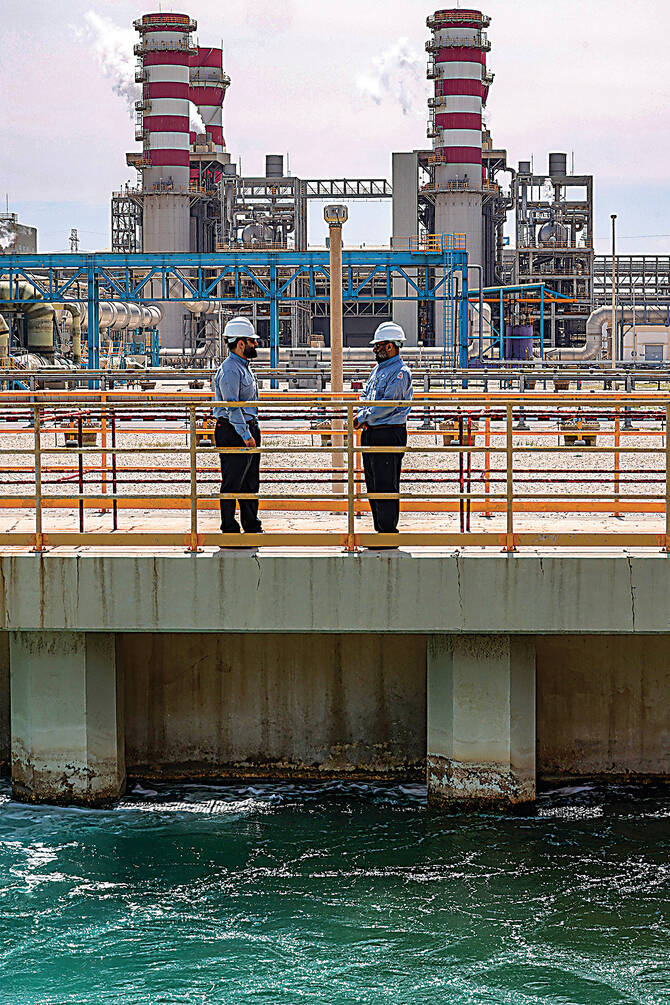
The MENA region has nearly 5,000 plants producing 28.96 million cubic meters of water daily. (SPA)
This macro-level vulnerability is driving changes at the micro-level. According to Elie Bseibes, managing director of Beach Water Technologies Co., across many sectors — including healthcare facilities, hospitality operations, agricultural sites, and remote accommodation— clients have “become increasingly attentive to the importance of operational resilience in water treatment systems.”
He explained to Arab News that in most cases, the focus is on ensuring uninterrupted water availability and stable system performance under a wide range of potential disruptions. As a result, many facilities are showing greater interest in redundant components, backup disinfection, and modular system configurations.
The road ahead
For now, the expansion continues. Between 2024 and 2028, the Middle East is projected to contract an additional 20.9 million cubic meters per day of seawater desalination capacity, 53.1 percent of the global total. By 2028, operational capacity in the region is expected to reach 41 million cubic meters per day, a 41.6 percent increase from current levels.
Bseibes noted, however, that “even where municipal desalinated water is available, facilities such as hospitals, hotels, laboratories, farms, and industrial users often require additional treatment stages — such as filtration, softening, reverse osmosis, or specialized disinfection — to meet their internal water quality standards.”
For this reason, many clients continue to prioritize on-site treatment systems that complement centralized supply, ensuring consistent water quality and operational flexibility at the facility level. He pointed to a gradual increase in decentralized and on-site water treatment solutions over the past decade, particularly for remote developments and facilities with specialized requirements.
“To maintain operational continuity for clients, companies in the sector generally adopt several practical measures, including maintaining a strategic inventory of critical spare parts and working with multiple qualified suppliers and manufacturers,” Bseibes added.
These practices help ensure that facilities can maintain reliable system performance even if supply conditions temporarily fluctuate.
For the millions across the Middle East who turn on their taps each day, the water that flows represents one of the most remarkable engineering achievements of the modern era. But as the attacks made clear, it also represents one of the region’s most enduring vulnerabilities.
Yet on a practical level, residents like Hassan have integrated these realities into daily life. “In my daily routine, I mostly rely on tap water, but I use it through a filtration system,” she said. “I use filtered tap water mainly for cooking and general kitchen use. For drinking water, I typically use a dispenser with large gallon bottles, which is convenient and something many households in the region are accustomed to.”
She added that she already tends to keep extra water at home, but that’s more out of convenience than concern about shortages. “It’s simply practical to have additional bottles available, especially when hosting guests or when you don’t want to run out unexpectedly.”
This paradox of living with both advanced water security and underlying vulnerability will could define Middle Eastern water policy for decades to come.