

Saudi SME job growth hits 10-month high amid expansion plans 

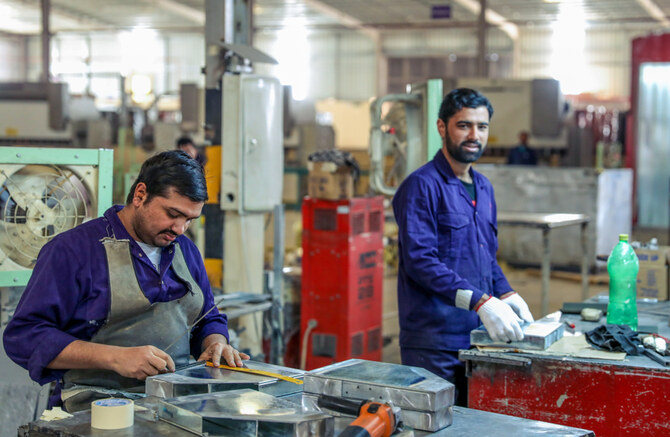
The Riyad Bank Saudi Arabia SME Purchasing Managers’ Index stood at 56.9 in December. Shutterstock
Short Url
Updated 12 January 2025
Follow

Saudi SME job growth hits 10-month high amid expansion plans 

  • SMEs doubled over past seven years, with 45% led by women entrepreneurs, says finance minister
  • Riyad Bank Saudi Arabia SME Purchasing Managers’ Index stood at 56.9 in December

RIYADH: Saudi Arabia’s small and medium enterprises recorded their strongest employment growth in 10 months during December, fueled by long-term expansion plans and robust domestic demand, according to a new report. 

The Riyad Bank Saudi Arabia SME Purchasing Managers’ Index stood at 56.9 in December, slightly lower than November’s 57.1 but well above the neutral 50 mark, indicating sustained growth in the sector. 

Strengthening the SME segment is a cornerstone of the Kingdom’s economic diversification strategy under Vision 2030, aimed at reducing dependence on oil revenues. 

Finance Minister Mohammed Al-Jadaan highlighted the sector’s rapid growth in October, noting that the number of SMEs in Saudi Arabia had doubled over the past seven years, with 45 percent now led by women entrepreneurs. 

“The Riyad Bank Saudi Arabia SME PMI concluded the year on a high note, reflecting a robust performance of the SME sector. The fourth quarter of the year showcased a marked improvement over the third quarter, with the average PMI hitting 56.8, the highest quarterly reading since the end of 2023,” said Naif Al-Ghaith, chief economist at Riyad Bank.  

He added: “This upturn in the SME sector is a testament to the thriving economic environment, characterized by increasing output levels and a surge in incoming new work.”  

The report attributed December’s employment surge to sharp increases in output and incoming new work, supported by stronger business and consumer spending. 

The analysis said that SMEs widely reported strong demand conditions, fueled by increased business and consumer spending, alongside a supportive economic environment. 

S&P Global said job creation rose in December, with staffing levels and growth rates accelerating at their fastest pace since February. 

“This surge in employment is fueled by long-term business expansion plans and upcoming new projects, reflecting a positive outlook among SMEs,” said Al-Ghaith.  

Despite higher input costs, including salary increases and rising raw material prices, inflation pressures eased slightly in December compared to the previous month. 

Business confidence among SMEs reached its highest level since March, marking three consecutive months of improved expectations. 

He added: “This optimistic trajectory aligns with Saudi Arabia’s Vision 2030.”  “The strong performance of SMEs, as evidenced by the Riyad Bank Saudi Arabia SME PMI, underscores the ongoing efforts to bolster economic diversification and support the growth of this sector.”  

He said that SMEs’ resilience and expansion are pivotal for achieving Vision 2030’s goals of creating sustainable employment and promoting inclusive economic growth. 

The positive SME performance aligns with broader economic trends. A separate S&P Global report showed that Saudi Arabia’s overall PMI for December reached 58.4, signaling robust growth in the non-oil economy. 

“By fostering a vibrant SME sector, Saudi Arabia can enhance its economic resilience, create sustainable employment opportunities, and promote inclusive growth, all key components of a diversified and dynamic economy,” concluded Al-Ghaith.  

The employment growth reflects the Kingdom’s ongoing commitment to transforming its economy into a global hub for innovation, entrepreneurship, and investment. 


India and US release a framework for an interim trade agreement to reduce Trump tariffs

Updated 07 February 2026
Follow

India and US release a framework for an interim trade agreement to reduce Trump tariffs

  • Under the deal, tariffs on goods from India would be lowered to 18 percent, from 25 percent, after Indian Prime Minister Narendra Modi agreed to stop buying Russian oil, Trump had said.

NEW DELHI: India and the United States released a framework for an interim trade agreement to lower tariffs on Indian goods, which Indian opposition accused of favoring Washington.
The joint statement, released Friday, came after US President Donald Trump announced his plan last week to reduce import tariffs on the South Asian country, six months after imposing steep taxes to press New Delhi to cut its reliance on cheap Russian crude.
Under the deal, tariffs on goods from India would be lowered to 18 percent, from 25 percent, after Indian Prime Minister Narendra Modi agreed to stop buying Russian oil, Trump had said.
The two countries called the agreement “reciprocal and mutually beneficial” and expressed commitment to work toward a broader trade deal that “will include additional market access commitments and support more resilient supply chains.” The framework said that more negotiations will be needed to formalize the agreement.
India would also “eliminate or reduce tariffs” on all US industrial goods and a wide range of food and agricultural products, Friday’s statement said.
The US president had said that India would start to reduce its import taxes on US goods to zero and buy $500 billion worth of American products over five years, part of the Trump administration’s bid to seek greater market access and zero tariffs on almost all American exports.
Trump also signed an executive order on Friday to revoke a separate 25 percent tariff on Indian goods he imposed last year.
Indian Prime Minister Narendra Modi thanked Trump “for his personal commitment to robust ties.”
“This framework reflects the growing depth, trust and dynamism of our partnership,” Modi said on social media, adding it will “further deepen investment and technology partnerships between us.”
India’s opposition political parties have largely criticized the deal, saying it heavily favors the US and negatively impacts sensitive sectors such as agriculture. In the past, New Delhi had opposed tariffs on sectors such as agriculture and dairy, which employ the bulk of the country’s population.
Meanwhile, Piyush Goyal, Indian Trade Minister, said the deal protects “sensitive agricultural and dairy products” including maize, wheat, rice, ethanol, tobacco, and some vegetables.
“This (agreement) will open a $30 trillion market for Indian exporters,” Goyal said in a social media post, referring to the US annual GDP. He said the increase in exports was likely to create hundreds of thousands of new job opportunities.
Goyal also said tariffs will go down to zero on a wide range of Indian goods exported to the US, including generic pharmaceuticals, gems and diamonds, and aircraft parts, further enhancing the country’s export competitiveness.
India and the European Union recently reached a free trade agreement that could affect as many as 2 billion people after nearly two decades of negotiations. That deal would enable free trade on almost all goods between the EU’s 27 members and India, covering everything from textiles to medicines, and bringing down high import taxes for European wine and cars.
India also signed a comprehensive economic partnership agreement with Oman in December and concluded talks for a free trade deal with New Zealand.