BELGRADE: Serbian President Aleksandar Vucic said Friday he would hold talks with Russian leader Vladimir Putin after Washington announced sweeping sanctions against a range of energy companies, including a Serbian firm.
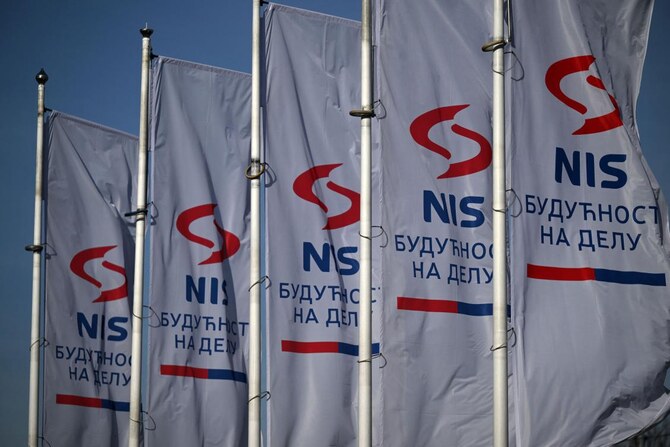
Petroleum Industry of Serbia (NIS), majority-owned by Russia’s Gazprom Neft and its parent company, Gazprom, is the only supplier of gas to Serbia and the majority owner of both gas pipelines that transport gas from Russia to households and industries in Serbia.
NIS was among the raft of companies hit by the latest round of US sanctions targeting the Kremlin on Friday.
Following the announcement, Vucic told a news conference he would speak with Putin “first over the phone, and then explore other ways of communication.”
Vucic said he would also be holding talks with US and Chinese representatives soon.
“We will respond responsibly, seriously, and diligently, and although we will act carefully, we will not rush into making wrong decisions,” Vucic added.
“We will ask the incoming administration to reconsider this decision once more and see if we can obtain some allowances regarding the decisions that have already been made.”
Serbia has maintained a close relationship with Moscow since the invasion of Ukraine and refuses to impose sanctions, unlike the EU which it hopes to join.
Vucic had stated earlier that if sanctions were implemented, it would be a severe blow to Serbia, which heavily relies on Russian gas and is currently negotiating a new contract, as the current one expires in March 2025.
Gazprom Neft owns 50 percent of NIS, Gazprom 6.15 percent and 29.9 percent is owned by the Republic of Serbia, according to NIS’s website.
Friday’s announcement comes just 10 days before US President Biden is due to step down, and puts President-elect Donald Trump in an awkward position, given his stated desire to end the Ukraine war on day one of his presidency.

Serbia to talk with Putin after US sanctions target energy company
https://arab.news/9gq2s
Serbia to talk with Putin after US sanctions target energy company
- Petroleum Industry of Serbia (NIS), majority-owned by Russia’s Gazprom Neft and its parent company, Gazprom, is the only supplier of gas to Serbia
- NIS was among the raft of companies hit by the latest round of US sanctions targeting the Kremlin on Friday
British group Bob Vylan sue Irish broadcaster RTE for defamation
- Punk-rap duo launch proceedings at Irish High Court over TV news report that accused them of ‘antisemitic’ chants during Glastonbury Festival performance
- Solicitors say ‘death to the IDF’ chant had been ‘criticizing military actions’ by the Israeli army and at no point targeted Jewish people
LONDON: British rap duo Bob Vylan are suing Ireland’s national broadcaster, RTE, for defamation over its reporting of their chants from the stage at the Glastonbury Festival in opposition to the actions of the Israeli military during the war in Gaza.
Following the group’s performance in June, RTE News reported that lead singer Pascal Robinson-Foster had led antisemitic chanting.
“These allegations are categorically denied by our clients and are entirely untrue,” Phoenix Law Solicitors, acting for the group, said on Tuesday. The firm confirmed that legal proceedings had been launched at the High Court in Dublin on Monday on behalf of Robinson-Foster and drummer Wade Laurence George.
During the performance, Robinson-Foster led chants of “Death, death, to the IDF,” a reference to the Israel Defense Forces, and “Free, free, Palestine.”
The performance sparked an outcry in the UK, including accusations that the group were guilty of hate speech, as well as criticism of the BBC for allowing the chants to go out on a live stream.
The group maintain that their actions were not antisemitic but merely a show of support for Palestinians suffering in Gaza.
“At their Glastonbury performance, Bob Vylan made statements expressing support for Palestinian self-determination and criticizing military actions by the Israel Defence Forces,” Phoenix Law Solicitors said.
“At no point did their comments target Jewish people or express hatred towards any group.
“In fact, our client has stated: ‘We are not for the death of Jews, Arabs or any other race or group of people.’ The comments made were politically charged but not antisemitic in nature.”
The group had requested an apology and retraction from RTE, the law firm added, but the broadcaster “failed to address the harm caused.” The aim of the legal proceedings is to “seek redress for the significant reputational and emotional damage suffered by our clients.”
Since the start of the war in Gaza in 2023, following the Oct. 7 attacks on Israel led by Hamas, the Israeli government and its supporters have increasingly accused those critical of the state’s actions during the conflict of antisemitism.
More than 70,000 Palestinians have been killed during the war, according to health officials in Gaza, and Israel’s actions been widely condemned by human rights groups, academics and many governments as amounting to genocide.
Bob Vylan’s festival performance took place at a time when scores of Palestinians were being killed each day, including many gunned down as they tried to obtain food from humanitarian aid hubs.
“Our clients are no stranger to utilizing their freedom of expression to speak out against the genocide in Gaza,” said Darragh Mackin, a Phoenix Law solicitor.
“There is however a fundamental distinction between speaking critically about the role of the Israeli state forces, and being antisemitic.”
RTE has said it does not comment on legal proceedings.
After the Glastonbury performance, Bob Vylan faced a backlash in the UK and abroad. Organizers of several music festivals canceled scheduled performances by the group, and US authorities revoked their visas. Robinson-Foster was interviewed by police last month but has not been charged with any crime.
British Prime Minister Keir Starmer described the incident as “appalling hate speech.” The BBC issued an apology for broadcasting the performance, saying it regretted not taking dawn the live stream.
During a podcast appearance in October, Robinson-Foster defended his actions and said the criticism his group had faced was “minimal compared to what people in Palestine are going through.”


