

After US exemption, UN says more significant Syria sanctions work needed

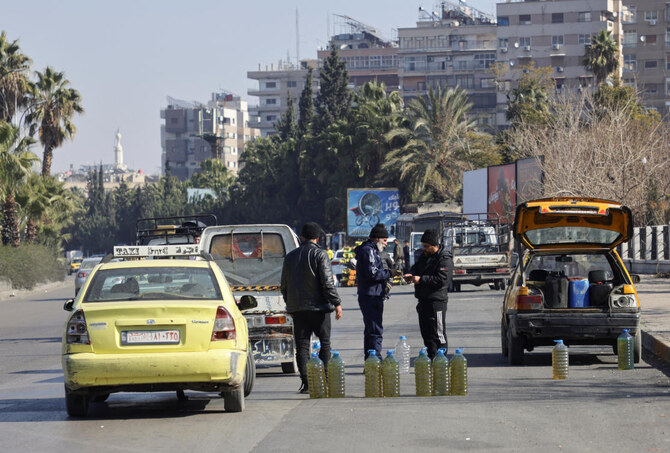
A street vendor sells diesel and gasoline along a street after the ousting of Syria's Bashar al-Assad, in Damascus, Syria, January 7, 2025. (Reuters)
Short Url
Updated 08 January 2025
Follow

After US exemption, UN says more significant Syria sanctions work needed

  • “I welcome the recent issuance of a new temporary General License by the United States government,” Pedersen told the council
  • The foreign ministry in Damascus on Wednesday welcomed the US move and called for a full lifting of restrictions to support Syria’s recovery

UNITED NATIONS: A US sanctions exemption for transactions with governing institutions in Syria is welcome, but “much more significant work ... will inevitably be necessary,” the UN special envoy on Syria, Geir Pedersen, told the Security Council on Wednesday.
After 13 years of civil war, Syria’s President Bashar Assad was ousted in a lightening offensive by insurgent forces led by the Islamist Hayat Tahrir Al-Sham (HTS) a month ago.
The US, Britain, the European Union and others imposed tough sanctions on Syria after a crackdown by Assad on pro-democracy protests in 2011 that spiraled into war. But the new reality in Syria has been further complicated by sanctions on HTS — and some leaders — for its days as an Al-Qaeda affiliate.
“I welcome the recent issuance of a new temporary General License by the United States government. But much more significant work in fully addressing sanctions and designations will inevitably be necessary,” Pedersen told the council.
The US on Monday issued a sanctions exemption, known as a general license, for transactions with governing institutions in Syria for six months in an effort to ease the flow of humanitarian assistance and allow some energy transactions.
“The United States welcomes positive messages from Hayat Tahrir Al-Sham, but will ultimately look for progress in actions, not words,” deputy US Ambassador to the UN Dorothy Camille Shea told the Security Council.
The foreign ministry in Damascus on Wednesday welcomed the US move and called for a full lifting of restrictions to support Syria’s recovery.
French Foreign Minister Jean-Noel Barrot said earlier on Wednesday that European Union sanctions on Syria that obstruct the delivery of humanitarian aid and hinder the country’s recovery could be lifted swiftly.
Russia’s UN Ambassador Vassily Nebenzia criticized the sanctions imposed on Syria by Washington and others, adding: “As a result, the Syrian economy is under extreme pressure and is not able to cope with the challenges facing the country.” Russia was an Assad ally throughout the war.

’END THE SUFFERING’
Formerly known as Nusra Front, HTS was Al-Qaeda’s official wing in Syria until breaking ties in 2016. Along with unilateral measures, the group has also been on the UN Security Council Al-Qaeda and Islamic State sanctions list for more than a decade, subjected to a global assets freeze and arms embargo.
There are no UN sanctions on Syria over the civil war.
Syria’s UN Ambassador Koussay Aldahhak was appointed a year ago by Assad’s government but told the council on Wednesday that he was speaking for the caretaker authorities.
“It is high time to end the suffering, to enable Syrians to live in security and prosperity, to live a dignified life in their country, to build a better future for their country,” Aldahhak said.
“For this reason, we call upon the United Nations and its member states to immediately and fully lift the unilateral coercive measures to provide the necessary financing to meet humanitarian needs and recover basic services,” he said.
Pedersen said he is seeking to work with the caretaker authorities in Syria “on how the nascent and important ideas and steps so far articulated and initiated could be developed toward a credible and inclusive political transition.”
Pedersen said attacks on Syria’s sovereignty and territorial integrity must stop, specifically calling out Israel.
As Assad’s government crumbled toward the end of last year, Israel launched a series of strikes against Syrian military infrastructure and weapons manufacturing sites to prevent them falling into the hands of enemies.
“Reports of the IDF using live ammunition against civilians, displacement and destruction of civilian infrastructure are also very worrying,” Pedersen said. “Such violations, along with Israeli airstrikes in other parts of Syria – reported even last week in Aleppo – could further jeopardize the prospects for an orderly political transition.”


Ambassadors, military attaches visit border villages, are briefed on weapons centralization south of Litani River

Updated 6 sec ago
Follow

Ambassadors, military attaches visit border villages, are briefed on weapons centralization south of Litani River

  • Aoun: Contacts ongoing at home and abroad to consolidate security in southern Lebanon

BEIRUT: A delegation of Arab and foreign ambassadors and military attaches toured areas south of the Litani River on Monday, accompanied by Lebanese Army Chief Gen. Rodolphe Haykal, for a briefing on the progress in implementing the plan to confine weapons to the state.

According to a military source, the visit aimed to “review the tasks being carried out by the Lebanese Army to implement the Homeland Shield Plan mandated by the Council of Ministers.”

The first phase of the plan is scheduled to conclude by the end of this month, after which the army will move to the next stage: centralizing all weapons north of the Litani line.

Diplomats are expected to convey their field observations to their respective governments on the eve of a US–Saudi–French meeting with the army commander on Dec. 17 and 18 in Paris, where they will also discuss supporting the Lebanese Army, the weapons centralization plan, and the progress achieved.

The commander of the southern Litani sector, Brig. Gen. Nicolas Thabet, briefed the diplomatic delegation on the operations being carried out by the army during a meeting held at the Benoit Barakat Barracks in Tyre, which was joined by the army commander and senior officers. The delegation then moved on to inspect the western sector.

Haykal stressed “the importance of supporting the army and the commitment of all parties to the ceasefire agreement and respect for Lebanese territorial sovereignty.”

While Thabet presented an operational overview to the ambassadors, diplomats focused on evaluating the first phase of the weapons centralization plan, the mechanisms for transitioning to the second phase, and the obstacles facing the army.

The diplomats inspected several army positions deployed along the forward edge, including the town of Aita Al-Shaab and the Wadi Zibqin area, where a Hezbollah facility had previously been located.

A week earlier, Thabet had disclosed that “during the execution of its mission south of the Litani, the army has dealt with 177 tunnels since the launch of the Homeland Shield Plan, closed 11 crossings along the Litani River, and seized 566 rocket launchers.”

Monday’s tour coincided with a meeting on the other side of the border between US Envoy Thomas Barrack and Israeli Prime Minister Benjamin Netanyahu in Tel Aviv, focused on de-escalating tensions with Lebanon and Syria.

On Monday, Israel continued through its media to promote the prospect of an imminent Israeli military escalation against Hezbollah unless it is disarmed by the end of the year.

According to the Lebanese Army, “the recent Israeli strikes targeted civilian homes. The army inspected them after they were hit and found no evidence that they contained any weapons.”

Army command further clarified that “after the Israeli enemy threatened two days ago to bomb homes, the Lebanese Army conveyed a message to the relevant mechanism expressing its readiness to inspect the houses before any strike to determine whether they contained weapons or ammunition.”

However, Israeli forces allegedly rejected the proposal and went ahead with air raids on the homes, destroying them.

For his part, President Joseph Aoun said on Monday before visitors that “contacts are ongoing domestically and internationally to consolidate security and stability in the south through negotiations via the mechanism committee, which will hold a meeting next Friday.”

He added that the mechanism’s work “enjoys Lebanese, Arab, and international support, particularly following the appointment of former Ambassador Simon Karam as head of the Lebanese delegation.”

Aoun noted that “the choice of negotiation is the alternative to war, which would yield no results but would cause further harm and destruction to Lebanon and the Lebanese without exception.”